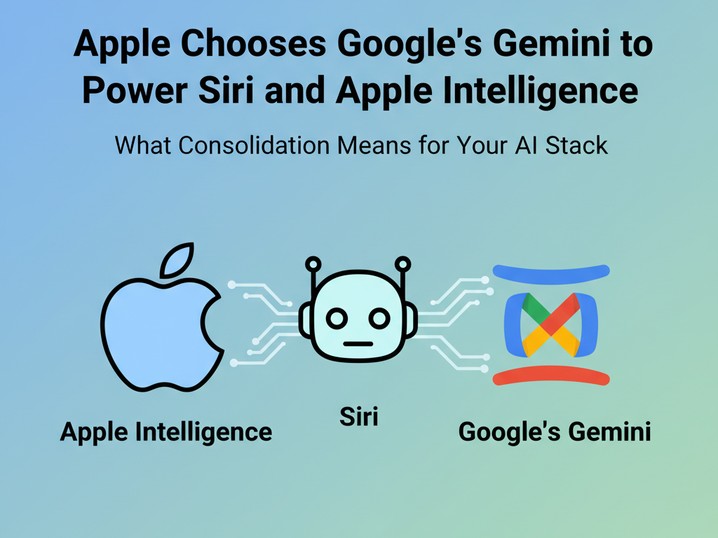

Apple Chooses Google's Gemini to Power Siri and Apple Intelligence: What Consolidation Means for Your AI Stack
**Executive Summary**
- Apple officially partnered with Google on January 12 to power next-generation Siri and Apple Intelligence using Gemini foundation models, marking a strategic reversal from Apple's historical vertical integration[1][4]
- Apple is paying approximately $1 billion annually for a customized 1.2 trillion-parameter Gemini model running on Apple's Private Cloud Compute infrastructure[1][2]
- For operators, this signals accelerating AI consolidation around a handful of foundation models—creating both opportunity and dependency risk that should influence your current tooling choices[4][5]
---
The Deal: What Changed, and Why Now
We watched Apple struggle with Siri for years. The voice assistant lagged behind Alexa and Google Assistant. It missed context. It failed on basic requests. Then came the AI wave—and Apple did what it historically never does: outsource core technology to a competitor[1].
On January 12, 2026, Apple and Google announced a multi-year collaboration. Apple will use Google's Gemini models to power future versions of Siri and a suite of Apple Intelligence features[4]. The partnership centers on a customized 1.2 trillion-parameter Gemini model, running on Apple's own servers, ensuring user data stays within Apple's ecosystem[1][2].
The financial commitment is substantial. **Apple is spending roughly $1 billion per year for access to Google's technology**[1][2]. For context: that's the annual revenue of a mid-market software company—spent on a single vendor relationship.
Here's what matters: This isn't a patch. This is foundational. As Apple's and Google's statement confirmed, "the next generation of Apple Foundation Models will be based on Google's Gemini models."[6] That means every Apple Intelligence feature, every improved Siri interaction, every personalized assistant moment is now built on Google's infrastructure.
And Apple did it after careful evaluation of alternatives—including OpenAI's ChatGPT and Anthropic's Claude[1][5]. Yet Google's Gemini won.
---
Why We're Here: AI's Consolidation Problem
The bigger question isn't what Apple gained. It's what this reveals about the AI market's trajectory.
For the past 18 months, we've watched startups and enterprises bet on AI independence. "Build your own models." "Fine-tune your own LLMs." "Own your AI layer." The narrative was attractive. Control. Differentiation. No dependency.
Apple believed it too. The company spent years developing on-device AI, privacy-first architectures, and its own foundation models. But then reality arrived: **Google's Gemini was more capable**[2]. Not marginally. Substantially enough to justify a $1 billion annual commitment and a partnership with a company Apple competes with in multiple markets[1].
That's consolidation.
Three weeks into 2026, we're seeing the consequences:
- Foundational model development is expensive, time-consuming, and increasingly concentrated among three players: Google, OpenAI, and Anthropic[1][2]
- Companies with massive compute resources and data advantages are pulling further ahead
- Smaller players—including Apple historically—are choosing to build on top of these foundations rather than underneath them
For operators, this matters because it signals where the market is settling. And settled markets mean vendor dependencies. Pricing power. Strategic leverage.
---
What Actually Changes for Your Team
Let's ground this. The rollout happens this spring[4]. Here's what's coming:
**Siri becomes context-aware.** Apple's demo showed a user asking Siri about their mother's flight and lunch reservation. Siri understood by pulling data from Mail and Messages—something it couldn't do reliably before[4]. For your team, this means Siri can actually become useful in your workflow (if you use Apple devices).
**Apple Intelligence gets smarter.** Gemini powers features beyond Siri: writing assistance, photo editing, summarization, and on-screen awareness[1][2]. These features will roll out gradually through iOS 26.4, macOS updates, and iPadOS releases throughout spring and summer 2026[4].
**Privacy architecture stays intact.** This is the part Apple emphasized: data doesn't flow to Google. Your queries run on Apple's Private Cloud Compute. Apple's infrastructure. Your information doesn't become Google training data—at least not through this channel[1][2][6].
**The gap with competitors narrows.** For years, Android users with Google Assistant and Amazon users with Alexa had functional advantages. That gap tightens significantly when Apple's Siri gains Gemini's reasoning capabilities[1].
But here's the friction: **None of this changes overnight**. The announcement happened January 12. Real deployment starts spring 2026. For most operators, it's a "watch and evaluate" moment, not a "deploy Monday" moment.
---
The Consolidation Risk: What Operators Should Be Thinking About
We need to talk about what this partnership actually signals, beyond the headlines.
Apple outsourcing AI to Google is remarkable because Apple *doesn't do that*. Vertical integration is foundational to Apple's strategy. Chips. Operating systems. App stores. Even cloud infrastructure. Apple owns the stack[2].
That they chose to break that pattern for AI tells us something uncomfortable: **The AI foundation layer is becoming too expensive and complex for any single company to own independently.**
For your team, this creates three real risks:
**Risk One: Vendor Lock-in Gets Worse**
Right now, you can theoretically move between cloud providers, switch your AI tooling, or diversify your LLM dependencies. As more applications run on standardized foundation models from three players—Google, OpenAI, Anthropic—your options consolidate[1][2][5].
Apple just chose Google. That choice cascades through the Apple ecosystem. Millions of users get Gemini-powered features. Developer expectations shift. Integrations are built around Gemini's capabilities. Switching costs rise.
Ask yourself: **What happens if Google raises prices after the exclusivity window closes?** Apple has negotiated a multi-year deal, but those terms will expire[2]. When they do, if Gemini is deeply integrated into Apple's user experience and workflows, renegotiation happens from a position of weakness, not strength.
**Risk Two: Cross-Cutting Dependencies**
Apple isn't the only major tech company exploring foundation model partnerships. Microsoft integrates OpenAI. Google integrates Anthropic (among others). Meta is developing Llama. The architecture is converging around a handful of foundation models used across dozens of applications[5].
This means a single outage, security breach, or pricing change at OpenAI or Google cascades through dozens of enterprise workflows simultaneously. Distributed risk becomes concentrated risk.
For a lean team using Apple devices for work, plus Slack (Google integrations coming), plus Microsoft Teams, you're increasingly dependent on the same three foundation model providers. If one falters, you lose multiple tools at once.
**Risk Three: Feature Parity and Lock-In**
As Apple, Microsoft, and Google bake Gemini, GPT-4, and Claude respectively into their core products, they'll be incentivized to hold back capabilities—releasing premium features as subscription upgrades, not standard offerings[1][2].
We've seen this pattern before. Cloud storage. Productivity tools. Now it's coming to AI. Expect "AI Premium" tiers. Expect features locked behind subscription gates. Expect pricing that improves for enterprise, not for lean teams.
---
For Operators: What to Do Now
You don't need to do anything immediately. But you should *think* about these things:
**1. Audit Your AI Dependencies**
List the tools your team uses that rely on foundation models: ChatGPT, Claude, Gemini APIs, Midjourney, Perplexity, Notion AI, etc.[5]
Which foundation models power each tool? Google, OpenAI, Anthropic, or proprietary?
Are you over-indexed on one provider? If 60% of your AI usage routes through OpenAI or Google, what's your contingency plan?
**2. Test Alternatives Before You Need Them**
Don't wait for a crisis. Spend an hour this quarter testing Claude on workflows where you currently use ChatGPT. Try Google's Gemini API if you've only used OpenAI. Try Perplexity if you haven't[5].
Why? When vendors consolidate, options disappear. Test now. Document what works. Build relationships with multiple vendors while you still have leverage.
**3. Negotiate Multi-Year Pricing While Competitive Pressure Exists**
The window for favorable pricing is *now*. Vendors are competing for market share. In 12-18 months, when consolidation settles, pricing moves north[1][2].
If you're on month-to-month plans with OpenAI or Google's APIs, push for annual commitments—but lock in pricing before the market hardens.
**4. Plan for Feature Redundancy**
Don't build workflows entirely around one vendor's "cool new feature." If you build internal processes around Gemini's latest multimodal capability, and Apple decides to gate it behind a premium tier, you're trapped.
Instead: Build workflows around boring, stable capabilities. Leave room to swap vendors. Treat fancy features as accelerators, not dependencies.
---
The Bigger Picture: What's Actually Happening
We're watching the AI market shift from "everyone builds their own" to "everyone builds on top of the same three."
That's not necessarily bad. Standardization can drive innovation faster. Focus shifts from foundation models to applications. More startups can compete without betting billions on model training[1][2].
But it also means the strategic advantage moves upstream. Google, OpenAI, and Anthropic aren't just technology vendors anymore. They're infrastructure. And infrastructure gets pricing power[4][5].
For operators running lean teams on tight budgets, this is worth tracking carefully. The tools you use Monday, the costs you justify to your CFO, the vendors you depend on—they're all consolidating around three players.
That consolidation creates both opportunity (more capital, better models, faster innovation) and risk (dependency, pricing power, lock-in).
Apple's choice to partner with Google isn't just tech news. It's a signal about where the market is going.
---
Next Steps
**This week:**
- Audit your team's AI tooling and identify your foundation model dependencies
- Test one alternative platform you haven't tried yet
**This quarter:**
- Renegotiate API pricing before March, emphasizing competitive alternatives
- Document which AI capabilities are mission-critical vs. nice-to-have
- Plan for feature redundancy in workflows built on foundation models
**By Q2 2026:**
- Revisit this strategy after Siri's Gemini integration launches and you understand real-world impact
- Reassess vendor dependencies based on actual usage and costs
The consolidation is here. Stay ahead of it.
---
**Meta Description:** Apple partners with Google's Gemini to power Siri and Apple Intelligence. What AI consolidation means for lean teams and your vendor dependencies in 2026.