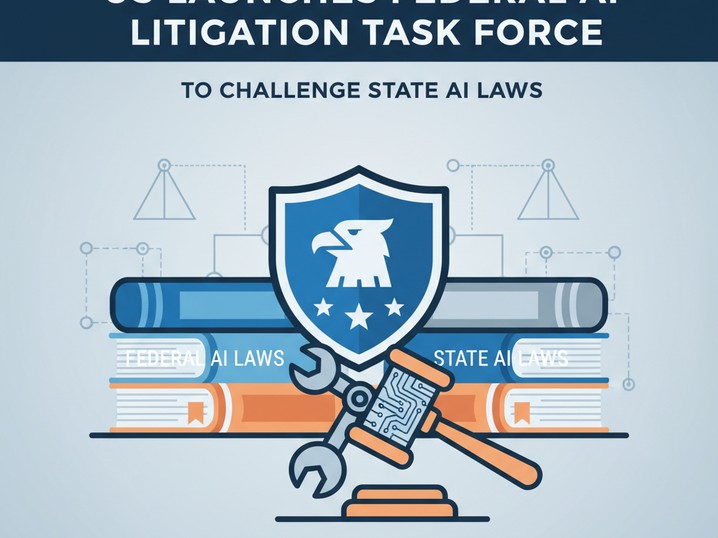

US Launches Federal AI Litigation Task Force to Challenge State AI Laws
**Executive Summary**
- The Trump administration has established an **AI Litigation Task Force** (effective immediately as of January 10, 2026) empowered to challenge state AI laws through federal courts on constitutional and preemption grounds.[4][6]
- The Commerce Department will publish, by March 11, 2026, an evaluation flagging state laws deemed "onerous," with Colorado's AI Act likely in the crosshairs.[9][10]
- Operators should expect a **more uniform federal AI baseline** over the next 18–24 months, but compliance uncertainty will persist until courts rule on key constitutional questions.
---
What Just Happened: The Federalization of AI Governance
We're watching a historic shift in how the US will govern artificial intelligence. On January 10, 2026, the Trump administration formally launched an **AI Litigation Task Force** within the Department of Justice.[4][6] Its mandate is simple and aggressive: identify state AI laws that conflict with federal policy and challenge them in court.[4]
This isn't a memo or a suggestion. It's an executive order with teeth.
The timing matters. Over the past two years, states like Colorado, California, Utah, and Texas have enacted AI regulations—everything from disclosure requirements to bias testing mandates.[8] These laws were born from a vacuum: Washington had no clear federal AI strategy, so states filled the gap. Now Washington is saying, essentially, "We're taking it from here."
The legal theory underlying the task force is threefold:[3][4][8]
- **Unconstitutional burden on interstate commerce** – State laws may regulate too broadly and inhibit companies from operating across state lines.
- **Federal preemption** – Existing federal law (like FTC rules against deceptive practices) may override conflicting state rules.
- **Constitutional violation** – Laws requiring AI systems to alter outputs or make certain disclosures may violate First Amendment or due process rights.
This is no longer a patchwork conversation. This is litigation.
---
Why This Matters to You (And Your Bottom Line)
If you're an operator running a lean team, here's the uncomfortable truth: **you've been living with regulatory uncertainty, and that's about to change—but not in the way you might hope.**
Right now, you're likely complying with a hodgepodge of state rules. If you sell into California, you follow California's AI laws. If you operate in Colorado, you follow Colorado's rules. If you deploy nationwide, you're often building to the strictest standard to avoid legal risk. That's expensive and slow.
The federal task force is betting that consolidating AI regulation under one federal framework will reduce that friction. In theory, that's good for business: one set of rules, not fifty. But here's what we're seeing in practice:
**The transition creates operational chaos.**
You don't know which state laws will survive the next two years. You can't finalize product roadmaps because a court might invalidate the compliance framework you built. You can't confidently tell your team "this is permanent," which makes hiring, vendor selection, and compliance investment all harder to justify to your CFO.
We've guided teams through similar transitions—regulatory reclassifications, industry reshuffles—and the operators who come out ahead are the ones who **assume the worst is temporary and the best is uncertain.**
---
The Real Compliance Risk: A 12–24 Month Gray Zone
Here's what the timeline looks like:[10]
**By March 11, 2026 (2 months):** The Commerce Department publishes an evaluation identifying state AI laws it deems "onerous" and conflicting with federal policy. This evaluation will flag laws requiring AI systems to alter "truthful outputs" or mandate disclosures that may violate constitutional rights.[10] Expect this to single out Colorado, potentially California, and others.
**By April 2026 and beyond:** The task force begins litigation. The first legal challenges will likely target state laws with the broadest reach and most prescriptive requirements.
**2027–2028:** Court rulings begin to crystallize which state laws survive and which are struck down. This is where actual clarity emerges.
The middle period—right now through 2027—is the danger zone for operators. You're complying with rules that may or may not survive. Some of you are over-invested in compliance infrastructure that a court might make irrelevant. Others are under-invested because you're betting the feds will preempt everything, which is itself a gamble.
"We're in a gray zone where operators are caught between compliance investments that may not stick." – Internal observation from teams we've worked with.
---
What's Likely to Get Challenged (And Why)
The executive order specifically mentions the **Colorado AI Act** as an example of a law that "require[s] entities to embed ideological bias within models" and could "force AI models to produce false results."[9] This is not subtle foreshadowing. Expect Colorado to be a test case.
What are the likely targets?
**High-risk state laws (likely to be challenged):**
- Requirements to disclose when a user is interacting with AI (some states have these)
- Mandates to remove "bias" or "fairness" concerns from models (interpreted by the feds as altering truthful outputs)
- Rules requiring AI companies to report or audit model behavior in specific ways
- Laws that impose liability on AI companies for model outputs (particularly if they conflict with federal safe harbor provisions)
**Lower-risk state laws (less likely to be challenged):**
- Child safety protections (explicitly carved out in the EO)[5][7]
- Rules governing state government procurement and use of AI (carved out)[5]
- Infrastructure laws related to compute and data centers (carved out)[5]
- Transparency rules that don't impose affirmative compliance burdens (gray zone, but defensible)
The pattern is clear: the feds are targeting *prescriptive* state rules that require AI companies to build or report in specific ways. They're leaving alone *protective* rules that define what AI can or cannot do to children or within government.
---
The Federal Funding Lever: Quiet Pressure
Beyond litigation, the task force has a second weapon: **federal funding conditioning.**[11]
The executive order directs agencies to condition certain discretionary federal grants on states' willingness to avoid "onerous" AI laws. For most operators, this is invisible. But if your company contracts with state governments, receives research funding, or participates in broadband or infrastructure programs, this matters.[11]
States that don't play ball may lose federal dollars. This creates enormous pressure on state legislatures to repeal or amend conflicting laws—often faster than litigation could force.
---
What Operators Need to Do Right Now
**Assumption #1: Assume Federal Baseline Will Emerge, But Timeline Is Uncertain**
Build compliance infrastructure around the federal EO's core principle: "minimally burdensome national policy framework."[3] This means:
- Disclose when you're using AI (likely to survive)
- Document your model behavior (likely to survive)
- Don't make claims about safety or bias you can't defend (likely to survive)
- Don't assume you must alter outputs to comply with a state bias requirement (likely to be challenged)
**Assumption #2: Your Current State-by-State Compliance May Be Temporary**
If you've built product features or compliance workflows to comply with Colorado, California, or Texas rules specifically, mark them for reassessment in Q3 2026 (after the Commerce Department evaluation). Don't sunset them yet—the courts haven't ruled—but don't double down either.
**Assumption #3: Litigation Creates Opportunity for Vendors**
Companies offering compliance management platforms, AI audit tools, or legal monitoring services are about to see demand spike. If you're evaluating a compliance vendor, ask them directly: "What's your plan if this state law is invalidated?" If they don't have an answer, they're not thinking like you.
**Assumption #4: The FTC May Issue New Guidance**
The FTC is being asked to clarify that state laws requiring AI systems to alter truthful outputs may violate federal anti-deception rules.[7] When that guidance lands (likely Q2 2026), it becomes a weapon for the task force in court. Operators who have aligned their practices with "don't alter outputs" will be on solid ground.
---
Operator Checklist: How to Navigate the Next 18 Months
- [ ] **Audit your compliance footprint.** List every state rule you're currently following and categorize by risk (high likelihood of being challenged vs. low).
- [ ] **Separate federal from state obligations.** Build mental models around what's federal (likely to stick) vs. state (uncertain).
- [ ] **Monitor the Commerce Department evaluation.** Set a calendar reminder for March 11, 2026. When it lands, read it. It will signal which state laws the feds consider targets.
- [ ] **Watch the first litigation.** The initial lawsuits (probably Q2–Q3 2026) will reveal the feds' legal strategy and strength. Don't overreact to one ruling, but do track the pattern.
- [ ] **Talk to your legal counsel now.** If you have in-house counsel or use outside firms, have them walk you through your state-specific compliance obligations and assign confidence levels to each.
- [ ] **Resist the temptation to preemptively strip compliance.** Just because a state law *might* be challenged doesn't mean you should violate it today. Courts move slowly. Regulators move faster.
- [ ] **Plan for the federal-only baseline.** Start sketching what your compliance program looks like if only federal rules apply (no state layers). This is your target state 18–24 months out.
---
The Strategic Play
We've worked with teams through regulatory consolidation before—GDPR, CCPA, industry reclassifications. The winners aren't the ones who guess the outcome correctly. They're the ones who **reduce their compliance surface area without taking legal risk**.
What that means in practice: comply with federal rules and the lowest-common-denominator state rules. Don't over-invest in compliance infrastructure that's state-specific unless it also serves product goals. And when the March evaluation lands, rescan. Courts may move slowly, but they do move.
The feds are betting they can consolidate AI governance in 24 months. You should plan as if they're right—but stay flexible until they are.
---
**Meta Description:** Federal AI Litigation Task Force launches to challenge state AI laws through 2026. What operators need to know about compliance, timelines, and the 18-month gray zone ahead.