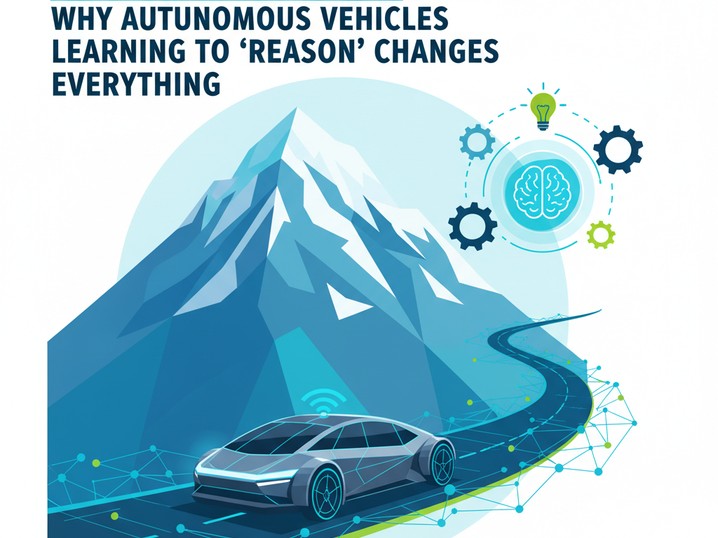

Nvidia Unveils Alpamayo: Why Autonomous Vehicles Learning to "Reason" Changes Everything
**Executive Summary**
- Nvidia's Alpamayo shifts autonomous driving from perception (seeing) to reasoning (thinking)—vehicles can now interpret ambiguous scenarios and explain their decisions in real time.
- Unlike perception-only systems, Alpamayo uses chain-of-thought logic to handle rare or novel situations, which is where today's self-driving fleets actually fail.
- For operators watching AI infrastructure mature, Alpamayo signals where safety-critical AI is heading: edge inference, explainability, and reasoning as foundational layers—not afterthoughts.
---
The Shift We've Been Waiting For
For the past five years, autonomous driving progress looked like this: feed cameras and sensors into a neural network, train it on millions of hours of driving footage, deploy it, and hope the real world doesn't throw anything novel at it.
It worked until it didn't.
The breakthrough at CES 2026 wasn't about better cameras or faster processors. Nvidia's Alpamayo represents something more fundamental: vehicles that can *think their way* through uncertainty, not just recognize what they're seeing.[1][3]
We've all felt the gap. You're in a robotaxi and the driver—whether human or autonomous—encounters something unexpected: a delivery truck double-parked in a bike lane, pedestrians jaywalking in the rain, or an off-duty police car using unmarked spaces. A perception-only system sees objects and lanes. A reasoning system sees *ambiguity*, weighs options, and explains why it chose to slow down, signal, or wait.
That's the difference between a surveillance system and an agent.
---
What Alpamayo Actually Is (And What It Isn't)
Let's be direct about what Nvidia announced. Alpamayo is an open ecosystem—not a finished product ready to drop into your fleet.[1]
It includes three foundational components:
**Alpamayo 1:** A 10-billion-parameter vision language action (VLA) model that processes video input and generates both driving trajectories *and* reasoning traces—essentially, it shows its work.[1][5] Think of it like a driver explaining their decision: "I'm slowing down because that pedestrian is looking at their phone, the light just turned yellow, and there's a truck in the right lane."
**AlpaSim:** A fully open-source simulation framework that lets developers test reasoning models across diverse weather, traffic scenarios, and edge cases without running thousands of real-world miles.[1][3] This is where you validate safety before deployment.
**Physical AI Datasets:** Over 1,700 hours of diverse autonomous driving footage, available openly for research and adaptation.[1]
Here's the part that matters operationally: Nvidia isn't positioning Alpamayo as a direct competitor to Tesla's Full Self-Driving. Instead, they're releasing it as a *teacher model*—a foundation that car manufacturers, researchers, and mobility companies can fine-tune and distill into their own stacks.[1][5] Mercedes-Benz will deploy it first in the 2026 CLA sedan in Q1 2026, offering enhanced Level 2 autonomy.[1] Lucid, JLR, and Uber are exploring it as well.[1]
If you're not in automotive, this might sound abstract. But for anyone evaluating AI infrastructure or watching where safety-critical reasoning is heading, this is a signpost.
---
Why Perception-Only Systems Hit a Wall
Today's autonomous vehicles lean heavily on supervised learning: show the system millions of labeled examples (this is a pedestrian, this is a lane, this is a red light), and it learns to classify. It works beautifully for common scenarios.
But the long tail of driving—the 0.1% of situations that happen rarely, unpredictably, or in novel combinations—is where fleets get stuck.
A pedestrian standing on a median. Three motorcycles weaving. A traffic light out. A pothole half-submerged in a puddle. A delivery driver triple-parked with hazards on.
None of these fit neatly into a training dataset. Perception-only models either misclassify or freeze, defaulting to braking and waiting for a human override.
Alpamayo's reasoning approach flips this: instead of asking "Have I seen this before?" it asks "What's happening here, and what should I do about it?"[3] The model generates a chain of thoughts—"There's congestion ahead, the right lane is slower, my exit is in 500 meters, I should move left now"—before committing to an action.[5]
This isn't magic. It's multi-step reasoning trained on real driving scenarios and reinforced through simulation. It's also the same architectural innovation that made large language models useful: instead of pattern-matching, *think through the problem.*
---
The Reasoning-First Stack
What sets Alpamayo apart operationally is how it integrates perception, prediction, and decision-making into one unified reasoning loop.[1]
**Traditional stack:** Perception (detect objects) → Prediction (forecast positions) → Planning (choose action)
**Reasoning stack:** Perception + Prediction *fed to reasoning layer* → Explicit decision logic → Action
The difference is explainability and robustness. When a vehicle makes a decision, stakeholders (regulators, liability teams, fleet operators) need to know *why*. "I detected a pedestrian" isn't enough. "I detected a pedestrian in an unclear legal crossing, the vehicle ahead is accelerating, my sensors show low visibility, so I'm slowing to 5 mph" is.
This is critical for insurance, regulatory approval, and trust. And it's where Alpamayo forces a reckoning: if your AV can't articulate its reasoning, it's not ready for deployment at scale.[3]
---
Why This Matters to Operators (Even If You're Not in Auto)
You might be asking: *Why should I care about autonomous driving reasoning models if I'm running a SaaS company, a marketing agency, or an ops team?*
Three reasons:
**First, this signals where safety-critical AI is heading.** If Nvidia is building reasoning-capable, explainable AI for vehicles, that same pattern is coming to healthcare AI, financial decision-making, and supply-chain optimization. The architecture—chain-of-thought reasoning, edge inference, transparency—is now table stakes for any high-stakes deployment.
**Second, reasoning models need inference compute at the edge.** This tightens the relationship between software (the model) and hardware (Nvidia's automotive platforms).[1] For operators evaluating AI infrastructure, this reinforces a trend: expect vendors to bundle reasoning capability, inference hardware, and safety validation as one stack. Single-component buys are becoming harder to justify.
**Third, open models are now the baseline.** Alpamayo is released openly on Hugging Face.[5] Companies aren't hiding reasoning models behind proprietary APIs anymore. This commoditizes the model layer, moving competitive advantage upstream (to datasets, safety validation, and deployment infrastructure) and downstream (to implementation and tuning).
If you're building an AI roadmap—whether for customer-facing tools, internal ops, or evaluating vendors—Alpamayo is a reminder that open models + reasoning + explainability are no longer nice-to-have. They're the direction infrastructure is moving.
---
The Deployment Reality Check
Here's what matters operationally: **Alpamayo is not a plug-and-play solution.** It's a foundation.[1]
Mercedes-Benz isn't using Alpamayo 1 raw in the CLA. They're adapting it—distilling it into lighter models for on-device inference, integrating it with their DRIVE autonomous driving stack, tuning it for European driving patterns.[1] That work takes engineering time.
For companies exploring reasoning models (whether in autonomous systems, fraud detection, or supply-chain decision-making), the takeaway is:
- **Budget for fine-tuning.** Open models are starting points, not endpoints.
- **Plan for simulation before real-world testing.** AlpaSim-style frameworks reduce expensive real-world validation but don't eliminate it.
- **Assign a safety team.** Reasoning models are more interpretable than black-box networks, but interpretability requires someone to audit it. Don't assume "explainable" means "safe by default."
- **Set clear SLOs for failure modes.** Level 2 autonomy has acceptable failure rates; Level 4 does not. Know your bar before deployment.
---
What's Actually New Here
Nvidia CEO Jensen Huang called this "the ChatGPT moment for physical AI."[1][5] It's hyperbolic—as all launch-day claims are—but there's a real insight buried in it.
Large language models succeeded because they could reason over arbitrary text sequences, adapt to novel prompts, and explain their output. Alpamayo brings that capability to *perception and action*. A model that can ingest a scene, reason about it, and output both a decision and an explanation is fundamentally different from a system that just classifies objects.
The timeline also matters. Tesla claimed its FSD V14.3 would deliver "conscious being" feeling in October 2025. Nvidia's announcement of a *general reasoning framework* (not just perception) in January 2026 signals the industry is shifting toward treating driving as a reasoning problem, not a classification problem.
That shift is where the real competition now is: **not who has the best perception, but who can reason fastest, most safely, and most transparently under uncertainty.**
---
Operator Takeaway: What to Do Monday
If you're evaluating AI infrastructure, funding an AI team, or watching where capital is flowing:
- **Start distinguishing perception-only from reasoning-capable systems.** When vendors pitch AI solutions, ask: "Does this system explain its decisions?" If it doesn't, it's likely hitting the same long-tail problem autonomous driving faces.
- **Budget explainability into your deployments.** Open models and reasoning capability don't guarantee safety or trust. Someone needs to audit, test, and validate. Include that in your cost model.
- **Expect hardware-software bundles to tighten.** Alpamayo + Nvidia hardware is the template. For operators, this means fewer pure-software deals and more integrated stacks. Plan procurement accordingly.
- **Keep an eye on regulation.** Explainable reasoning models are friendlier to regulators than black boxes. If your industry is tightening compliance, reasoning-capable systems (even expensive ones) may become mandatory faster than you expect.
- **Don't wait for perfection.** Level 2 deployment starts with Mercedes in Q1 2026. That's six weeks away. Companies aren't waiting for Level 5. Your own timeline should reflect: *What can we deploy safely now, and what's the learning loop that gets us to the next level?*
---
The Real Test
The true measure of Alpamayo won't be launch announcements or CEO soundbites. It'll be whether the Mercedes-Benz CLA actually handles rare scenarios better than perception-only competitors, whether Uber can distill the model into robotaxi deployments, and whether developers actually adopt it over proprietary alternatives.
For operators, the signal is clear: reasoning-capable, explainable AI at the edge is now the direction. Whether that's in self-driving, fraud detection, or supply-chain optimization, the architecture is the same.
The question isn't whether to pay attention to Alpamayo. It's whether you're building reasoning into your own AI roadmap.
---
**Meta Description:** Nvidia's Alpamayo shifts autonomous driving from perception to reasoning—vehicles can now think through rare scenarios and explain decisions. Here's why it matters for your AI infrastructure.