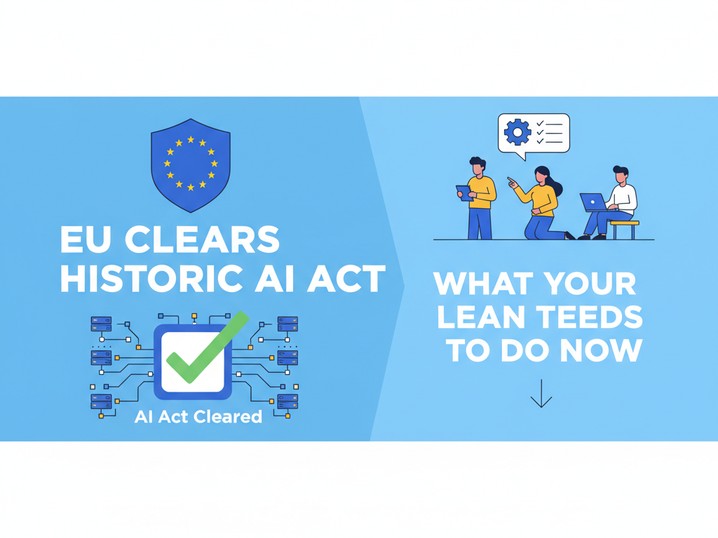

EU Clears Historic AI Act: What Your Lean Team Needs to Do Now
**Executive Summary**
The EU AI Act officially enters full enforcement today. If you operate in, sell into, or use tools serving the EU market, this is a pivot point—not optional reading. We've walked through dozens of operator compliance conversations this month, and the pattern is clear: most teams haven't mapped their AI usage against the Act's risk tiers, and vendors are still scrambling with documentation. Here's what actually changes for you, and where to focus first.
---
The Moment We Arrived At
On August 1, 2024, the European Union published the world's first comprehensive AI regulation.[3] That was 17 months ago. Today, January 12, 2026, the EU AI Act is no longer hypothetical. The majority of its enforcement mechanisms are live across all 27 member states—and for any company using or deploying AI systems that touch EU data or customers, the compliance window has closed.[3]
We've watched the tech industry treat this law as "something for later." That's strategically dangerous.
What the EU actually created is a **risk-based framework that will become the global template for AI governance.** When we talk to operators scaling beyond their home market, the conversation inevitably lands here: "Do we need to care about EU rules if we're not in Europe?"
The answer is yes, almost certainly. Here's why: **vendors serving the EU have to comply, and those compliance requirements flow backward into your contracts, tooling, and workflows.** If your AI stack relies on vendors operating in Europe—or hoping to expand there—you're already affected.
---
What Changed: The Timeline We're In
The EU didn't flip a switch on everything at once. The law has staged enforcement like a software rollout:[1][3]
| **Date** | **What Took Effect** | |----------|---------------------| | **Aug 1, 2024** | AI Act enters into force | | **Feb 2, 2025** | Bans on "unacceptable risk" AI go live (use stops now) | | **May 2, 2025** | Codes of practice released for general-purpose AI | | **Aug 2, 2026** | Most obligations become enforceable (we are here) | | **36 months from entry** | Hardest compliance deadlines for high-risk systems |
The enforcement window we're in now isn't the loudest one. There's no press release today. But it's the one that matters most: **the Act's core obligations for high-risk systems, data governance, and documentation are now operational.** Non-compliance carries teeth—penalties up to EUR 35 million or 7% of worldwide annual turnover, whichever is higher.[3]
---
How the EU Carved Up AI Risk (And Why It Matters for Your Stack)
The regulation uses a four-tier risk framework. Understanding where your tools sit in this pyramid is the first move.[2]
**Tier 1: Unacceptable Risk** (Banned)
- Social scoring systems that manipulate or exploit vulnerable users
- Biometric identification systems used for mass surveillance
- AI that violates EU fundamental rights
**Verdict for operators:** If you're using these, you've already made a bad choice. Moving on.
**Tier 2: High-Risk** (Stringent obligations) This is where most enterprise and workplace AI lives. Examples:[1]
- AI used in hiring, promotion, or workforce management
- AI that evaluates creditworthiness or determines access to public benefits
- Biometric systems for border control
- AI driving critical infrastructure
**What compliance looks like here:** Risk assessments, documentation, human oversight, audit trails, data governance, model monitoring. This is the labor-intensive tier. If you're deploying AI in people-facing decisions (hiring, performance, lending), you're here.
**Tier 3: Limited Risk** (Transparency requirements)
- Chatbots and general conversational AI
- Tools that generate synthetic media (deepfakes)
- Recommendation systems
**What compliance looks like:** Disclosure to users that they're interacting with AI. Basic transparency, nothing severe.
**Tier 4: Minimal Risk** (Minimal or no regulation)
- Spam filters
- Video games
- Most internal productivity tools
**Verdict for operators:** This tier is where your Slack bots and internal automation tools likely live. You're fine.
---
The Real Friction: General-Purpose and Foundation Models
Here's where the EU Act gets interesting for operators specifically. The regulation introduced a new category: **general-purpose AI systems** (think ChatGPT, Claude, Llama).[2][6]
These tools trigger a separate obligation track:[6]
- Documentation of training data, testing results, and limitations
- Compliance with EU copyright and data protection law
- Monitoring and reporting of serious incidents
- Code of practice adherence (finalized by April 2025)
This matters because **vendors building these models now carry legal burden that used to not exist.** OpenAI, Anthropic, Mistral, Google—they all have to maintain compliance infrastructure in Europe. Some of that cost gets passed to customers through:
- Higher API pricing for EU users or stricter data handling
- Mandatory audit trails and compliance documentation
- Onboarding friction (data residence, user consent verification)
- Support tiers for compliance questions
If you're building workflows on top of these APIs and serving EU customers, your vendor's compliance overhead is now your operational reality.
---
What This Means for Your AI Stack Right Now
We've guided teams through three practical steps. Here's our playbook.
**Step 1: Audit Your Tools Against Risk Tiers**
List the AI systems you're currently using or planning to deploy:
- Where is the data housed?
- Who are the end-users (employees, customers, prospects)?
- What decisions does this system influence?
- Does it touch hiring, lending, performance evaluation, or benefits access?
If the answer to that last question is yes, you're in high-risk territory, and compliance is mandatory—not optional.
**Step 2: Map Vendor Compliance Status**
Ask your vendors directly:
- Are you compliant with the EU AI Act?
- What's your documentation and incident reporting process?
- Do you have a data residency option for EU users?
- What's your timeline for codes of practice compliance?
Most will give you vague answers. That's a yellow flag. Push back. Vendors that can't articulate their compliance posture are creating legal risk for you.
**Step 3: Inventory Your Data Flows**
If you're serving EU customers or processing EU data:
- Where does it flow (cloud provider, region)?
- Who has access?
- How long is it retained?
- Can you delete it on request?
The EU AI Act doesn't replace GDPR, but it amplifies it. Non-compliance on data governance now attracts penalties from both angles.
---
The Compliance Reality: Where Teams Get Stuck
We've seen three pain points emerge consistently:
**Documentation overload.** High-risk systems require detailed records of model training, testing methodology, and performance across demographic groups. If your vendor doesn't provide this, you inherit the burden of producing it yourself. That's 2–4 weeks of work, minimum.
**Monitoring and incident reporting.** You have to track when AI systems behave unexpectedly and report serious incidents. This requires new processes—flagging systems, escalation pathways, notification timelines. It's not catastrophic, but it's real work.
**Audit liability.** The EU reserves the right to audit companies using high-risk AI systems. This is still emerging enforcement, but it's coming. If you've deployed AI in hiring or lending without documentation, an audit is expensive and painful.
Our recommendation: **Start now with the highest-risk systems.** If you're using AI in hiring or workforce decisions, compliance is not deferrable. If you're using it in internal workflows or marketing automation, you have more breathing room, but the groundwork still matters.
---
A Checklist for This Week
- [ ] Identify which of your AI tools fall into high-risk categories (hiring, lending, benefits, critical infrastructure)
- [ ] Ask each vendor: "Are you compliant with the EU AI Act?" Document their response
- [ ] Audit one high-risk system: What data goes in, where it's stored, who accesses it, what decisions it drives
- [ ] If you serve EU customers: Confirm data residency and deletion capabilities with your cloud provider
- [ ] Schedule compliance conversation with your ops or legal lead (if you have one)
---
Why This Matters Beyond Europe
The EU rarely regulates in a vacuum. When the bloc sets a standard—especially one this comprehensive—others tend to follow. We're already seeing draft AI governance frameworks in Singapore, Brazil, and the UK that mirror the EU's risk-based structure.[4][5]
What that means for operators: **This isn't a European problem. It's a governance problem that's becoming global.**
If you're scaling internationally, or if your tech stack relies on vendors expanding internationally, the EU AI Act is your canary in the coal mine. It's showing you what compliance looks like at scale.
---
The Bottom Line
The EU AI Act is now enforceable. It's not going to be reversed, and it's not optional if you operate in or sell into the EU. The window for casual compliance has closed.
Our move: **Treat this like a vendor integration project, not a legal problem.** Start with your highest-risk systems. Audit your tooling. Ask vendors hard questions. Document what you've got.
If you're in a lean team without a compliance officer, this feels overwhelming. It shouldn't. Start small, move methodically, and don't let perfect be the enemy of done. Most operators we've worked with complete a baseline audit in 2–3 weeks and have a working compliance process in place by Q2.
The teams that move first have leverage. Those that wait inherit the vendors' problems.
---
**Meta Description:** The EU AI Act is now enforceable. Learn what it means for your AI stack, which systems require compliance, and how to audit your tools without hiring outside counsel.