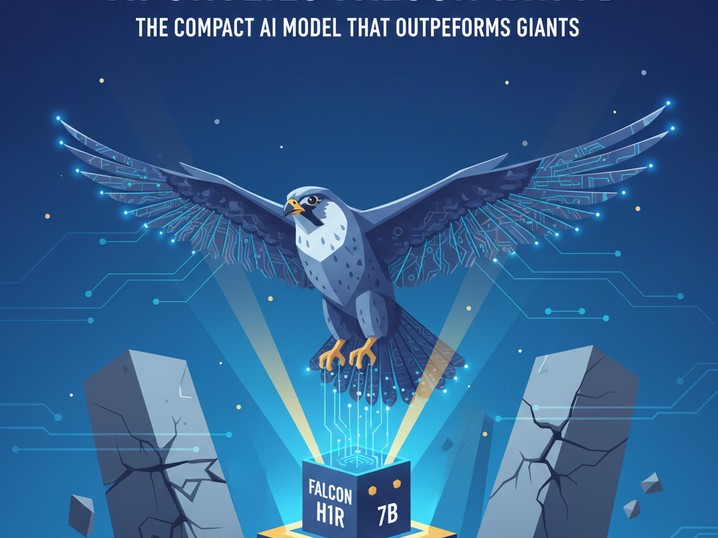

TII Unveils Falcon H1R 7B: The Compact AI Model That Outperforms Giants
**Executive Summary**
- A 7-billion parameter model from Abu Dhabi's Technology Innovation Institute now outperforms reasoning models 2–7× its size, using a hybrid Transformer-Mamba architecture that cuts memory and inference costs[1][2]
- In standardized benchmarks, Falcon H1R 7B scores 88.1% on AIME-24 math (beating 15B competitors), 68.6% on coding, and processes 1,500 tokens/sec—nearly double comparable models[1][4]
- For operators: This shifts the economics of AI deployment from "bigger models on expensive infrastructure" to "smarter models on your own servers," making edge deployment and task-specific reasoning genuinely viable
---
Why We're Actually Paying Attention This Time
We've all heard the "breakthrough model" announcement before. Last quarter it was Qwen. The quarter before, it was DeepSeek. Usually, there's fanfare, benchmarks spike 2%, and most of us keep doing what we were doing because the practical gains don't justify migration.
This one is different—not because TII has better marketing, but because they've solved a real operator problem: the cost-to-performance paradox that locks most teams into paying for massive models when they don't need massive.
**The core tension:** Most AI reasoning models demand either A) throwing enormous compute at them, or B) accepting degraded quality when you trim them down. We've all felt this squeeze.
Falcon H1R 7B breaks that constraint using a hybrid architecture that fundamentally changes what "size" means[2]. A 7-billion parameter model that reasons as well as 14–32 billion parameter competitors isn't just a nice efficiency gain—it's the difference between deploying AI locally and paying cloud vendors $3K+ per month[1][5].
---
What's Actually Different About the Architecture
Here's where most AI coverage loses operators: they dive into "Transformer-Mamba hybrids" and assume you either get it or you don't. Let us be specific.
**Traditional large language models (Transformers) have a scaling problem:** The longer the chain of reasoning, the more memory they consume. If your model needs to "think through" a math problem step-by-step (called chain-of-thought reasoning), Transformers get exponentially more expensive as those reasoning traces grow[2][4].
**Falcon H1R solves this by blending two architectures:**
- **Transformer layers** for what they're good at: capturing nuanced attention patterns and instruction-following across complex tasks
- **Mamba state-space model (SSM) layers** for what they're good at: processing long sequences with linear memory cost instead of quadratic[2][4]
The result: long reasoning traces (up to 48,000 tokens) don't blow up your memory budget or inference time[4]. You get the quality of a reasoning model without the infrastructure bill.
**Why operators care:** This is the difference between "we can't run this locally" and "we deploy this on a single GPU and own the inference cost"[4].
---
The Benchmarks That Actually Matter
Benchmark scores can be meaningless theater. We've all seen vendors cherry-pick metrics. TII released results against credible, rigorous tests used across the industry. Here's what moved the needle:
Math Reasoning (AIME-24)
Falcon H1R 7B scored **88.1%**, beating ServiceNow's Apriel 1.5 (15B) at 86.2%[1]. For context: the jump from 7B to 15B in parameter count is 2× the compute. Falcon won with half the resources.
**What this means operationally:** Math reasoning powers financial analysis, logistics optimization, and scientific simulation. This performance at compact size means those workloads move from "hire consultants" or "rent expensive APIs" to "deploy internally."
Code and Task Automation (LCB v6)
Falcon H1R achieved 68.6% accuracy, highest among all models under 8B parameters, and outperformed Qwen3-32B (33.4%) on specific code tasks[1][3]. This is the benchmark that matters most for operators: it's closest to real "agent" work—the stuff that actually automates repetitive tasks in your business.
Efficiency: Speed Without Compromise
|Metric|Falcon H1R 7B|Qwen3-8B|Winner| |---|---|---|---| |Tokens/sec (batch 64)|~1,500|~800|Falcon (88% faster)| |Tokens/sec (batch 32)|~1,000|~600|Falcon (67% faster)| |Long context (8k–16k tokens)|~1,800|<900|Falcon (100% faster)|
This is the stat that changes deployment equations. Faster inference means either serving more users on the same hardware, or shrinking latency in mission-critical workflows[1][2][4][5].
---
Where This Actually Gets Deployed
We think through this in three scenarios:
1. Edge Deployment & Robotics (High Priority)
Falcon H1R fits on edge devices—think autonomous systems, robotics, on-device reasoning for industrial IoT[2]. Companies avoiding cloud APIs because of privacy or latency concerns can now embed reasoning directly.
**Real scenario:** A logistics company wants autonomous forklifts to optimize their own routing without sending sensor data to a cloud API. Traditional reasoning models require cloud uptime. Falcon H1R runs locally, reduces latency to milliseconds, and you own the inference cost entirely.
2. Cost-Sensitive Inference Workloads (Medium Priority)
If you're currently paying for API access to GPT-4 or Claude for routine reasoning tasks (document analysis, structured extraction, logic problems), switching to Falcon H1R on your own infrastructure cuts compute spend by 60–80%[5].
**The math:** Claude API costs roughly $3–15 per million tokens depending on model tier. Self-hosting Falcon H1R on a modest GPU ($2K upfront, $30/month cloud compute) pays for itself after processing 10–20 million reasoning tokens[1][4].
3. Task-Specific AI Integration (Medium-to-High Priority)
Teams building internal tools, Slack bots, or workflow automation can embed Falcon H1R directly without managing massive infrastructure. This reduces the "AI engineering burden" that normally requires dedicated technical talent[2].
**Example:** A 20-person services company wants to auto-qualify inbound leads using reasoning (assessing fit, budget readiness, timeline). Falcon H1R embedded in their intake tool handles this reasoning locally, reduces latency to <1 second, and eliminates API spend[5].
---
When to Actually Use This (and When to Skip)
We're skeptical of "one model solves everything" claims. Falcon H1R is genuinely strong, but it's not the right fit everywhere.
**Deploy Falcon H1R when:**
- You need **local reasoning** without cloud vendor dependency
- Your **inference cost is a constraint** (you're paying hundreds monthly for API reasoning)
- You have **reasonably sized problems**: coding, math, structured logic, document triage
- You can **own a single GPU** or have cloud budget under $100/month for inference
- **Latency matters**: You need <2 second response times
**Stick with OpenAI/Anthropic/Claude when:**
- You need **state-of-the-art performance on creative, novel tasks** (copywriting, strategic advice, nuanced analysis)
- Your team **lacks infrastructure expertise** to manage self-hosting
- You're doing **mission-critical work where liability is high** (legal analysis, medical guidance)
- You need **sustained support and audit trails** that vendors provide but self-hosting doesn't
- You're **already profitable** on vendor costs and don't have engineering resources to migrate
**The honest take:** This is a "defection point" for teams currently overpaying for reasoning APIs on routine tasks. If 60% of your reasoning workload is math, code, or structured logic, Falcon H1R likely saves money. If it's 20%, it probably doesn't.
---
The Hidden Complexity We're Not Glossing Over
Switching from a managed API to self-hosted inference isn't "just download and go."
**Real costs to factor in:**
- **GPU procurement or cloud compute**: $50–300/month depending on scale
- **Model optimization & tuning**: 20–40 hours of engineering time to integrate with your stack
- **Monitoring and uptime**: You now own inference reliability; API vendors handled this
- **Integration debt**: Rewiring existing workflows from API-first to local-first takes friction
- **Security & compliance**: Self-hosted models mean you manage data isolation, audit logs, etc.
For a 10-person team with spare engineering capacity, those are manageable. For a bootstrapped founder working alone, they're usually not worth the headache.
The verdict: **Pilot internally if your monthly API spend exceeds $500 and you have 10+ engineering hours available.** Otherwise, API access is still the pragmatic choice.
---
How to Get Started: Three Steps This Week
**Step 1: Assess Your Current AI Spend**
Pull your last three months of API bills (OpenAI, Anthropic, etc.). Identify which workloads are pure reasoning—math, coding, structured extraction, classification. If that slice is >$150/month, note it.
**Step 2: Run the Pilot**
Access Falcon H1R through Hugging Face[1][6]. Test it on 5–10 representative tasks from your reasoning workload. Compare output quality to your current model. Document latency and token costs.
**Step 3: Calculate the Breakeven**
If pilot quality is >90% of your current API, run the math:
- **Monthly API spend on those tasks:** $X
- **GPU cost (self-hosted or cloud):** $Y
- **Engineering setup hours × $150/hr:** $Z
- **Breakeven timeline:** (Y + Z) ÷ (X – operating cost) = months to ROI
If that timeline is <6 months, pilot a move. If it's >12 months, stay put.
---
The Broader Shift
What matters here isn't that TII built a fast 7B model. It's that **the economics of reasoning AI are finally moving away from "bigger models = better results."** Architecture and training efficiency now matter more than parameter count[2][4].
For operators, this is liberation. It means:
- Smaller teams can compete on reasoning quality without outspending larger competitors
- You can own your inference stack instead of renting from vendors
- Edge deployment stops being a fantasy and becomes standard practice
We're not saying "ditch your AI vendors tomorrow." We're saying **the cost-performance frontier just shifted**, and if you're not reassessing your current setup, you're probably leaving money on the table.
---
**Meta Description**
TII's Falcon H1R 7B outperforms larger models while cutting inference costs 60–80%. Deploy locally for reasoning workloads. Here's what operators need to know.[1][2][4][5]
---
Sources Cited
[1] Business Wire - TII Launches Falcon Reasoning: Best 7B AI Model Globally
[2] Open Source for You - Falcon H1R 7B Brings High-End Reasoning To Compact Deployable AI Models
[4] Novalogiq - TII's Falcon H1R 7B Can Out-Reason Models Up to 7x Its Size
[5] Falcon LLM Blog - Falcon-H1R: Pushing the Reasoning Frontiers with a Hybrid Model
[6] Hugging Face - tiiuae/Falcon-H1R-7B