
Claude's "Co-Work" Model Signals a Bigger Shift in How We'll Actually Use AI
**Executive Summary**
Claude is moving beyond single-prompt query-response into persistent, project-based collaboration where context and memory stack over time. For lean teams, this matters because it reframes AI from a question-answering tool into a knowledge worker you iterate with—reducing rework and compounding accuracy. The shift from transactional to continuous engagement suggests teams redesigning workflows around AI participation (not just augmentation) will outpace those still treating models as on-demand lookup services.
---
The Shift Nobody's Talking About
We've been thinking about AI wrong.
For the past two years, the dominant mental model has been straightforward: pose a question to Claude or ChatGPT, get an answer, copy it somewhere, move on. It's fast. It's efficient by the standards of a single prompt. But it's also fundamentally transactional—more like texting a consultant than working alongside one.
Anthropic just quietly signaled a departure from that frame.
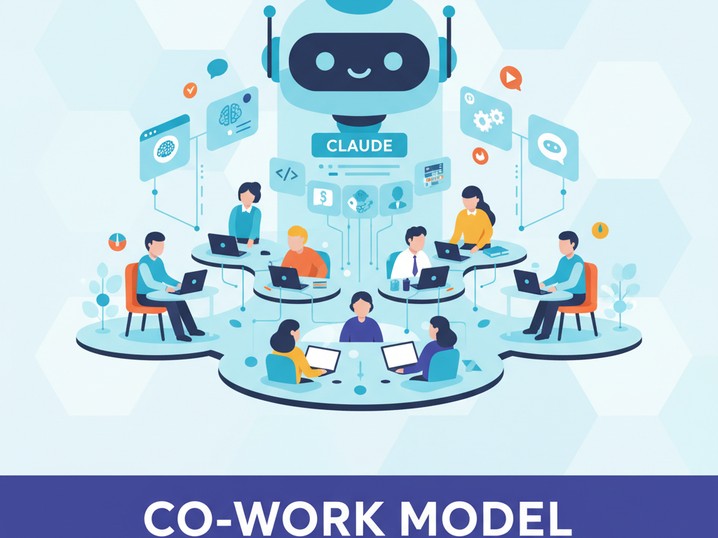
Earlier this week, the company announced Cowork, an agentic tool built largely by Claude itself[7], alongside expanded collaboration features and what they're calling "long-term project memory."[3] The pieces don't sound revolutionary in isolation. But together, they point toward something that operators need to pay attention to: **AI is being repositioned as a co-worker, not a utility.**
This isn't about Claude becoming smarter (though Opus 4.5 does outperform earlier versions on medical and scientific simulations[1]). It's about how the tool fits into your team's actual workflow—the difference between "I'll ask Claude to help me draft this proposal" and "Claude and I will collaborate on this proposal across the next three sessions, building on what we discussed yesterday."
We've guided teams through enough AI implementations to know: the first approach caps your ROI. The second one multiplies it.
What "Co-Work" Actually Means (And Why Your Team Isn't Ready Yet)
Let's ground this in something concrete.
Imagine you're a VP of Product at a 25-person SaaS company. You need to write a detailed feature spec for a new workflow automation component. Traditionally, you might:
- Brainstorm with Claude in a single chat (30 minutes)
- Copy the output into a doc
- Spend two hours rewriting it to match your voice and context
- Share with engineering; they ask clarifying questions you've now forgotten why you decided
- Iterate through email or Slack
With Claude's new co-work capabilities[2][3], the workflow looks different:
- Create a Claude project and invite your engineering lead and product designer as collaborators
- Start building the spec across multiple sessions—Claude remembers your product philosophy, technical constraints, and even earlier drafts
- Create interactive artifacts (structured checklists, decision trees) that live inside the project and update as your thinking evolves
- Your teammates see real-time edits, comment inline, and Claude synthesizes feedback into the next iteration
- The spec builds on itself; you're not re-explaining context every session
The difference is persistent context. Claude no longer resets after each conversation. Instead, it develops what Anthropic calls "long-term project memory"—remembering architectural decisions, style preferences, and previous constraints across multiple sessions[3]. This drastically reduces the need to re-upload context and cuts token waste.
For a solo founder or small ops team, this is material. You're not starting from zero every time.
Why This Matters Right Now
Lean teams win on iteration speed and decision quality. Both get worse the more context you lose.
Right now, most teams treat AI as a productivity accelerant—faster drafting, quicker research, better brainstorms. That's real, but it's also table stakes. The edge, increasingly, is treating AI as an actual collaborator in workflows that require back-and-forth refinement.
Here's what changes when you shift your model:
**Less rework.** If Claude remembers your brand voice, product strategy, and previous versions, you're not re-explaining the foundation every chat. You're building on it.
**Better decisions under pressure.** When you're iterating on something high-stakes—hiring criteria, pricing strategy, customer acquisition workflow—persistent context means Claude can flag inconsistencies or suggest refinements based on what you've already decided. It's like having a thinking partner who actually listened to the last meeting.
**Fewer context windows burned.** Modern LLMs have massive context windows, but infinite context still costs tokens. If Claude remembers your project goals without you re-uploading them every session, you save both money and mental friction.
**Team alignment without meetings.** When multiple people can collaborate in a shared Claude project, seeing each other's contributions and Claude's synthesis in real time, you eliminate a class of synchronous meetings. Your designer sees how the spec evolved; your engineer sees the intent behind decisions; Claude surfaces disagreements before they become Slack wars.
---
The Collaboration Layer Changes Everything
Here's where this gets interesting for operators managing actual teams.
Claude's new collaboration features[2] go beyond just sharing a chat link. You can:
- Add team members directly with different permission levels
- Keep certain artifacts private to a project (not company-wide)
- Bulk invite entire teams without adding people individually
- Get automatic email notifications when projects are shared
- Control what's visible to whom based on role
This sounds administrative, but it's not. It's the difference between AI integration and AI-augmented team workflow.
We've talked to a few early adopters (heads of ops, sales leaders, one scrappy marketing director at a 12-person startup). Their pattern is consistent: once they stop using Claude in isolation and start using it as a project space, adoption jumps. Not because Claude got smarter, but because it became harder to *not* include it.
One ops director we know started using a shared Claude project for sprint planning. Instead of a Jira board plus Slack conversations plus ad hoc emails, the team iterates directly in Claude. The model surfaces task dependencies, flags unrealistic timelines, and remembers sprint constraints from the previous week. Did it revolutionize their sprints? No. But it reduced weekly planning meetings from 90 minutes to 40 minutes and eliminated the "wait, why did we cut that feature?" moment that always happened on Wednesday.
Small edges compound.
---
The Persistent Memory Question: When Does This Actually Pay?
Here's where we get honest about ROI, because operators don't deploy features—they deploy solutions that move the needle.
Persistent project memory saves time in specific scenarios:
**Complex, multi-session projects.** Anything that requires sustained thinking across days or weeks. Product specs, content calendars, audit workflows, financial planning. Claude remembers what matters without you manually summarizing.
**Team handoff work.** When you're onboarding someone new or handing a project to a colleague, a shared Claude project becomes the institutional memory. It's not a replacement for documentation, but it's faster than the "let me catch you up on everything we discussed" conversation.
**Iterative creative or strategic work.** If you're drafting a go-to-market narrative, positioning document, or customer journey map, Claude evolves it with you across sessions. You don't re-pitch the foundation each time.
**When context is genuinely hard to communicate.** If your business model is unusual, your customer base is nuanced, or your technical constraints are specialized, persistent context actually saves. Claude builds knowledge over time instead of starting fresh.
Persistent memory probably *doesn't* help for:
- One-off research or quick answers
- Transactional drafting (emails, social posts, quick summaries)
- Tasks where you're pulling from multiple disparate sources
- Work that's truly sequential (do this, then I'll tell you what I need next)
The strategic question for your team: **What percentage of your current AI usage is persistent-context work vs. transactional?**
If it's mostly one-off queries, you're not the target for co-work features yet. If you have five-to-ten ongoing projects where context compounds, it's worth restructuring around collaborative projects.
---
How to Actually Implement This (Not Theory, The Actual Steps)
If you're convinced this is worth trying, here's how to start without massive friction:
**Week 1: Pick one project.** Choose something that's currently messy—either because it requires multiple drafts or because the context lives scattered across docs and Slack. A marketing campaign brief, a hiring rubric, a technical design doc. Something that would legitimately benefit from continuity.
**Week 1-2: Set it up as a Claude project.**[2] Create the project, invite the two-to-three people who actually need to see this evolve. Don't invite the whole company; keep it tight. Give clear permission levels (edit vs. view).
**Week 2-3: Use it for your actual workflow.** Don't treat it as a "let's try this tool" exercise. Actually do the work inside the project. Draft, get Claude's feedback, refine, tag teammates for input, iterate. Let context actually build.
**Week 4: Measure what changed.**
- How many Slack threads did you avoid?
- Did anyone ask you to "catch them up" because they could just read the project history?
- Did the final output improve because Claude remembered earlier constraints?
- How much faster did iteration cycle?
Even if the gains are modest (15-20% faster, 10% fewer explanatory messages), that's material at team scale. Run the math: if your team spends five hours a week on this type of collaborative work, and co-work saves even 15%, that's 2.5 hours recovered per week. At 50 weeks a year, that's 125 hours—roughly three weeks of productive capacity for a two-person team.
---
The Competitive Angle (What You Need to Know)
OpenAI released ChatGPT Health this week. Google has Gemini Extensions. Anthropic is pushing Claude into healthcare, agentic orchestration, and now collaborative workspaces.[1][7]
The pattern is clear: AI vendors are specializing and integrating deeper into workflows. The days of "one model, many generic use cases" are ending. Models are becoming infrastructure for specific workflows.
For operators, this means:
**Generalist AI isn't enough anymore.** You're not just picking "the smartest model." You're choosing which model's workflow design and integrations match your team's actual work.
**Integration friction is a real cost.** If Claude requires five manual steps to connect your project data, and a competitor bakes it in, that competitor wins. Anthropic knows this—they built MCP (Model Context Protocol) as an open standard for connecting external data sources[1]. The question is whether their integrations reach your stack.
**Collaboration-first tools compound adoption.** Tools that are designed for solo prompting struggle when teams adopt them. Tools designed for collaboration (like the new Claude projects) scale faster. This is worth paying attention to.
---
Verdict: Deploy, Don't Defer
Here's our read:
If you have a team (not solo founder), and you're doing work that requires iteration and input from multiple people, Claude's co-work direction is worth a pilot. Not because it's revolutionary—it's not. Because it suggests a model of AI integration that actually matches how lean teams operate.
We'd prioritize this for:
- Product and design teams (specs, wireframes, decision docs)
- Ops and finance teams (planning, audit workflows, process docs)
- Sales teams (account strategy, competitive positioning)
- Marketing teams (campaign briefs, content calendars)
The ROI threshold is lower than you'd expect: even a 10-15% improvement in iteration speed compounds across a quarter.
**Your next move:** Audit two-to-three ongoing projects where context currently scatters across documents and conversation. Run a four-week pilot using Claude projects. Measure what changes. If adoption sticks and output improves, expand. If it doesn't, at least you've validated before committing.
The AI vendors that win this year won't be the ones with the smartest models. They'll be the ones whose tools fit naturally into how teams already work. Claude's co-work move suggests Anthropic is thinking like an operator, not an AI researcher.
That's worth taking seriously.
---
Checklist: Before You Pilot
- [ ] Identify one project that requires 3+ sessions and 2+ team members
- [ ] Invite the core people (2-3, not the whole company)
- [ ] Move existing drafts/context into Claude project
- [ ] Commit to using it for four weeks without reverting to email/Slack
- [ ] Track: iteration cycles, context-resetting moments, team friction points
- [ ] At week 4, calculate time saved × hourly cost × annual projection
- [ ] Decide: expand to second project or revisit next quarter
---
**Meta Description:** Claude shifts from transactional prompting to persistent collaboration. How this changes ROI for lean teams and which workflows benefit most.