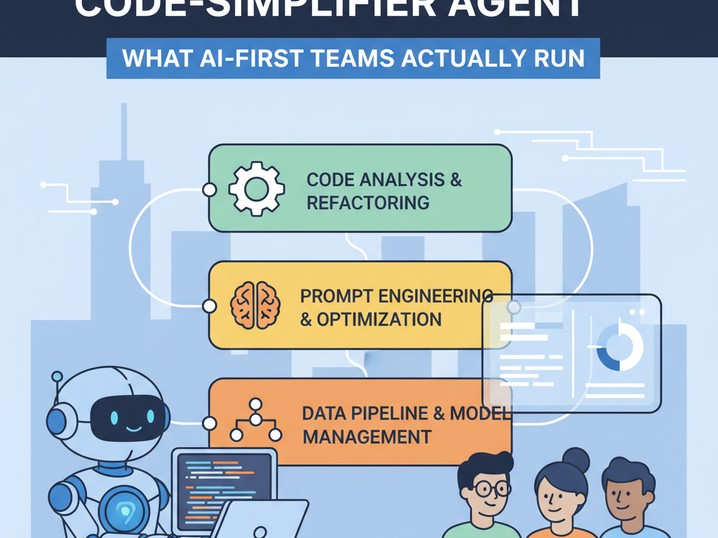

Claude Code's Internal Code-Simplifier Agent: What AI-First Teams Actually Run
**Executive Summary**
- The Claude Code team open-sourced a formal agent workflow that tackles the real problem: messy pull requests after long development sessions[1]
- This isn't a new tool to install—it's a pattern demonstrating how modern engineering teams formalize cleanup as a dedicated agent pass, not an afterthought[1]
- For lean teams already using AI for development, copying this workflow eliminates a recurring friction point and reduces code review friction without hiring additional engineers
---
The Problem Nobody Wants to Admit: Technical Debt Created in Real Time
We've all been there. A team ships a feature after a 12-hour sprint. The code works. Tests pass. But the pull request is 200 lines with inconsistent naming, nested logic that could be cleaner, and three different approaches to the same pattern because people jumped between tasks.
The code review becomes a negotiation. The reviewer asks for cleanup. The developer resists ("it's already working"). Three days later, the PR merges with a note: *"We'll clean this up next sprint."*
It never gets cleaned up.
This isn't about perfectionism or style guides. It's about compounding friction. Each piece of messy code slows the next developer. Inconsistency creates cognitive load. Unused complexity becomes the baseline for the next feature. Six months later, your codebase has arthritis.
For lean teams, this is especially painful. You don't have a dedicated refactoring cycle or a platform team to police standards. You're shipping fast, which means cleanup gets deprioritized faster.
Boris Cherny and the Claude Code team faced this problem internally. Their solution wasn't to add more rules or hire another reviewer. They formalized code simplification as an explicit agent pass—a dedicated workflow step that runs after long sessions or before complex PRs, independent of human judgment[1]. They then open-sourced that agent definition so other teams could adopt the same pattern.
What This Agent Actually Does (and What It Doesn't)
Before we go further: this is not a new tool you download from the app store. This is an agent prompt—a formalized set of instructions that Claude Code executes within an existing Claude Code session[5].
Think of it like this: instead of telling Claude "make this code better," the Claude Code team built a repeatable, tested instruction set that says *how* Claude should approach simplification—when to simplify, what to preserve, what metrics matter.
The agent's scope is specific. It focuses on[1]:
- Reducing unnecessary complexity
- Improving readability and structure
- Cleaning up large or messy diffs after extended work sessions
- Making refactors easier to review and ship
Notably, it does *not* change behavior. It doesn't restructure your architecture, migrate dependencies, or rewrite tests. It's a precision tool for the 80/20 of code cleanup: the stuff that makes code harder to read without adding value.
The difference matters. Your team doesn't wake up to a refactored codebase that breaks things. You get: "Here's the same behavior, clearer."
Why This Matters: The Practical Benefit
Here's the straightforward value: after a long coding session where you've stacked features, fixed bugs, or jumped between contexts, the code works—but it's messy. The agent runs through it and produces a clean diff in minutes. No human effort required.
For small teams without dedicated time for cleanup, this is the difference between "we'll refactor this later" and actually shipping clean code.
One team documented their experience: after a long development sprint, the agent ran through four files (all TypeScript) in roughly three minutes[1]. The resulting diff was clean enough to ship without a second cleanup pass.
The payoff compounds. Cleaner code during handoffs means less context loss. Consistency makes the next sprint faster. Small teams especially feel this—you can't afford review tax on style when you're already lean.
How This Works in Practice
The agent runs within Claude Code, which means it has access to your codebase context, your git history, and your project standards (if you've documented them in a CLAUDE.md file)[2].
Here's the actual workflow:
**Trigger**: End of a long coding session or before you open a PR for review.
**Agent execution**: Claude analyzes the code you've written against your project patterns, readability conventions, and unnecessary complexity. It then generates suggestions or direct edits.
**Scope**: The changes are conservative. It's looking for quick wins—renaming inconsistent variables, collapsing nested conditionals, extracting repeated patterns.
**Output**: A cleaned-up diff that you review and commit, or a PR that's already structured cleanly for human review.
The Real Enabler: Documentation
Here's where this gets practical. The agent works better if your project has documented standards.
If your CLAUDE.md file says "We use constructor injection for dependencies" and "Async operations use this pattern," the agent follows those rules. If that file is empty or outdated, the agent makes reasonable guesses—which often means conservative changes that don't simplify much.
One senior engineer maintaining a 13KB CLAUDE.md file for a monorepo noted that they've even started allocating token limits to internal tool documentation, like selling "ad space." If a tool can't be explained concisely, it's not ready for the file[2].
This has a practical implication: if you're considering adopting this workflow, budget 2-4 hours to write or formalize your CLAUDE.md. It's straightforward documentation work, but it's the foundation.
The payoff: every agent interaction after that point respects your standards automatically.
Adopting the Pattern: A Practical Checklist
If you're interested in using this approach, here's how to start:
**Week 1: Document your standards**
- Create a CLAUDE.md file in your repo root (or append to an existing one)
- List your naming conventions, architectural patterns, and preferred libraries
- Include examples of good code in your context (not bad code)
- Target: 1-2KB of useful documentation
**Week 2: Test the agent on non-critical code**
- Run the Claude Code simplifier agent on a feature branch or internal tool
- Review the suggestions. Do they match your expectations?
- Adjust your CLAUDE.md based on gaps
**Week 3: Integrate into your workflow**
- After a long coding session, run the agent before you commit or open a PR
- Review the cleanup, commit it, and move on
- Track how much time you save on manual cleanup over the next few weeks
**Ongoing: Keep CLAUDE.md current**
- Every 4-6 weeks, update it with new patterns you're using
- Remove outdated guidance
- Version control it like any other code
---
Bottom Line
The Claude Code team didn't invent code simplification. They formalized it as a replicable, ready-to-use workflow[1].
For teams using AI-assisted development, this is worth copying. It's especially valuable for small teams where cleanup overhead directly impacts your bandwidth—you can't allocate someone to refactor after every sprint, so letting an agent handle it is a genuine win.
Start with documentation. Let the agent follow.
---
**Meta Description:** Boris Cherny shared Claude's internal code-simplifier agent—a well-documented skill that automates code cleanup after long development sessions. Small teams can copy this workflow to ship cleaner code without diverting engineering time from feature work.