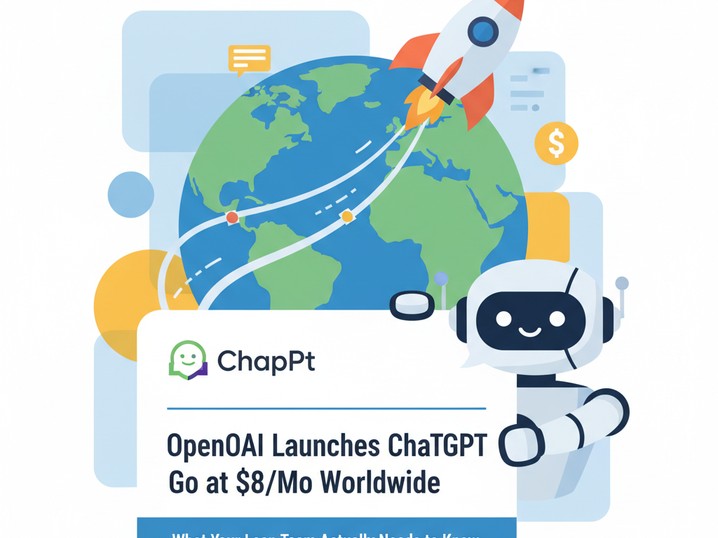

OpenAI Launches ChatGPT Go at $8/Mo Worldwide—What Your Lean Team Actually Needs to Know
**Executive Summary**
- ChatGPT Go ($8/month) is 60% cheaper than Plus and 10x more capable than free tier, making it the first genuinely viable middle tier for operators scaling without enterprise budgets.[3]
- OpenAI is testing ads in free and Go tiers starting in the US weeks—monitor privacy controls and free-tier retention before recommitting to free-plan workflows.[5]
- For most 5-50 person teams, Go subsidizes routine AI work (research, writing, image generation) while Plus handles specialized tasks, potentially cutting total AI spend 30-40% if deployed strategically.[3][4]
---
The Real Problem OpenAI Just Solved
We've heard it from founders and department heads for months: *ChatGPT Plus is too expensive for our whole team, but free tier is too limited for daily work.*
That gap was real. ChatGPT Plus at $20/month forced hard choices—you could either pay for a few power users or leave the rest of your team on throttled free access. Either way, you lost productivity or blew budget.
OpenAI just closed that gap. On January 16, ChatGPT Go launched globally at $8 USD/month in the US,[3] positioning itself between free (which caps your monthly messages) and Plus (which costs 2.5x more).[4] For lean teams, this changes the math entirely.
---
What You're Actually Getting for $8/Month
ChatGPT Go runs on **GPT-5.2 Instant**, a lightweight version of OpenAI's flagship model.[5] Here's how it stacks:
| Feature | Free | Go ($8/mo) | Plus ($20/mo) | |---------|------|-----------|--------------| | **Messages/month** | ~40 | ~400 | Unlimited | | **File uploads** | Small | Large | Large | | **Image generation** | Limited | 10x more | Unlimited | | **Model access** | GPT-4o | GPT-5.2 Instant | GPT-5.2 Pro + Thinking | | **Memory/context** | Minimal | Longer | Maximum | | **Video generation (Sora)** | ✗ | ✗ | ✓ | | **Code execution** | ✗ | ✓ | ✓ |
The gap between free and Go is dramatic—10x more messages, proper file handling, meaningful image creation.[3][5] The gap between Go and Plus is narrower for most daily work but includes Sora (video), advanced reasoning, and full legacy model access.
**What this means:** Go is designed for high-volume but routine tasks. Writing, research, brainstorming, basic analysis, image sourcing—the kind of work your entire team does weekly but doesn't require bleeding-edge reasoning.
---
The Ad Question: What You Need to Know Now
Here's the part everyone's nervous about.
OpenAI announced it will test ads in the US starting in the coming weeks, in both free and Go tiers.[3][5] A carousel format displaying relevant products based on your prompt—if you ask for recipes, you might see a grocery delivery ad.
We get it. Adding ads to a paid tier feels like a tax increase after you've already committed budget.
**What OpenAI says:**
- Ads won't share conversation data with advertisers.[5]
- You can turn off personalization and clear chat history.[5]
- They're committed to "answer independence"—ads won't influence ChatGPT's responses.[5]
**What you should actually do:**
- **Wait for US rollout details.** The ad formats, frequency, and actual privacy controls roll out "in the weeks ahead."[3] Don't commit 50 seats until you've seen what this actually looks like.
- **Audit your current free-tier usage.** If your team relies on free ChatGPT for sensitive work (customer data, financial modeling, proprietary strategy), Go might not be the right move yet.
- **Test with a pilot first.** Buy 5-10 seats for a low-sensitivity team (marketing, general research) for 30 days. Monitor adoption, ad friction, and whether people actually hit the message limits.
The risk isn't existential—OpenAI has every incentive to make ads unobtrusive—but it's real enough to validate before scaling.
---
Where Go Actually Saves You Money
Let's get specific. Here are three operator archetypes and what Go means for their budgets.
Marketing/Content Team (6 people)
**Current setup:** 2 people on Plus ($40/mo), 4 on free. Monthly spend: $40.
**Go scenario:** All 6 on Go ($48/mo). You've added $8 to monthly spend but your whole team now has meaningful daily access. Researchers can upload brand docs. Copywriters can generate 5-10 image variations instead of 1-2. Analysts can run larger data reviews.
**ROI math:** If this saves one content iteration cycle per week per person—maybe 3 hours—that's 18 hours recovered monthly. At fully-loaded cost ($75/hour for junior content work), that's $1,350 in productivity. Your $8 incremental spend pays for itself in about 4 hours of reclaimed time.
**Verdict:** Deploy. The payoff is clear and fast.
Operations/Sales (10 people)
**Current setup:** 4 on Plus ($80/mo), 6 on free. Spend: $80.
**Go scenario:** 4 stay on Plus (they do analysis, forecasting, complex workflows). 6 move to Go ($48/mo). Total: $128/mo. Net cost: +$48.
**What changes:** Your sales team can now use ChatGPT for:
- Drafting personalized outreach (without hitting message caps halfway through the day)
- Researching prospect companies and markets
- Building lead qualification frameworks
- Generating follow-up sequences
**The friction point:** Go doesn't include advanced analysis tools that your Plus users rely on. Stick with Plus for forecasting, complex spreadsheet work, and strategic modeling.
**Verdict:** Pilot this. The cost increase is modest, but you need to see if Go's message limits are actually enough for daily sales work. If your team hits caps by 2 PM, Go doesn't solve your problem—you'd need everyone on Plus.
Solo founder doing sales, marketing, ops
**Current setup:** You alternate between free (budget-conscious days) and occasional Plus ($20/mo when you need it). Spend: ~$20/mo average.
**Go scenario:** Just go with Go ($8/mo). You get 10x the messages, file uploads, image generation—and you drop your monthly spend by $12.
**What you can now do:** Stop rationing. Use ChatGPT for customer research, email drafts, sales calls, marketing copy, quick analysis—all without hitting free tier limits by Thursday.
**Verdict:** Deploy immediately. It's cheaper and actually usable.
---
The Broader Play: Why This Matters Now
OpenAI is making a deliberate move. The company disclosed annualized recurring revenue surpassing $20 billion in November 2025.[6] Computing infrastructure costs are astronomical—training GPT-5.2 alone cost billions. Adding an ad-supported tier and a lower-price option does two things:
- **Captures price-sensitive segments.** Not every customer can justify Plus. Go gets students, freelancers, small teams, and cost-conscious enterprises into a paid tier that still generates recurring revenue.
- **Subsidizes free access through ads.** Free users are a halo effect—they convert to Plus when they hit limits, they refer others, they build habit. Ads keep that free tier alive without bleeding revenue.
For operators, this signals stability. OpenAI isn't facing an existential margin problem (yet), and their playbook—tiered pricing, ads, enterprise add-ons—looks increasingly like SaaS orthodoxy. That's good for planning. You're not betting on a house of cards.
---
What to Watch Before Committing
**1. Ads actually roll out as promised.** Right now, this is an announcement. Real implementation might surprise you.
**2. Message limits hold up under real usage.** 10x more messages than free tier is nice. But what's the real ceiling? If your team hits Go's limits by mid-day, it's not a solution—it's a bottleneck.
**3. Privacy controls are actually usable.** Toggling off personalization is good marketing copy. Does it work? Will your team actually use it, or will they just accept targeted ads?
**4. Free tier doesn't decay.** If OpenAI gradually throttles free accounts to push Go adoption, the ROI math changes. Right now, free tier is genuinely usable for low-volume work.
---
Your Move: Pilot → Deploy → Monitor
**Week 1: Audit**
- Catalog current ChatGPT use by team and frequency (who's on free, who's on Plus, how often do they hit limits).
- Identify one low-sensitivity pilot group (not customer-facing, not confidential financial work).
**Week 2: Pilot**
- Buy 5-10 Go seats for your pilot group for 30 days.
- Track: message frequency, whether they hit the monthly cap, feedback on ads (once they roll out), adoption rate.
**Week 3-4: Measure**
- Compare pilot group productivity to baseline (did they ship faster, collaborate more, write better drafts—however you measure).
- Survey: Do ads feel intrusive? Did privacy controls matter?
**Week 5: Decide**
- If pilot worked: Roll out to your non-Plus users.
- If it flopped: Stick with current free/Plus split or try a different tier mix.
- If ads are the problem: Wait 60 days and reassess once rollout is complete and controls are visible.
---
The Bottom Line
ChatGPT Go is the first genuinely smart price point for operators. It's not a Plus substitute, but it's a legitimate middle tier that makes sense for 70% of routine AI work at a price that pencils out quickly.
The ad question is real, but it's not a dealbreaker—not yet. Pilot first. Monitor. Adjust.
The bigger picture: Lean teams now have a credible, affordable way to scale AI access without gambling on enterprise licensing or enterprise budgets. That changes what's possible in a 5-50 person company this quarter.
---
What's Your Scenario?
We'd like to hear how this lands for your team. Are you considering a move from Plus to Go for part of your team? Are you waiting on ad details before committing? Hit reply—operator war stories (and budget breakdowns) are the best way we learn what actually works.
---
**Meta Description:** ChatGPT Go ($8/mo) launches globally with 10x more messages than free. Here's the ROI math for lean teams, what the incoming ads mean, and when to deploy vs. pilot.