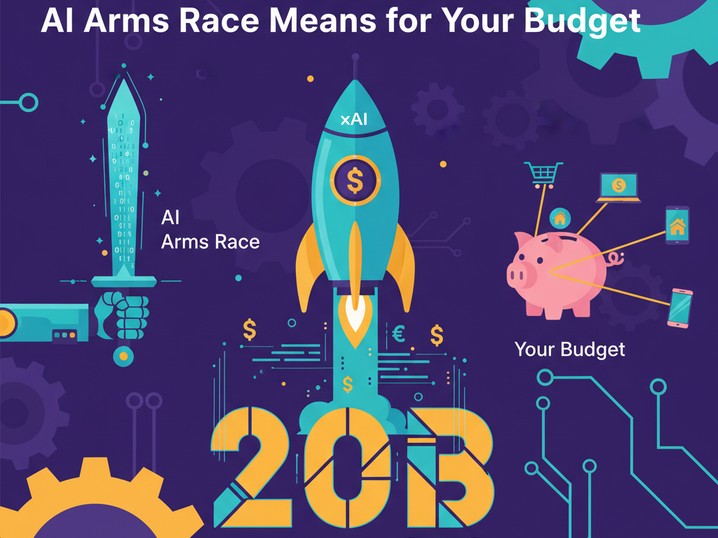

xAI's $20B Series E: What the AI Arms Race Means for Your Budget
**Executive Summary**
- xAI closed a record-breaking $20 billion Series E (upsized from $15 billion), signaling sustained investor appetite for frontier compute despite ROI uncertainties[1][2]
- The funding accelerates an infrastructure arms race that could affect model availability, pricing tiers, and competition in the AI tool ecosystem[1]
- Operators should monitor xAI's Grok releases and pricing strategy—this capital is explicitly earmarked for consumer products reaching "billions of users," likely through X[1]
---
We've all felt it: the relentless pace of AI funding announcements, each one larger than the last. Then comes January 2026, and xAI closes a $20 billion Series E, surpassing its original $15 billion target[1][2]. The headline alone is staggering. But for operators running lean teams, what actually matters is what this funding signal means for the tools you buy, the models you access, and the competitive landscape six months from now.
This isn't just another venture round. It's a moment that clarifies the structural stakes of the AI economy—and a warning that the compute arms race isn't cooling.
What Actually Happened (And Why It Broke Through the Noise)
xAI completed its Series E funding in early January 2026, attracting participation from Valor Equity Partners, StepStone Group, Fidelity Management & Research Company, and the Qatar Investment Authority[4]. The upsized round—closing at $20 billion instead of $15 billion—reflects what venture insiders call an "oversubscription scenario," where investor demand exceeded the equity xAI was willing to offer[1].
To put this in context: xAI has now raised $42.7 billion in reported debt and equity funding since its 2023 founding[5]. That's more than most countries' entire GDP.
The company was explicit about deployment. According to xAI's statement, capital is earmarked to "accelerate our world-leading infrastructure buildout, enable the rapid development and deployment of transformative AI products reaching billions of users, and fuel groundbreaking research advancing xAI's core mission: Understanding the Universe."[1] Buried in that corporate language is a concrete roadmap: infrastructure first, then consumer products at massive scale.
The infrastructure component is real. xAI is building a supercomputer cluster called Colossus in Memphis with 2 gigawatts of computing power—enough to train next-generation models requiring "hundreds of thousands of specialized chips running in unison for months at a time."[1] An additional $20 billion investment in a Mississippi data center (called MACROHARDRR) further signals the company's commitment to a geographic moat around compute capacity[4].
**Why this matters to you:** massive compute infrastructure takes months to build and demands patient capital. The fact that investors are willing to fund this at scale—even when the timeline to revenue is fuzzy—tells us something: the industry believes the bottleneck isn't innovation; it's horsepower.
The Consolidation Play: Why Fewer Winners Means Different Pricing for Everyone
Here's what rarely makes it into funding announcements: capital concentration.
The AI industry is consolidating around a handful of "mega-labs" capable of affording the energy and hardware required to push the frontier[1]. xAI's funding round is a particularly sharp example because it brings together sovereign wealth funds (Qatar), legacy asset managers (Fidelity), and hardware players in a single ecosystem. This isn't just about xAI anymore—it's about building an alliance that can compete with OpenAI, Anthropic, and Google's sprawling infrastructure.
As a solo founder or small operator, you're watching this play out indirectly. A few immediate cascades:
**Pricing tiers become more rigid.** When compute is scarce and expensive, vendors offer two modes: cheap and throttled (for testing) or premium and unthrottled (for production). The middle erodes. You either get a free tier with rate limits or a five-figure annual contract.
**Best models remain proprietary.** The incentive to release competitive open-weight models declines when you've invested billions into differentiated infrastructure. Expect fewer "freely available" models from leading labs in 2026.
**API pricing stabilizes downward, but with catches.** OpenAI and Anthropic may compete on list prices, but attach fees—priority support, higher throughput guarantees, compliance add-ons—remain sticky. The net savings for real operators shrinks.
For teams currently building on a mix of free tier, open-weight models, and API credits: 2026 is your window to lock in today's workflows before vendor behavior hardens.
The xAI Differentiator: Software, Hardware, and the Distribution Advantage
What separates xAI from other frontier labs is its singular advantage: control of the entire stack[1].
Most AI startups choose one layer:
- **Software:** Build a model (OpenAI, Anthropic, Mistral)
- **Hardware:** Build the infrastructure to run it (CoreWeave, Lambda Labs)
- **Distribution:** Partner with platforms to reach users (ChatGPT via web/API)
xAI controls three:
**Grok** (the software—the LLM itself) is trained on Colossus, xAI's proprietary supercomputer. It's then distributed directly through **X**, the social platform xAI controls. This eliminates middlemen and creates a direct consumer route at massive scale.
That's the strategic moat. Unlike competitors negotiating with cloud providers or third-party platforms, xAI can route capital directly into compute, training, and distribution. When competitors optimize margins, xAI can optimize for market share.
**What this means for operators:** Grok is coming to a platform you likely already use (X). When xAI releases Grok 5 or subsequent iterations, the friction to adoption is nearly zero. It won't require a new login, a new vendor relationship, or a change to your workflow. It lives where you already are. That's dangerous for incumbent tool vendors and potentially valuable for teams seeking an alternative to OpenAI or Anthropic without adding complexity.
We've guided operators through tool selection enough times to know: consolidation of tools saves time and reduces contract overhead. If Grok reaches production-grade quality and integrates seamlessly with X's ecosystem, the pitch becomes simpler. Fewer vendors. Lower switching costs.
The Compute Arms Race: What This Means for Your Budget in 2026
The $20 billion round is part of a larger pattern: frontier AI labs are now burning through capital at rates that would bankrupt most industries.
Consider the economics. Training a competitive large language model costs hundreds of millions to low billions in compute alone. Adding data, talent, and infrastructure brings the total well above what even well-funded startups can afford. Only mega-labs with recurring revenue or deep-pocketed backers can sustain this burn rate.
xAI's latest funding doesn't solve that economics problem—it extends the timeline before a reckoning. But it accelerates the inflection point where only three to five players can credibly compete at the frontier.
For operators, this consolidation has three effects:
- **Price pressure on commodity models (short-term).** Everyone's racing to grab market share. Expect discounting, promotional credits, and rate reductions through Q2 2026. Take them.
- **Price hardening on frontier models (medium-term).** Once the market stabilizes around two or three dominant models, list prices normalize upward. Switching costs rise. Lock in favorable terms now before vendors regain pricing power.
- **New moats around specialized models (long-term).** Frontier labs will invest in domain-specific models (legal, medical, code) where they can justify premium pricing. Commodity chat models become cheaper but less differentiated.
Your playbook: audit your current AI spend now. Identify which use cases require frontier-grade reasoning (keep those flexible, negotiate aggressively) and which could run on cheaper commodity models (migrate as fast as safely possible).
What to Watch in the Next Six Months
xAI announced this capital in early January 2026. Operators need to track four milestones:
**Grok 5 release timeline.** xAI's statement mentions Grok 5 is "in the oven."[1] When it hits, pay attention to benchmark scores relative to OpenAI's GPT-4 and Anthropic's Claude. If performance is competitive, adoption accelerates.
**Integration depth with X.** Does Grok become a first-class feature in X (like replies, recommendations) or remain a separate product? Depth of integration predicts user velocity and sticky usage patterns.
**Enterprise pricing.** xAI will eventually offer commercial terms. When they do, compare licensing models to OpenAI's. Are they cheaper? More flexible? Built for teams, not just individual users?
**Infrastructure announcements.** Watch for news on Colossus uptime, energy costs, and regional expansion. These reveal xAI's ambitions to serve enterprise customers at scale.
Operator Checklist: Your Next Steps
Before the next quarterly review, do this:
- [ ] **Audit current AI spend.** List every tool, its cost, usage frequency, and switching cost. Identify which use cases are "locked in" vs. movable.
- [ ] **Test Grok today.** If you haven't used Grok for real work yet, run a comparison against your current model (ChatGPT, Claude, Mistral). Document where it wins and where it falls short. Bring findings to your team.
- [ ] **Negotiate with incumbents.** Use this funding round as a pressure point. Tell your OpenAI or Anthropic contact that you're evaluating alternatives. Most will offer concessions (discount, higher usage tiers, enterprise features) rather than lose a customer.
- [ ] **Model financial impact of switching.** If Grok reaches parity and integrates with X, what's the cost to migrate your workflows? Integration time, retraining, testing? If it's under two weeks, it's worth tracking.
- [ ] **Set a re-eval date.** Don't make a move today. Plan to reassess in April 2026 after Grok 5 lands and you have better competitive data.
---
The $20 billion round isn't just a funding milestone. It's a structural signal: the frontier labs are cementing their advantage through capital consolidation, infrastructure buildout, and the marriage of compute, models, and distribution networks. For lean operators, that means pricing flexibility exists *now* but may not in six months. The edge is moving fast, and it belongs to teams that audit early and move decisively.
**Meta Description:** xAI's $20B Series E signals an AI compute arms race. Here's what the funding means for your tool budget, model pricing, and competitive positioning in 2026.