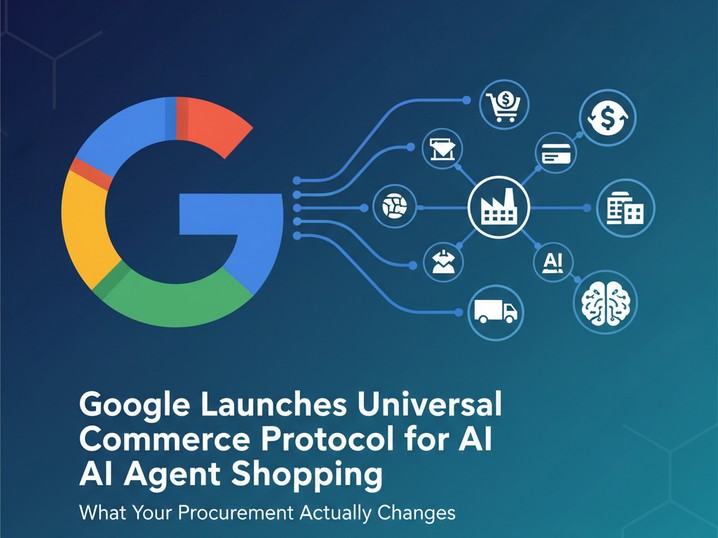

Google Launches Universal Commerce Protocol for AI Agent Shopping — What Your Procurement Actually Changes
**Executive Summary**
- Google's new Universal Commerce Protocol (UCP) standardizes how AI agents buy across retailers, removing the need for custom integrations per platform
- By 2028, an estimated 15–20% of e-commerce volume flows through AI agents; 80% of retailers aren't ready[2]
- For operators: This is a procurement automation opportunity *and* an API readiness test—prepare your systems now or lose visibility into how your purchasing actually works
---
The Problem That Finally Has a Solution
We've all felt the friction. Your team needs to source from five vendors for Q2, and each one requires a separate login, a different catalog format, and its own order workflow. It's 2026, we have AI that can reason through complex purchasing decisions, and yet your supply chain still moves like it's 1995.
On January 11, Google quietly announced something that changes this entirely: **the Universal Commerce Protocol**[2]. It's an open standard—developed with Shopify, Etsy, Wayfair, Target, and Walmart—that lets AI agents buy directly from any compatible retailer *without* the merchant ever building custom integrations[2].
But here's what matters to operators: this isn't just about consumer shopping. The same infrastructure is coming for your procurement pipeline.
Until now, every AI platform had what Google calls the **"N×N problem."** If you have 3 sales channels and 10 suppliers, you need 30 custom API connections[2]. Add a new supplier, and suddenly your integration backlog grows faster than your team can handle. The result? Most companies still manage purchases through a scatter of emails, spreadsheets, and vendor portals.
UCP breaks that pattern by creating **one standard language** that any AI agent can speak with any merchant[4]. No more custom builds per platform. No more custom builds per vendor.
---
How This Actually Works (And Why It Matters to Your Bottom Line)
Imagine this scenario: Your operations team needs a lightweight carry-on bag for an upcoming client event. Instead of toggling between three supplier portals, comparing inventory, and manually processing an order, they type into your Gemini-integrated procurement interface: *"Find a carry-on under 2 kg from our approved vendors."*
The AI agent contacts each vendor's UCP server simultaneously, cross-references real-time inventory, compares pricing against your negotiated rates, verifies shipping costs, and surfaces three curated options[2]. Your team picks one. Payment is processed using stored credentials. Order confirmation lands in your system automatically.
Two clicks. No portal-hopping. No manual data entry.
Behind the scenes, here's what's happening:
The agent creates a shopping session on the merchant's UCP server, negotiates which capabilities both sides support, adds the item to a cart, retrieves your payment authorization, and confirms the order[4]. The merchant stays in control—they're still the seller of record, they handle fulfillment, and they own the customer relationship[3]. Your agent is just the intermediary.
This solves three operator headaches simultaneously:
**Procurement speed:** From hours to minutes. Real-time inventory. No phone calls.
**Cost visibility:** Agents can compare pricing across vendors in real time and surface the best option, not the default vendor[2].
**Data accuracy:** Order confirmation flows directly into your ERP or accounting system, eliminating manual entry and reconciliation errors.
---
The Broader Shift: AI Isn't Coming to Shopping, It's Already Here
Here's what keeps most operators up at night: AI-driven purchasing isn't some distant future. It's *happening now*.
BCG estimates that **15–20% of e-commerce transactions will be AI-mediated by 2028**[2]. That's not a fringe segment. That's one in every five purchases flowing through autonomous agents.
The size of the opportunity? Analysts project a **$9 trillion market by 2030**, yet **80% of e-commerce leaders remain unprepared** for agent traffic[2].
This matters to you whether you're a buyer *or* a seller:
**If you're managing procurement:** Your vendors are about to become AI-compatible—or they'll lose transactions to competitors who are. Start auditing your supplier API readiness now.
**If you sell a product:** Your customer relationships are about to be mediated by agents instead of humans. Your product data quality becomes a competitive advantage, not a back-office task.
The old playbook—drive traffic, optimize conversion funnels, build direct customer relationships—is being rewritten by a world where *agents* make the buying decisions.
---
What Operators Need to Do Right Now (Three Moves)
**Move 1: Audit Your Supplier API Readiness**
Pull up your top 15–20 vendors and ask: Are they UCP-compatible today? When will they be? What's their timeline?
Most won't be ready for six months. Some won't be ready for a year. That's fine—but you need visibility *now*, not when you're scrambling to integrate an agent into your procurement workflow in Q3.
Create a simple spreadsheet:
| Vendor | Current Integration | UCP Roadmap | Timeline | Owner | |--------|-------------------|-------------|----------|-------| | Vendor A | Custom API | Yes—planned Q2 2026 | 4 months | Sarah | | Vendor B | Email + manual entry | No current plans | TBD | Marcus | | Vendor C | EDI (legacy) | Evaluating | Unclear | Jennifer |
The vendors in the TBD category? Those are your negotiation targets. Tell them you're evaluating UCP-compatible suppliers and would prefer to standardize.
**Move 2: Start a Procurement Agent Pilot**
Pick one frequent purchasing scenario—office supplies, shipping materials, freelance tools—and run it through a UCP-compatible agent for 30 days.
Measure three things:
- **Time saved per transaction:** Current state (manual process) vs. agent-driven
- **Cost per unit:** Are agents finding better pricing through real-time comparison?
- **Error rate:** Manual data entry mistakes vs. automated flow
Don't expect perfection. You'll find edge cases, broken integrations, and vendors who claim UCP compatibility but don't quite deliver. Document them.
Real outcome from a pilot we've seen: A 30-person SaaS company saved 8 hours per week on vendor comparison alone. For them, that was $400/month of team time recovered—enough to justify agent infrastructure investment.
**Move 3: Start Preparing Your APIs**
If you *sell* to other businesses—whether B2B SaaS, logistics, suppliers, or marketplaces—start thinking about UCP compatibility.
This doesn't mean building from scratch. Shopify, Salesforce, and other platforms are baking UCP support directly into their infrastructure[3]. If you operate on Shopify or Salesforce, you're likely to get UCP compatibility in an update rather than requiring manual implementation.
But if you're custom-built or on a smaller platform, you need a roadmap.
Start here: Can your system currently accept real-time inventory queries, process orders via API, and return order confirmation? If yes, you're 70% of the way to UCP readiness. If no, that's a 2–3 month engineering sprint.
---
The Honest Assessment: What Actually Works and What's Hype
We'll be direct: UCP is **real infrastructure**, not marketing. Google co-developed this with 20+ major players including payment processors (Adyen, Visa, Mastercard), retailers (Walmart, Target, Etsy), and platforms (Shopify)[2]. When Salesforce announces native UCP support for Agentforce Commerce, that's not vaporware—that's shipping code[3].
But there are genuine friction points operators should know:
**Adoption timeline:** UCP launched January 11, 2026. Widespread availability? Realistically Q3–Q4 2026 for early adopters. Full mainstream adoption likely 2027–2028.
**Vendor fragmentation:** Not every supplier will adopt UCP immediately. You'll run hybrid procurement for at least the next 18 months—some vendors on UCP agents, others on the old playbook.
**Payment complexity:** UCP supports Google Pay and PayPal[7], but your vendor might use Stripe, Square, or a regional processor. That integration friction hasn't fully disappeared.
**Data quality dependency:** Agents are only as smart as the data feeding them. If your vendor's product catalog is garbage—missing specs, outdated pricing, wrong inventory counts—an agent will surface garbage faster, not smarter[1].
The last one is critical: **structured, trusted product data is now a competitive advantage**[1]. Vendors who invest in clean, consistent catalog data win agent traffic. Vendors who don't lose it.
---
The Verdict: Deploy This Quarter
For operators at 5–50 person companies, here's our recommendation:
**Deploy a procurement agent pilot** within the next 8 weeks. Start with a single vendor or product category. Measure time saved and cost impact. Use it to understand which vendors are ready for UCP and which need pressure.
This isn't about massive infrastructure investment. It's about *testing before* your competitors do. The operators who run a 30-day pilot in Q1 2026 will have hard data on ROI by April. By the time UCP reaches mainstream adoption in Q4, you'll already know whether agents fit your procurement workflow.
The companies that wait? They'll be scrambling to integrate agents into procurement processes that were never designed for autonomous purchasing. You can avoid that.
---
**Meta Description** Google's Universal Commerce Protocol standardizes AI agent purchasing across retailers. Here's how operators should prepare procurement pipelines, audit vendor readiness, and capture the automation opportunity before competitors do.