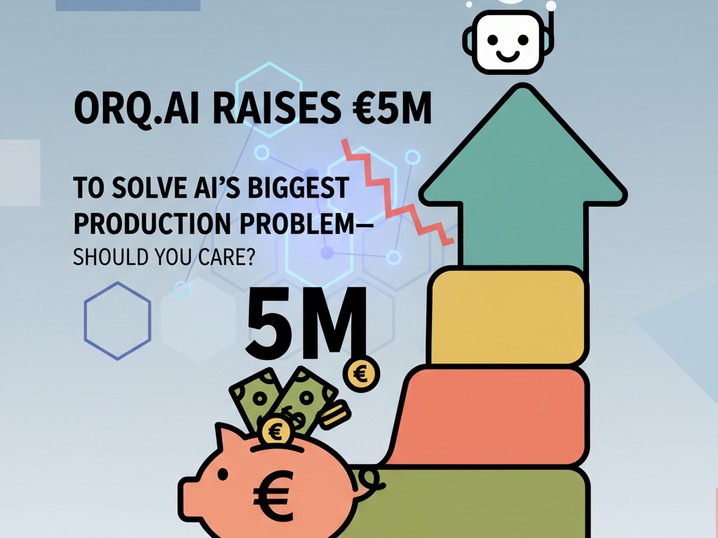

Orq.ai Raises €5M to Solve AI's Biggest Production Problem—Should You Care?
**Executive Summary**
- **The gap:** Most AI teams can prototype fast but deploy fragile systems that require constant firefighting. Orq.ai addresses this with managed infrastructure for production agents.
- **The signal:** €5M seed validates demand from 100+ organizations already paying for reliable AI deployment—not experimental tools.
- **Operator verdict:** Evaluate this if your team is stuck between "works in testing" and "breaks in production." Skip if you're still in the prototype phase.
---
The Problem We All Recognize
You know the pattern: the team ships an AI system that sings inside a notebook, leadership sees a slick demo, expectations skyrocket.
Then production hits.
The agent hallucinates on edge cases. It doesn't route queries correctly. Token costs spiral. Audit trails disappear. Six months later, you're spending engineering time babysitting what was supposed to be autonomous.
This isn't a new problem—it's the oldest problem in AI infrastructure. Move fast and break things works for startups shipping code. It doesn't work for companies running production AI agents that touch customer data, revenue, or compliance requirements.
[Amsterdam-based Orq.ai just raised €5M in seed funding to address exactly this gap][4]. On the surface, it's one more AI infrastructure play in a crowded market. But the signal underneath matters: 100+ organizations are already paying for a platform that treats production reliability like a feature, not an afterthought.
We need to look at what this really means for operators making build-versus-buy decisions right now.
---
What Orq.ai Actually Does (Without the Fluff)
Let's cut through the positioning. Here's what you're actually getting:
**A single platform to build, test, and operate AI agents without switching tools.[1][3]**
Most companies today use a patchwork: LangChain for development, a different framework for testing, custom scripts for deployment, and a spreadsheet for monitoring. Orq.ai collapses that into one interface.
The core features break down like this:
**Agent Studio:** Design agent behaviors and decision rules without rewriting infrastructure code.[2] You configure what the agent does, not how the underlying system works.
**Managed Runtime:** Deploy agents across cloud, hybrid, or on-premises environments without building orchestration yourself.[2] The platform handles routing, retries, versioning, and failover.
**AI Gateway:** Connect to 300+ LLM models and switch between them without rewriting your prompts.[1][4] This matters more than it sounds—if GPT-4 pricing doubles, you route to Claude or Mistral instantly.
**Monitoring and Observability:** Trace every prompt, token decision, and tool call.[5] Real dashboards. Real alerts. Not logs you have to parse yourself.
**Knowledge Base (RAG-as-a-Service):** Embed retrieval and reranking without building your own pipeline.[5]
**Compliance and Audit:** Role-based access, service accounts, full audit trails, GDPR and EU AI Act readiness baked in.[3][4]
The differentiation isn't any single feature—it's that everything is connected. Your experimentation flows directly into deployment. Evaluation metrics inform optimization. Audit trails surface automatically.
For comparison: traditional DevOps platforms assume code is deterministic. AI agents aren't. Orq.ai is built for that uncertainty.
---
The Business Case: What Actually Matters
Here's where most product announcements fall apart. They brag about features. Operators care about outcomes.
Orq.ai claims teams using the platform **ship 67% faster and free up more than 10% of engineering capacity.[2][4]** That's a specific claim, not a vague promise. Let's pressure-test it.
**Shipping 67% Faster**
This likely means time from agent design to production deployment compresses dramatically. Instead of building custom infrastructure, writing deployment scripts, and building monitoring—teams use pre-built components.
For a 10-person engineering team, that's roughly 1 FTE freed up per project. If your company ships 3 AI agents per year, you're recovering 3 FTE-months annually. At $15k per month loaded cost, that's $45k in labor recovered.
Platform cost: ~$5k-20k annually depending on usage and models.[1]
Net value: Positive in year one, assuming your team was truly blocked by infrastructure work.
**The Catch:** This only works if your team actually has blocked engineering capacity. If you're prototyping, this doesn't save you anything yet.
**Freeing 10% Engineering Capacity**
Ongoing—not one-time. Less time babysitting production agents means more time building new ones.
This assumes your team is currently spending 10+ hours per week on observability, debugging, re-routing requests, and incident response. If your agent usage is still experimental, you're not burning that time yet.
---
Where This Matters vs. Where It Doesn't
Let's be direct about scenarios:
**Deploy Orq.ai if:**
- Your team has built 2+ AI agents and hit production reliability problems (hallucinations, routing failures, cost explosions)
- You need to integrate agents with existing workflows (Slack, CRM, internal tools) without custom engineering
- You operate in regulated industries (finance, healthcare, legal) where audit trails aren't optional
- Your team is running 5+ concurrent AI agent projects and infrastructure is becoming a bottleneck
- You're currently managing agents across cloud and on-premises and need unified control
**Pilot Orq.ai if:**
- You have one production agent causing ongoing operational headaches
- Your compliance team needs proof of auditability before scaling AI agent deployment
- You're building multi-agent workflows and need orchestration you don't have to build yourself
**Skip Orq.ai (for now) if:**
- You're in pure prototype mode with one or two experimental agents
- Your agents are simple chatbots that don't integrate with business systems
- You're using managed AI services (e.g., AWS bedrock workflows) that handle infrastructure for you
- You have unlimited engineering capacity to build custom infrastructure
---
The Honest Assessment: What We'd Watch
The funding is real. The customer base is real. But three things deserve scrutiny before you commit:
**Integration Tax:** How much engineering work does it actually take to wire Orq.ai into your stack? The platform promises third-party integrations, but enterprise integrations rarely are plug-and-play.[3] Ask for a reference customer in your industry. Insist on seeing the integration roadmap.
**Pricing at Scale:** €5M seed means the company is still figuring out monetization. The market rates for similar infrastructure (data platforms, LLMOps tools) suggest Orq.ai will likely move to usage-based or usage + seat pricing as they scale. Get a multi-year commitment in writing if you're planning to base architecture decisions on current pricing.
**Lock-in Risk:** The platform supports third-party frameworks (LangChain, etc.) and multiple deployment options.[3] But once you've built 10 agents in Agent Studio, switching costs are high. This isn't necessarily bad—most infrastructure has switching costs—but it's not neutral. Ensure your contract includes data export and migration support.
---
The Operator Decision Framework
Here's how we'd approach this:
**Week 1:** Map your current agent pain. Are you blocked by infrastructure? Or still learning what agents can do?
**Week 2:** Request a 30-minute screen share with someone who's already using Orq.ai in your industry. Ask specifically: "What took longer than expected? What surprised you?"
**Week 3:** Pilot with one non-critical agent. Pick something that's currently causing operational friction—not your flagship system.
**Week 4:** Measure: Did infrastructure overhead actually decrease? Did time-to-production improve? Did observability change your ability to debug?
If the answer is yes to two of three, you have data to justify expansion.
---
The Bottom Line
Orq.ai is addressing a real gap: the messy middle between "AI works in the lab" and "AI runs reliably in production." The €5M raise validates that enough companies are willing to pay for a solution rather than build it themselves.
But this is infrastructure, not magic.
**The verdict: If your team is shipping multiple AI agents and burning engineering time on reliability and orchestration, it's worth a conversation. If you're still learning what agents can do, give it six months.**
For operators specifically: Think of Orq.ai as buying back engineering time. That only makes sense if your engineers are currently spending time building the thing Orq.ai replaces. Measure that time first. Then do the math.
We'll keep watching how this competes with open-source alternatives and whether the 67% shipping-speed claim holds up across teams of different sizes. Early signals are strong. The real test is what happens once the first hundred paying customers hit edge cases their specific workflows introduce.
**Meta Description:**
Orq.ai's €5M seed enables production AI agents for operators. We break down when it matters, when to pilot, and what the real ROI looks like—plus the risks you should watch.