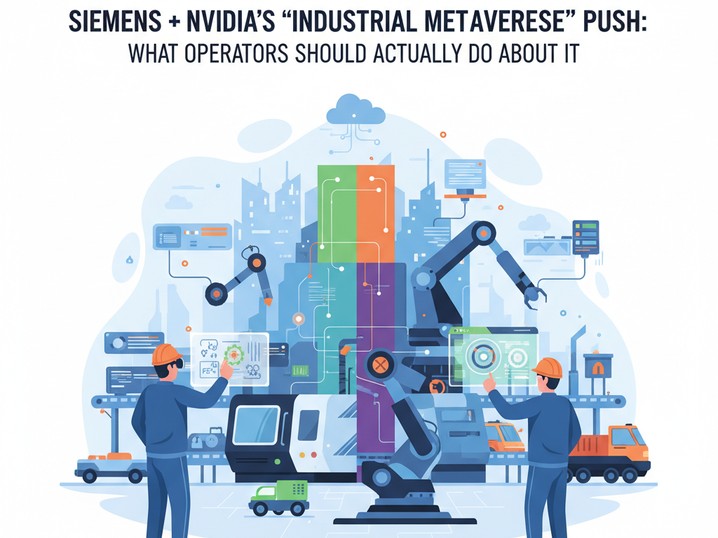

Siemens + Nvidia’s ‘Industrial Metaverse’ Push: What Operators Should Actually Do About It
- Siemens and Nvidia just moved “industrial metaverse” from buzzword to **de facto stack** for AI + digital twins in manufacturing and logistics.[2][6]
- Early deployments (like PepsiCo) are already seeing **20% throughput gains** and **10–15% Capex reductions** from AI-driven digital twins.[4][5]
- For lean operators, the move now is not “buy Siemens,” but **design your data and workflows so they can plug into this emerging standard** within 12–24 months.
---
What Just Happened at CES — In Operator Terms
At CES 2026, Siemens CEO Roland Busch and Nvidia CEO Jensen Huang announced an expanded partnership to build what they call an **“Industrial AI Operating System”** and scale an **“industrial metaverse”** for factories, production, and supply chains.[2][3][6]
Under the hood, that means:
- **Siemens** is bringing its engineering, automation, and digital twin tools (Simcenter, Xcelerator, etc.).[2][6]
- **Nvidia** is providing the full AI and simulation stack (Omniverse, CUDA-X, PhysicsNeMo, GPUs).[1][2][6]
- Together, they’re turning digital twins from **static models** into **“active intelligence”** that can see, predict, and optimize physical operations in real time.[2][6]
This isn’t just a joint press release. Siemens is:
- Launching **Digital Twin Composer**, software to build **industrial metaverse environments at scale** using Siemens’ digital twins plus real-time data, rendered with Nvidia Omniverse.[1][7]
- Committing to **GPU acceleration across its entire simulation portfolio** to deliver 2–10x speedups in key workflows.[2]
- Using its own **Erlangen electronics factory** as the first fully AI-driven, adaptive manufacturing blueprint starting in 2026.[2]
Nvidia, in turn, positions this as the next industrial revolution: “transforming digital twins from passive simulations into the active intelligence of the physical world.”[2]
For us as operators, the question isn’t whether this is “cool.” It’s:
Will this change how we design, operate, and invest in our own systems within the next few budget cycles?
We believe the answer is yes.
---
Why This Matters Even If You Don’t Run a Factory
You may not be PepsiCo or Siemens, but the pattern here is one we’ve seen before.
- In software, **Salesforce + AWS** became the default cloud/CRM backbone.
- In productivity, **Microsoft 365** quietly became the “you must integrate with this” standard.
Siemens + Nvidia are setting themselves up as the **default infrastructure for AI-enabled operations** in the physical world:
- **Digital Twin Composer** lets companies combine 2D/3D design data, process models, and live sensor data into a single photorealistic environment.[1][5]
- That environment becomes a **persistent, high-fidelity 3D representation** of products, processes, and facilities — the core of this “industrial metaverse.”[1][7]
- AI then runs on top of that representation to test scenarios, optimize flows, and flag issues before you touch the real line, warehouse, or route.[1][2][5]
PepsiCo’s early results, using Siemens + Nvidia to model full production environments, are instructive:
“Up to **90% of potential issues** identified virtually before physical changes, **20% throughput increase**, and **10–15% Capex reduction** by uncovering hidden capacity.”[4][5]
Those numbers are not marketing-level fluff; they map directly to the questions our readers ask:
- **Throughput** = revenue and on-time delivery.
- **Capex reduction** = fewer painful “we bought the wrong thing” projects.
- **Issue detection** = less firefighting and weekend rework.
When I’ve been in the room justifying automation spend, the most uncomfortable slide is always the “assumptions” tab in the model. Digital twins plus AI don’t eliminate assumptions, but they shrink the guesswork—and that’s the real budget story here.
---
What “Industrial Metaverse” Really Means in Practice
Let’s strip the metaverse buzzword and translate this to practical capabilities.
Using Siemens + Nvidia’s stack, an operator could:
- **Clone a facility** (or line, or warehouse) in software with physics-accurate behavior.[1][2][5]
- Feed it **live data** from PLCs, sensors, WMS, MES, or ERP systems.[1][5]
- Let **AI agents** run thousands of “what if” experiments on:
- Line layouts
- Staffing shifts
- Maintenance schedules
- Buffer sizes and routing rules
- Automation investments
- Push only the **best-performing changes** back into the real world.
Siemens calls this moving from static models to **dynamic systems that adapt alongside real-world operations**.[5] Nvidia calls the end state **autonomous digital twins** that support real-time optimization.[2]
From an operator perspective, the promise is:
- **Shorter design-to-deploy cycles** for new lines or processes.
- **Lower risk** on capex and layout changes.
- **Continuous micro-optimization** instead of once-a-year reengineering.
- The ability to answer “what if we…” without stopping production.
We’ve seen smaller teams do “mini versions” of this using spreadsheets plus simulation plugins. The Siemens–Nvidia move basically says: the enterprise version of that is coming fast, and it will standardize around their stack.
---
Mini Case: How This Plays Out in a 40-Person Operation
Let’s imagine David, our Head of Operations at a 40-person company with a light manufacturing or kitting operation and a small warehouse.
Today, David probably:
- Designs layout changes in PowerPoint or CAD.
- Runs rough-cut sims in Excel (“what if we add a second packing station?”).
- Justifies investments with a mix of time studies, tribal knowledge, and best-guess models.
In a Siemens–Nvidia world, a realistic near-term path looks like:
- **Digital baseline**
- CAD/plant layout imported into a 3D model.
- Inventory and order data mapped from the WMS/ERP.
- **Simulation environment**
- Machines, conveyors, and routing logic modeled with physics-level accuracy.[1][5]
- Operator paths and constraints captured (breaks, walking speed, ergonomic limits).[4]
- **AI scenario testing**
- AI agents simulate changes:
- Rearranging zones
- Changing replenishment rules
- Tweaking shift patterns
- System surfaces scenarios that increase throughput or cut travel time without extra capex.
- **Operational deployment**
- David runs a limited pilot in one area, with clear before/after KPIs.
- The twin stays “live,” constantly comparing expected vs. actual performance to suggest next tweaks.
This is roughly what PepsiCo is doing, just at different scale: recreating machines, conveyors, pallet routes, and operator paths with physics-level accuracy to identify issues before touching hardware.[4][5]
The key is not that David buys Siemens today. It’s that he:
- Starts **documenting processes and data** in ways that could feed a digital twin later.
- Builds a culture where **data-driven layout and workflow experiments** are normal, not rare.
That’s where we’ve seen teams get the fastest ROI once the heavier tools arrive.
---
Where This Lands on the Hype vs. Reality Spectrum
Based on what we’ve seen and the data so far, we’d frame it like this:
**Verdict:** Plan around Siemens–Nvidia as a *strategic direction*, not an immediate line item—**Pilot, don’t Deploy** (yet), unless you’re already running complex physical operations with >$5M/year in throughput.
**What’s real today**
- **Digital Twin Composer** exists as a product, with mid-2026 availability via Siemens Xcelerator Marketplace.[1][5][7]
- PepsiCo has **measured gains** in throughput and Capex using this stack.[4][5]
- Siemens is using its **own plants** as reference architectures, not just customer logos.[2][3]
**What’s still maturing**
- Vendor claims like “world’s first fully AI-driven adaptive manufacturing sites” are directional, not off-the-shelf.[2]
- Integration into mid-market stacks (typical ERP/WMS/CRM/IoT toolchains) will take time and partner build-out.
- Skill requirements are non-trivial: modeling, data engineering, and change management are still the hard parts.
When we’ve guided teams through similar waves (e.g., early RPA, then cloud analytics), the pattern is consistent: those who **prepare their data and processes early** capture outsized value when tooling matures and prices normalize.
---
If You’re Running a Lean Team: What To Do in the Next 12 Months
Here’s how we’d approach this if we were in your chair, with your constraints.
1. Decide Which Side of the Line You’re On
You’re in one of two camps:
- **Heavy physical operations (Deploy/Pilot region)**
- You manage manufacturing lines, logistics networks, or complex physical workflows where 5–10% efficiency equals six figures or more per year.
- You already use MES, SCADA, WMS, or advanced PLCs.
- **Light or digital-first operations (Plan & Prepare region)**
- Your “factory” is mostly people + SaaS tools (agency, SaaS, services, content, etc.).
- You might have a small warehouse, lab, or workshop, but it’s not the main P&L driver.
If you’re in the first camp and have budget, **start scoping a small digital twin pilot** with your current vendors, making sure they’re tracking the Siemens–Nvidia stack.
If you’re in the second camp, **don’t buy heavy twin tooling yet**—but absolutely prepare.
2. Make Your Operations “Twin-Ready”
Regardless of stack, digital twins live or die on data quality. Over the next 6–12 months, focus on:
- **Standardizing identifiers**
- SKUs, machines, locations, workcells need consistent, unique IDs.
- **Instrumenting key flows**
- Capture timestamps: when work starts, finishes, moves, or blocks.
- **Logging change history**
- When layouts, rules, or staffing change, record what changed and when.
A simple rule we use with teams:
If you can’t replay last month’s operations at the level of “where did time and materials go?”, you’re not ready for a digital twin.
You don’t need Siemens to start that discipline. A mix of your existing systems, a data warehouse, and basic AI analytics will already pay off.
3. Run a “Lite Twin” Pilot With Your Existing Stack
Before you ever touch Nvidia Omniverse, you can simulate aspects of a digital twin using tools you likely already own:
- Use your BI stack (Power BI, Looker, Tableau) plus AI to:
- Simulate staffing changes.
- Model routing changes in your warehouse.
- Test new SLA policies on historical data.
- Use workflow tools (Airtable, Notion, Monday) to:
- Map your actual processes vs. “what’s on paper.”
- Attach cycle times and wait times to each step.
We’ve helped teams build “spreadsheet twins” that uncovered:
- 8–12% hidden capacity in fulfillment without new headcount.
- Entire automation projects that could be downsized or deferred.
Those wins alone can fund future investment in richer simulation platforms.
4. Ask the Right Questions of Vendors
Next time a vendor pitches you anything involving “digital twin,” “industrial AI,” or “metaverse,” use this checklist:
**Vendor Reality Check**
- What **specific metrics** did your last deployment improve? (Throughput, utilization, Capex, Opex)
- Over what **timeframe** and with what **baseline**?
- How do you **integrate with Siemens or Nvidia**, if at all? Roadmap?
- What’s the **time to first useful insight** after contract signing?
- What **internal roles** did your most successful customer need on their side?
- What does **year 2** look like in terms of license, support, and infra costs?
PepsiCo’s reported 20% throughput and 10–15% Capex improvements give you a benchmark: if a vendor in your space can’t at least explain how they approach that kind of impact, be cautious.[4][5]
---
When You Should *Skip* This (For Now)
Despite the hype, there are clear cases where you should **not** rush into industrial metaverse tooling:
- You don’t have **stable, repeatable processes** yet.
- Your data is fragmented, mostly in emails and ad hoc spreadsheets.
- Small improvements (<5%) don’t move your financial needle meaningfully.
- You can still get big gains from **basic automation and analytics**.
In those situations, the better play is:
- Fix process basics.
- Deploy lightweight AI (forecasting, scheduling, routing) on top of existing tools.
- Keep an eye on the Siemens–Nvidia ecosystem, but don’t be an early adopter.
We’ve seen more teams burned by **over-buying infrastructure** than by waiting one more year while strengthening fundamentals.
---
How We’d Brief Your Boss or Co‑Founder
If you need to forward something up the chain, here’s the message we’d stand behind:
Siemens and Nvidia are turning AI + digital twins into the default stack for industrial operations. Early results (PepsiCo) show 20% throughput and 10–15% Capex gains. We don’t need to buy anything yet, but we should:- Make our data and processes “twin-ready” over the next 6–12 months.- Run low-cost “lite twin” simulations with our current tools.- Ensure future vendors can plug into or coexist with the Siemens–Nvidia ecosystem.
That positions you as pragmatic, not dazzled—and sets you up to move fast once the tooling hits your segment and price point.
---
Operator Playbook: 90-Day Actions
If we were running your shop, here’s what we’d do in the next quarter:
- **Map one critical flow end-to-end** (sales-to-ship, order-to-cash, intake-to-delivery).
- **Instrument it** so you can track: start, stop, handoff, rework, wait, and queue times.
- **Run at least three “what if” experiments** on historical data using your BI + AI tools.
- **Document a “twin-ready spec”**:
- Standard IDs
- Data sources
- Required KPIs
- Integration touchpoints
- **Add two questions to every infra/tool RFP:**
- “How does this integrate with digital twin platforms?”
- “What’s your roadmap for Siemens/Nvidia interoperability?”
That way, when Siemens’ Digital Twin Composer and similar tools hit your price and complexity band, you’re not starting from zero.
---
“Industrial AI is no longer a feature; it’s a force that will reshape the next century.” — Roland Busch, Siemens CEO at CES 2026[6]
Our job as operators isn’t to chase that future. It’s to make sure that when it arrives in our segment, **we’re ready to cash it in, not just read about it.**
---
Meta Description
Siemens and Nvidia just turned “industrial metaverse” into a serious AI stack. Here’s what lean operators should do now—and when to skip it.