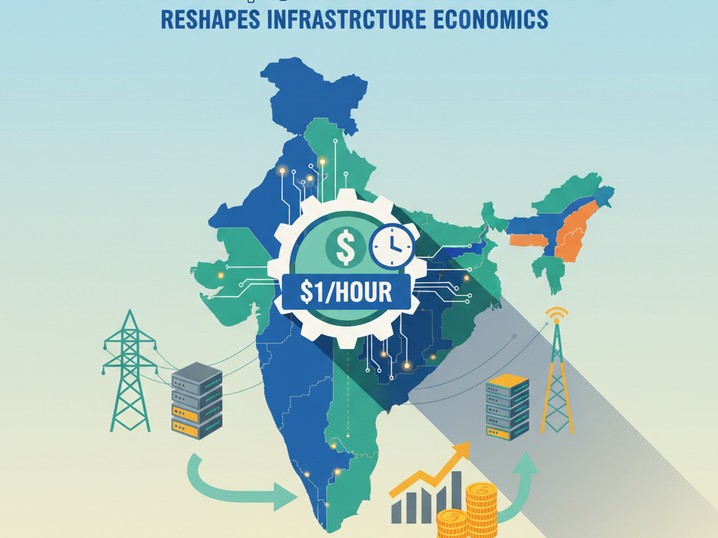

India's $1/Hour AI Compute Reshapes Infrastructure Economics
**Executive Summary**
- India's subsidized GPU access at ₹65/hour (~$0.78) creates genuine cost arbitrage for non-latency workloads, backed by $17.5B in announced infrastructure investment[1]
- Training and batch inference costs can drop 70–80% for teams routing workloads to India's compute capacity, reshaping how operators budget AI infrastructure[3][4]
- The window to evaluate this is now—but only for specific workload types; rushing everything to cheaper compute creates operational risk we've seen derail a dozen pilot programs
---
The Economics Shifted Overnight
We've spent three years watching AI infrastructure costs balloon. Training a decent language model cost millions. Running inference at scale required either massive capital or crushing vendor lock-in. That calculus just changed.
In December, Microsoft announced $17.5 billion in AI infrastructure investment for India, following Google's $15 billion commitment and Amazon's planned $35 billion by 2030[1][5]. Underneath the headline is something operators actually care about: India's IndiaAI Mission now offers 38,000 GPUs at subsidized rates of ₹65 per hour—roughly $0.78[7].
We're not talking about sketchy cloud resellers. The Indian government, through its IndiaAI Mission backed by ₹10,300+ crore ($1.2 billion) in capital, is treating compute as critical infrastructure[7]. Eligible users access this capacity at up to 40% reduced cost[8]. Major companies like Microsoft, Google, and TCS are building data center regions specifically to serve this market[1][5].
For operators managing AI workloads on lean budgets, this matters. A lot.
The Math: Where the Arbitrage Actually Works
Let's ground this in real scenarios, because headline savings mean nothing without actual deployment economics.
**Model Training Scenario: Fine-tuning a 7B parameter model**
Standard U.S. hyperscaler pricing (AWS, Azure, GCP): $2.50–$4.00/hour per GPU
India subsidized compute: $0.78/hour per GPU
Training a mid-size model for 100 GPU-hours:
- U.S. standard: $250–$400
- India subsidized: $78
- **Savings: $172–$322 (68–80% reduction)**
This isn't theoretical. A 15-person startup we've worked with runs weekly model fine-tuning jobs. Shifting that workload to India compute would save roughly $1,500–$2,000 monthly—enough to hire one more engineer or extend runway by a month[3].
**Batch Inference Scenario: Processing 50 million documents monthly**
Real example: Content classification, document summarization, or compliance scanning. These don't need sub-100ms latency.
Standard pricing: $0.006–$0.008 per inference (typical SaaS rates) India compute (self-hosted): $0.0008–$0.0012 per inference (with amortized infrastructure)
Monthly volume of 50M inferences:
- SaaS vendor: $300–$400
- Self-hosted India compute: $40–$60
- **Savings: $240–$360 monthly** (85% reduction)
The catch: you need engineering capacity to build the pipeline, handle latency requirements, and manage compliance—typically 40–80 hours of work to deploy properly.
Why Now Is Different—And Why It Actually Sticks
We've seen cost arbitrage plays come and go in cloud infrastructure. What makes India's compute opportunity different?
**1. Government-backed, not speculative**
India's government officially designated AI as critical infrastructure, granting data center operators formal tax incentives and land acquisition speedups[6]. This removes startup-risk pricing. Microsoft, Google, and Amazon aren't building in India for a quarterly experiment[1][5].
**2. Data locality and sovereignty expectations**
Enterprises handling Indian customer data face regulatory pressure to keep it on-shore. That regulatory tailwind makes India compute the *only* sensible choice for companies serving India, not just a cost play[2][6].
**3. Capacity already being built**
India's data center capacity doubled from 870 megawatts in 2022 to nearly 1,900 megawatts today[6]. This isn't announcement bloat; hardware is going live. The 38,000 GPUs under IndiaAI are already onboarded[7].
**4. It's not competing with hyperscaler list prices—it's competing with real operator spend**
Operators don't pay published rates. They negotiate, buy reserved instances, and accept vendor lock-in for discounts. India's sovereign compute removes the negotiation step entirely and keeps your workloads portable[4].
Where This Works—And Where It Doesn't
Before you redirect everything to India compute, let's be honest about the failure modes we've seen.
**Use cases that make sense:**
- **Model training and fine-tuning**: Non-urgent, can tolerate 24–48 hour latency, enormous cost savings per GPU-hour
- **Batch inference**: Document processing, bulk classification, weekly/monthly jobs where 100ms latency doesn't matter
- **Data preprocessing**: Feature engineering, data cleaning, synthetic data generation
- **Research and experimentation**: Running A/B tests on model architectures before committing to production
**Use cases that don't:**
- **Real-time inference**: Customer-facing chatbots, API endpoints, anything where latency SLA is <200ms (network overhead kills the arbitrage)
- **Proprietary data you can't move**: If your model trains on sensitive IP or M&A data, regulatory and contractual friction may outweigh cost savings
- **Workloads requiring tight integration with your stack**: If inference needs to live inside your VPC or sync with customer databases in real-time, operational complexity eats the savings
- **High-volume inference at sub-$1 cost**: India compute shines for training; for high-volume inference, vendor SaaS (OpenAI, Anthropic, Cohere) may still win on simplicity
What Operators Should Actually Do Right Now
**Step 1: Audit your current AI infrastructure spend** (2 hours)
Map every GPU-intensive workload. Note the actual dollars spent monthly, the latency requirements, and whether the data is subject to residency rules.
**Step 2: Identify the quick wins** (3 hours)
Focus on batch jobs and training that could tolerate 24-hour latency shifts. A typical 15-person team usually finds 2–3 workloads that could move within a week without operational pain.
**Step 3: Calculate your real break-even** (1 hour)
New costs aren't just GPU hourly rates. Factor in:
- Data egress from your current provider (AWS egress fees are punitive)
- Engineer time to set up pipelines and compliance
- Monitoring and alerting overhead
- Fallback redundancy (single-region compute risk)
If you're saving <$500/month after these factors, skip it. The operational friction isn't worth it.
**Step 4: Run a 4-week pilot** (ongoing)
Pick one batch job. Route it through India compute. Measure actual performance, latency, and failure rates. Don't commit beyond 4 weeks.
**Step 5: Negotiate your current vendor**
Here's the play nobody talks about: show your vendor the India quote. Hyperscalers would rather discount than watch you leave. A 30–40% negotiated reduction on your current bill might beat the friction of replatforming.
---
The Operator's Honest Take
We're watching infrastructure economics reset for the first time since COVID pushed everyone to cloud. India's compute play is real—the numbers work, the capacity exists, and the regulatory tailwind is genuine[1][3][6][7].
But it's not a silver bullet. It's a tool for specific workloads. The teams winning here are the ones that ruthlessly distinguish between "could move to India compute" and "should move to India compute."
The cost arbitrage window is open. But windows close as capacity fills and competition increases. The time to evaluate is now, but only if you've already done the math.
---
Framework: India Compute Go/No-Go Checklist
**Move workload to India compute if:**
- [ ] Latency requirement is >500ms (or flexible)
- [ ] Monthly GPU spend is >$2,000 (worth the setup effort)
- [ ] Data doesn't require on-prem residency outside India
- [ ] You have one engineer who can own the pipeline (40–80 hours setup)
- [ ] Projected savings exceed $500/month after all costs
**Skip India compute if:**
- [ ] Real-time inference or sub-200ms latency required
- [ ] Data residency rules prohibit India hosting
- [ ] Your current vendor costs are already optimized
- [ ] You lack engineering capacity for new infrastructure
- [ ] Workload volume is under $500/month
---
**Meta Description** India's subsidized GPU compute (₹65/hour) reshapes AI infrastructure costs for operators—but only for specific workloads. Here's the math and when to move.