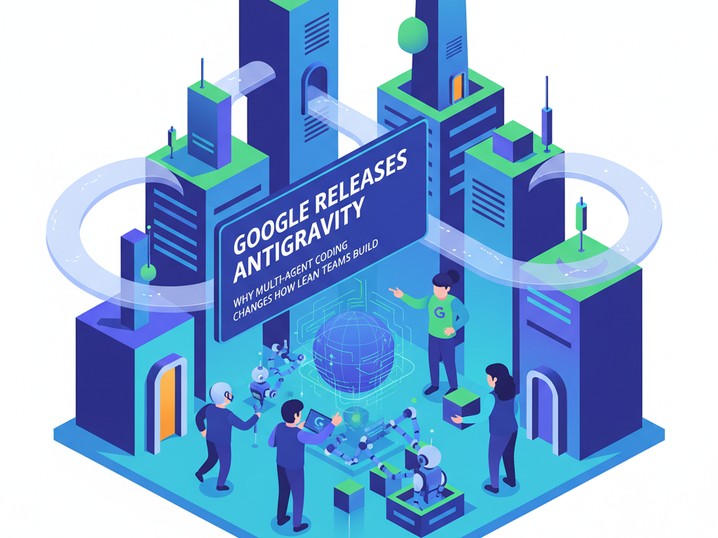

Google Releases Antigravity: Why Multi-Agent Coding Changes How Lean Teams Build
**Executive Summary**
- Google Antigravity automates entire coding workflows—planning, writing, testing, debugging—eliminating manual context-switching that costs dev teams 10-15 hours weekly[1][2]
- Free tier removes budget friction for 5-50 person teams testing multi-agent collaboration; pay-as-you-go scales without upfront commitment[2]
- Deploy within days for scaffolding new projects, refactoring legacy code, and fixing bugs across large codebases—but not for novel architecture decisions where human judgment still owns the verdict[1]
---
The Operator Problem: Your Developer Is Stuck in Context Hell
We've all watched it happen. Your engineer starts the day with a clear task—"refactor the authentication module" or "build a todo list with a real-time database." But by noon, they're toggling between the editor, the browser, the terminal, the docs, back to the editor again. They're not thinking about the code. They're managing the plumbing.
That whiplash isn't laziness. It's the reality of modern development: **one engineer, five cognitive contexts, zero margin for parallel work**.
When your team is lean—maybe two engineers, maybe one—that context tax is devastating. A developer spending 40% of their week switching between tools is a developer shipping 40% slower.
This week, Google introduced **Google Antigravity**, and it directly addresses this friction[1]. Not as another sidebar chatbot. As a full rethinking of the IDE itself.
---
What Antigravity Actually Does (For Non-Engineers)
Think of Antigravity as "Mission Control for code"[3].
Traditional AI coding assistants hand you autocomplete. Antigravity goes further: **you describe what you want, and multiple AI agents plan, build, test, and verify it autonomously**[1][2].
Here's how it works:
**The delegation loop:**
- You write a high-level task: "Create a Python game with scoring logic and collision detection"[1]
- The agent analyzes your codebase, breaks the task into steps, and drafts an implementation plan[3]
- You review the plan (not hundreds of lines of code—a structured artifact)[3]
- If it looks right, the agent writes the code, runs it in the browser, tests the features, and surfaces any issues[1]
- You see results. Not raw terminal output. Artifacts: screenshots, recordings, test reports[2]
**What makes this different from Cursor or GitHub Copilot:**
| Feature | Traditional Coding Assistant | Antigravity | |---------|------------------------------|-------------| | How it helps | Autocomplete, code suggestions | Autonomous planning & end-to-end execution | | What you manage | Every line of code | High-level task approval | | Testing workflow | Manual (editor → browser → repeat) | Automatic (built-in browser integration) | | Multi-file changes | One file at a time | Coordinated across entire project | | Parallel work | Chatbot is linear | Multiple agents work simultaneously[3] |
---
Where This Saves Real Time (And Money)
Here's the unvarnished math:
**Scenario: Refactor a 10-file codebase for a new authentication provider.**
- Traditional workflow: 16-20 hours (planning, writing, testing edge cases, debugging)[1]
- Antigravity workflow: 4-6 hours (high-level direction, three reviews, verification)[1]
**That's not a 20% win. That's a 70-80% compression.**
For a bootstrapped founder paying $120/hour for contractor support, that's $1,000+ saved per refactor. For a VP running a lean engineering team of three, that's nearly a sprint week recovered.
The platform shines on:
- **UI generation from plain-language descriptions**—no more hand-coding React layouts[1]
- **Multi-file refactoring**—updating patterns across your entire codebase in one go[1]
- **Fixing bugs at scale**—the agent analyzes the issue, proposes patches, tests them, all without your involvement[1]
- **Scaffolding new projects**—spin up boilerplate, database schemas, and API structure in minutes instead of hours[1]
"The agent can autonomously plan and execute the task across the editor, terminal, and browser."[2]
---
The Honest Catch: What Antigravity Can't Do Yet
This isn't a silver bullet. And if we're talking ROI, we need to name the limits.
**Where it still needs humans:**
- **Architectural decisions** — Should we use PostgreSQL or MongoDB? Should this be a microservice? Antigravity can't own those choices. You can[1]
- **Novel problems** — If you're building something nobody's built before, an agent trained on GitHub will struggle to invent from scratch[1]
- **Security-critical code** — Bank authentication, payment processing, encryption protocols—you'll want human review before pushing to production, not just agent verification[1]
- **Domain-specific logic** — Rules unique to your business (your pricing model, your compliance requirements) still need human translation into code[1]
**Practical friction:**
- Setup takes 15-30 minutes for your first project[3]
- Agents generate code you'll want to review carefully the first few times[3]
- If your codebase is truly chaotic (no file structure, mixed languages, no tests), agents struggle to reason about it[1]
---
Pricing and Access: The No-Brainer Part
Google Antigravity is **free for individuals**[2]. No credit card to test. No trial clock ticking.
You can:
- Download it for MacOS, Windows, or Linux[2]
- Run it locally without a cloud account[2]
- Start building immediately without procurement friction[2]
For teams, it supports multiple agent instances working in parallel[3]. Generous rate limits on Gemini 3 Pro, plus support for Claude Sonnet 4.5 and OpenAI's GPT-4o if you want model optionality[2].
Translation: **You can pilot this inside a week with zero financial risk.**
---
The Operator's Roadmap: When to Deploy This
**Deploy now if:**
- You have a legacy codebase you've been meaning to refactor (but deprioritized because of time)
- You're spinning up a new internal tool or side project
- You need to scaffold boilerplate faster than your team can write it
- You're short on senior engineers and need to amplify the work of your existing team
**Pilot in 2 weeks if:**
- Your primary codebase is production-critical and you want human eyes on agent-generated code first
- Your team has never worked with agentic development and needs a learning curve
- You're curious about the productivity unlock but unsure about ROI
**Skip for now if:**
- Your codebase is so unique or so poorly documented that agents will produce garbage
- Your team is already shipping at velocity and you don't have the mental cycles to experiment
- You're building something that requires cryptographic certainty (no room for learning curve mistakes)
---
How to Start: Three Actions for Monday
**1. Download and spend 30 minutes with a test project**
Pick something low-stakes: a todo app, a scraper, a data pipeline. See how the agent handles it. Notice how it feels to delegate instead of code[3].
**2. Draft one real task you'd like to automate**
Don't overthink it. "Refactor our user authentication" or "build an admin dashboard for our reporting tool." Something that's on your backlog, takes 10-15 hours, and isn't mission-critical.
**3. Loop in your most curious engineer**
Agentic development is new. Your team needs to build intuition about what agents can and can't do. The engineer who's excited to experiment will be your internal champion[3].
---
The Bigger Picture: Why This Matters Right Now
Google isn't releasing Antigravity because LLMs got smarter. They're releasing it because **the development bottleneck shifted**[1].
For years, the bottleneck was autocomplete. "How do I write this faster?"
Now it's orchestration. "How do I coordinate 10 different tasks in parallel without losing my mind?"
Lean teams have always punched above their weight by moving fast and staying ruthless about what matters. Antigravity is a force multiplier for exactly that operation: fewer people, more output, less friction.
It's also a proof point that AI is moving from "helpful assistant" to "actual leverage." Not hype. Not "AI will replace developers." Just: **your engineer now has more mental energy for the problems that actually require judgment.**
---
What Comes Next
Watch how Google iterates on the Agent Manager—the dashboard for orchestrating multiple agents on different tasks[3]. As that gets more sophisticated, the leverage increases. You'll be able to spawn five agents on five different bugs and check back in an hour.
That's when the time savings become genuinely transformative for small teams.
For now, the signal is clear: **download it, test it, and treat the next two weeks as intelligence gathering**. You're not committing to anything. You're collecting real data on whether multi-agent development actually moves the needle for your business.
And in a market where every hour counts, that intelligence is worth the 30-minute setup cost.
---
**Meta Description:** Google Antigravity automates coding workflows across planning, building, and testing. Here's how lean teams extract real ROI without budget friction.