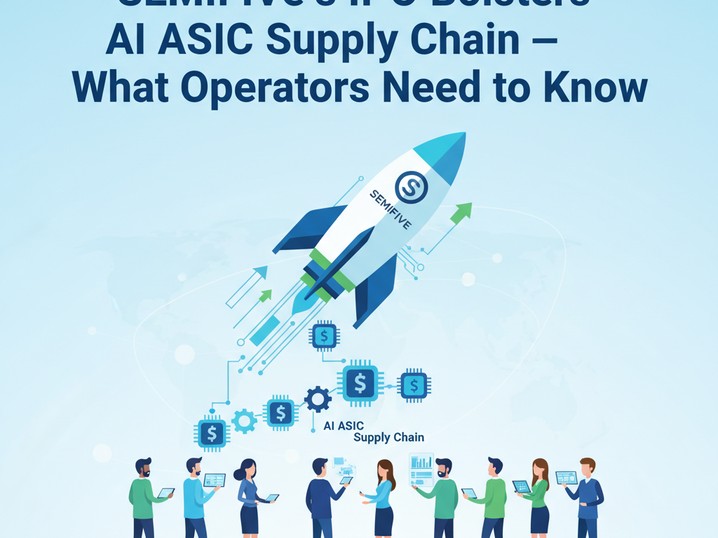

SEMIFIVE's IPO Bolsters AI ASIC Supply Chain — What Operators Need to Know
**Executive Summary**
- SEMIFIVE's KOSDAQ IPO (Dec 17, 2025) unlocks $400M+ in capacity to produce custom AI chips at 2nm–4nm nodes, directly addressing the chip bottleneck most lean teams don't yet see coming.
- The company's platformized design approach reduces ASIC development cycles by 50% and cuts entry costs—meaning your small team can now commission specialized hardware that previously required enterprise-scale resources.
- For operators running AI-driven workflows, this shifts the calculus: instead of waiting for Nvidia's next GPU batch or overpaying for overkill compute, you can now custom-build inference chips for specific workloads within months, not years.
---
The Chip Shortage Nobody's Talking About
We've all felt the GPU crunch. Your team needs compute capacity. You wait weeks for spot instances. Your cloud bill balloons because you're running inference on GPUs sized for training. You watch competitors with deeper pockets snap up H100s while you're squeezed into whatever's available on the secondary market.
But here's what's actually happening below the surface: **the bottleneck isn't GPUs. It's custom silicon.**
Thousands of startups—from AI fabless firms building domain-specific chips to device manufacturers embedding models into edge hardware—are stuck in a nightmare scenario. They can't use off-the-shelf GPUs because their workload (say, real-time video inference at <5W power) demands a bespoke chip. But commissioning a custom ASIC typically takes 18–24 months, costs $5M–$50M, and requires teams of specialist engineers most startups don't have.
Result: they either abandon the hardware play entirely or they overspend on generic solutions that don't fit their use case.
SEMIFIVE's IPO doesn't fix GPUs. It fixes something quieter and more important—**access to custom silicon.**[1][2]
---
The Core Problem SEMIFIVE Solves
Custom chip design has always been a rich person's game. You need IP architects, physical design engineers, verification specialists, and 18 months to reach production. For a team of 20, this is off the table.
SEMIFIVE's bet is different: **platformize chip design the way TSMC platformized manufacturing.**[2]
Instead of designing from scratch, SEMIFIVE's customers (fabless companies, device makers, AI startups) use a modular design platform—think of it as Figma for chips. Reusable building blocks (CPUs, memory controllers, high-speed interfaces, custom accelerators) snap together via automation. The company's proprietary "Design Automation Engine" stitches modules together, handles verification, and cuts development cycles from 18–24 months to **9–12 months, often closer to 6 for simpler designs.**[2]
What does that actually mean for a lean operator?
**A concrete scenario:** You're running a Series A AI safety company. Your LLM inference stack needs ultra-low latency on proprietary model weights. Standard cloud GPUs are overkill and expensive. With SEMIFIVE's platform, you can:
- Define your chip specs in Q1
- Use pre-validated IP blocks (memory, PCIe, custom accelerator tiles)
- Hit production samples by Q3
- Begin small-volume mass production via SEMIFIVE's foundry relationships by Q4
That's 9 months to production silicon. Compare that to the traditional 24-month slog, and the ROI math shifts entirely. You're not waiting for the market to ship you what you need—you're shipping it yourself.
---
Why This IPO Timing Matters Right Now
SEMIFIVE's Dec 2025 IPO raise signals something deliberate: **the market is ready to fund custom AI chip capacity, not just model innovation.**[1][3]
The numbers are stark. SEMIFIVE grew revenue 57% year-over-year in 2024, with revenue from advanced-node processes (2nm–4nm) surging dramatically.[3] The company is already profitable at small scale and operating globally—it has subsidiaries in Tokyo, design centers across the US and Europe, and partnerships spanning South Korea (HyperAccel, Hanwha Vision), China, and India.[2]
The IPO isn't about survival. It's about **scaling production capacity to meet a wave of demand the market knows is coming.**
"Just as TSMC has platformized semiconductor manufacturing, SEMIFIVE is lowering barriers to entry by platformizing semiconductor design, enabling anyone to develop AI semiconductors quickly and easily."[2]
That quote from CEO Brandon Cho isn't marketing fluff—it's a declaration of what's about to shift. When custom chips stop being a luxury and start being table stakes, the teams that can iterate fastest win.
We've seen this before. The shift from custom server builds to cloud compute was about democratization. The shift from cloud VMs to managed AI services was about abstraction. This shift—from monolithic GPU inference to custom silicon—is about **control and efficiency at scale.**
---
What This Means for Your Buying Decisions (And Your Stack)
Let's be direct: this doesn't immediately change your life if you're running a 10-person SaaS company on a $500/month Azure budget.
**But it changes everything if you're:**
- Building inference infrastructure for edge deployment (IoT, robotics, surveillance)
- Running high-volume LLM inference where GPU costs are eating margins
- Operating in regulated spaces (healthcare, finance) where data residency and custom compliance hardware matter
- Scaling to 100M+ API calls/month where unit economics force you to own silicon
Here's the operator calculus:
| **Your Situation** | **Old Path (2023–2024)** | **New Path (2025+)** | |---|---|---| | Edge AI chips for robotics | Wait for Nvidia Jetson refresh, overpay for general-purpose compute | Commission custom 4nm chip via SEMIFIVE in 9 months, cut power by 60% | | High-volume LLM inference | Run on GPUs, accept 40% cloud margin bleed | Build inference-optimized ASIC, own margin, amortize over 3 years | | Compliance-driven deployment | Wait for vendor certifications, buy off-the-shelf | Embed compliance logic into custom chip architecture, zero vendor lock-in | | Time-to-market for new hardware | 24–36 months | 9–12 months |
---
The Supply Chain Domino Effect
Here's what most operators haven't connected yet: **SEMIFIVE's capacity expansion unlocks downstream competition.**
Right now, Broadcom and TSMC's internal teams handle most high-value custom ASIC work. They're selective about customers—typically $10M+ annual commitments.
SEMIFIVE operates at lower minimums, faster cycles, and lower risk for startups. As their IPO capital flows into design centers, fab partnerships, and IP acquisition, they're not just adding capacity—they're redistributing it downmarket.[1][2]
This means:
- **More competition for Nvidia's edge AI dominance.** Custom inference chips will start outperforming GPUs on power/cost/latency for specific workloads.
- **Faster product cycles.** Teams that used to spend 18 months on hardware can now iterate in 6-9 month sprints.
- **Lower barrier to hardware play.** If you're a Series A AI startup, commissioning a custom chip is now a legitimate path forward, not a fantasy.
We're already seeing signals. SEMIFIVE's customers include Furiosa AI, Rebellions, and HyperAccel—all building inference-focused ASICs for production deployment.[2] Each one is eating into GPU market share in niche segments.
---
How to Think About This Strategically
**Timing question:** Should you commission a custom chip today?
Honest answer: **not yet for most.** You're probably better off iterating on cloud compute until your workload is locked and your volumes are predictable. Commissioning silicon too early locks you into architecture decisions that might become obsolete.
**But** if you're 12–18 months out from needing production-scale hardware, this is your signal to start conversations with SEMIFIVE or similar players.
**Operator checklist—should you explore custom silicon?**
- Is your current inference infrastructure costing >25% of monthly gross margin?
- Do you have workload-specific demands (custom ops, embedded compliance, extreme latency requirements) that off-the-shelf hardware can't solve?
- Are you at >100M tokens/month or equivalent scale?
- Is time-to-market for custom hardware worth 9 months of engineering focus?
- Can you commit to 5K–50K units annually for 2–3 years?
If three or more are yes, SEMIFIVE's platform is worth a conversation.
**If you're skeptical:** talk to their existing customers (Furiosa AI, Rebellions, HyperAccel). These aren't marquee names, but they're shipping volume. That's the proof point.
---
Operator Takeaway: Move Before It Becomes Obvious
SEMIFIVE's IPO is the moment when the infrastructure shift from "specialized advantage" to "table stakes" begins. In 12 months, custom inference chips will be normalized enough that venture investors will start asking why you haven't commissioned one.
Here's what we'd do:
- **Audit your current compute spend.** If cloud inference is >20% of COGS, model the ROI on a custom chip. SEMIFIVE's design-to-production cycle is now fast enough that the math works for many teams.
- **Lock your workload specifications.** Don't commission silicon until your model architecture, batch sizes, and deployment environment are stable. Changing these mid-production is where projects crater.
- **Start relationships now.** Even if you don't build a chip in 2026, understanding SEMIFIVE's design process, timelines, and cost structure positions you to act decisively when you're ready.
- **Watch the competitive ecosystem.** Furiosa AI, Rebellions, and HyperAccel are shipping inference ASICs. They're your real competitors now, not just other software vendors. Study what they're doing.
The hardware wave isn't coming—it's here. We're just in the early innings of seeing lean teams use custom silicon to punch above their weight. SEMIFIVE's IPO is the signal that this path is now real, funded, and de-risked enough for operators to consider.
If you're running on margins, this shift is your opportunity. Don't wait until it's obvious to everyone else.
---
**Meta Description:** SEMIFIVE's Dec 2025 IPO unlocks custom AI chip capacity at lower costs and faster timelines—shifting how lean teams approach inference infrastructure. Here's what operators need to know before the shift becomes obvious.