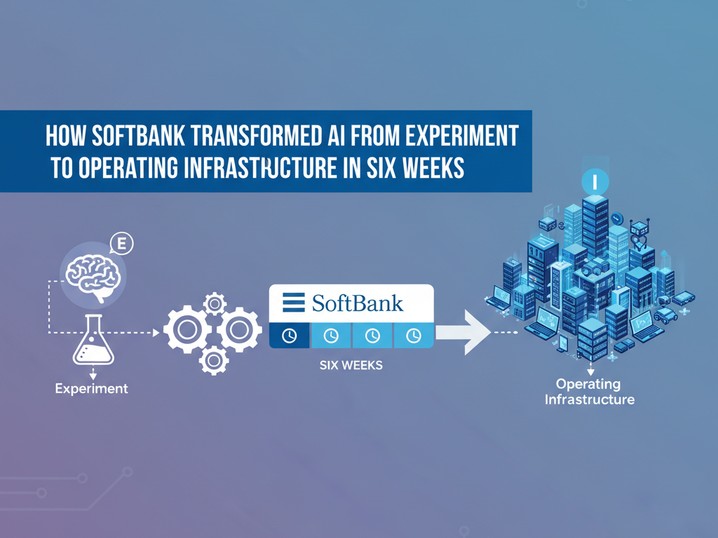

How SoftBank Transformed AI From Experiment to Operating Infrastructure in Six Weeks
**Executive Summary**
- SoftBank deployed a company-wide "100 agents per person" challenge and saw 20,000 employees create 900,000 AI agents in six weeks—proving rapid, scaled adoption is possible.[2]
- The real lesson isn't the headline number; it's the operational framework: time-boxed sprints, templates, shared workflows, and clear incentives unlock AI faster than gradual rollout.
- For operators running lean teams, this model offers a playbook to move AI from pilot phase into core infrastructure—without waiting for consensus or hiring specialists.
---
Why This Moment Matters for Your Team
We've all been there: leadership approves an AI pilot, a few team members experiment, months pass, and adoption flatlines. Meanwhile, competitors are shipping.
What SoftBank just proved is that the bottleneck isn't technology—it's orchestration.[2] When you give people templates, time, and clear objectives, adoption moves at a different pace entirely.
Junichi Miyakawa, SoftBank Corp's President & CEO, framed it plainly at their July 2025 event: "We showed how easy it is to build an AI agent in ten minutes. We then challenged every employee to create 100 agents by the end of August. In six weeks, 20,000 employees created 900,000 agents."[2]
The gap between those two numbers—from "we made it easy to build" to "900,000 deployed"—is the real story. And it's replicable for teams far smaller than SoftBank.
What Actually Happened: Beyond the Headline
Let's strip away the scale for a moment. Yes, 900,000 sounds abstract. What matters is the structure underneath.
SoftBank didn't ask employees to innovate. They issued a specific constraint: **100 agents per person in a defined timeframe**. That's not a suggestion—it's a system.[2]
Here's what that discipline meant in practice:
**Clear scope.** Employees weren't asked to solve AI adoption broadly. They were asked to build a specific number of agents using provided tools and frameworks.
**Shared infrastructure.** The organization provided templates, libraries of pre-built workflows, and access to AI platforms. No one started from zero. This removed the "where do I even begin?" friction that kills most initiatives.
**Time-bounded execution.** Six weeks creates urgency without paralysis. Long enough to learn and iterate, short enough to prevent scope creep or abandonment.
**Visible progress.** In a company of 63,000, when 20,000 employees are each building agents, it becomes visible. Peer pressure and curiosity do real work.[1]
For operators, here's the implication: **scale doesn't require sophistication. It requires structure.**
Why Agents, Not Generic "AI Adoption"
SoftBank's focus on agents—not just ChatGPT access or general "AI literacy"—matters because agents are *task-specific*.
An agent handles customer service conversations, automatically routing requests and pulling data.[2] Another automates presentation slide creation from messy notes. Another manages data enrichment workflows.
Unlike a LLM chatbot that's useful for broad Q&A, an agent performs work. It's more like hiring someone to do a specific job over and over.
From an operator's perspective, this distinction is crucial: **agents map to workflows you actually run**. A sales team doesn't benefit from "AI training." They benefit from agents that qualify leads, enrich prospect data, or draft follow-ups in your CRM.
When SoftBank asked employees to build 100 agents, they were functionally asking: "What routine tasks in your job could you hand off to software?" That's a framework that translates to any team.
The ROI Math That Makes This Real
Let's ground this in numbers your CFO understands.
SoftBank's partnership with Correlation One showed measurable returns: portfolio companies implementing the AI skills program saw an estimated **$24 million annual cost savings** from completed AI use-case projects.[1] One winning team's recommendation alone was valued at that figure.
The mechanism: employees across SoftBank built agents that automated repetitive work. When an agent replaces a human-hours task—a weekly report, a routine customer service interaction, a data reconciliation process—the math is immediate.
If one agent saves a single employee five hours per month, across a 100-person team:
- 100 agents × 5 hours = 500 hours/month
- 500 hours × $60/hr fully-loaded = $30,000/month
- $30,000 × 12 = $360,000/year per team
Scaling to multiple teams, the compounding effect becomes significant. And critically, **the cost of building the agent is typically one-time or minimal** if you're using no-code platforms or internal AI tools.[2]
Your CFO will want three things: labor hours saved, monthly recurring cost (near zero if internal), and payback timeline (weeks to months). This model delivers all three.
The Framework: How to Run This in Your Organization
We've guided teams through rapid AI rollout. Here's what works:
**1. Identify the constraint first.**
Don't ask "how much AI should we do?" Ask "what specific repetitive tasks are killing our team's week?" For a sales team: lead qualification, proposal drafting. For ops: invoice processing, scheduling. For marketing: content outlines, competitor research.
Be ruthless about specificity. One clear use case beats ten vague ambitions.
**2. Build templates, not from-scratch.**
The hardest part of any automation isn't the concept—it's the first 20% of execution. Use industry-standard templates or hire someone for two weeks to build 4-5 starter agents your team can fork.
SoftBank didn't ask employees to invent from nothing. They provided the scaffolding.[2]
**3. Set a time-boxed target, not a vague goal.**
"Adopt AI" dies. "Build 10 agents by March 1st" lives.
The specificity creates accountability. It also makes failure obvious (you hit 6 agents; you learn why the last 4 stalled). Vague goals hide failure.
**4. Make it visible.**
Weekly standups where teams demo agents. Leaderboards if your culture supports it. Showcase one successful agent every Friday.
Social proof and peer competition are underrated forces in adoption.
**5. Measure and reward outcomes, not effort.**
Two agents that save 50 hours/month beat 20 agents that save five hours total. Reward for impact, not volume.
When This Approach Stalls (And How to Recover)
We'd be remiss not to flag the failure modes we've seen:
**"We built agents but no one uses them."**
Agents fail when they don't integrate into the actual workflow. If your team has to switch windows or copy-paste, adoption drops 80%. Build agents *into* the tools your team already uses: Slack, Salesforce, your internal documentation. Frictionless access is non-negotiable.
**"We burned out our engineers building custom logic."**
The SoftBank model scales because employees build agents using templates and no-code platforms—not custom code. If you're asking engineers to hand-code every agent, you've built a scarcity bottleneck. Use platforms with guardrails: OpenAI's Agent API, LangChain templates, or purpose-built agent platforms.
**"Agents went stale after month two."**
Agents require maintenance. As processes change, agents break. Budget for quarterly audits and monthly refresh cycles, not fire-and-forget deployment.
**"We didn't measure before, so we can't measure after."**
This is the biggest miss. Before rolling out agents, establish a baseline: How long does the task take now? How many errors? How many person-hours monthly? Then measure the same metrics after. Anecdotal wins feel good; comparative metrics drive budgets.
Your Next Move: A 60-Day Playbook
**Week 1-2: Audit and design.**
Map your team's top five repetitive tasks. Pick the highest-ROI target. Document the current process (yes, actually write it down). Estimate time and cost savings.
**Week 3-4: Build or acquire templates.**
Either work with a platform to set up a starter agent, or hire a contractor for two weeks to build a reusable template your team can modify.
**Week 5-6: Launch small, measure relentlessly.**
Deploy the agent to two power users. Let them stress-test. Measure hours saved, errors caught, workflows improved.
**Week 7-8: Iterate based on feedback, then broaden.**
Fix the obvious breaks. Then invite the full team to build variants using the template. Set a 60-day goal: "We'll have 10 operational agents by end of Q1."
**Week 9+: Measure, celebrate, scale.**
Monthly standups. Highlight the agents saving the most time. Invest the savings back into expanding the program.
The Broader Shift
SoftBank's achievement wasn't technological. It was organizational.
They proved that **systematic, time-boxed AI rollout beats organic adoption every time**. Constraints focus energy. Structure beats aspiration.
For operators like you, running lean teams where every hour counts, this framework is permission to move faster than your bigger competitors. You don't need every employee in the world building agents. You need your 15 or 50 people each shipping two or three agents that directly impact your bottom line in the next 60 days.
The bottleneck was never the AI. It's always been orchestration.
---
**Meta Description:** SoftBank deployed 900K AI agents in 6 weeks using a structured framework, not technology. Here's how to replicate it in your lean team—with templates, time-boxing, and clear ROI.