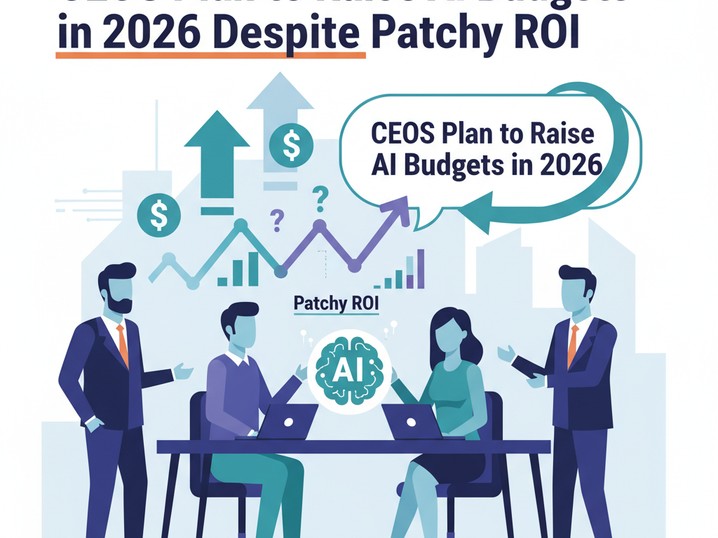

CEOs Plan to Raise AI Budgets in 2026 Despite Patchy ROI
**What You Need to Know**
- 69% of CEOs are carving 10–20% of their budgets for AI in 2026, treating it as core infrastructure rather than optional spend[1][5]
- Only 54% report measurable "operational efficiency gains"—yet investment is accelerating anyway[3]
- This spending momentum means your competitive baseline will keep rising in 2026 whether your rivals see clean ROI or not
- The real operator question shifts from "Should we do AI?" to "Which AI initiatives actually move the needle?"
---
We've watched this pattern before. A capability gets overhyped. Executives panic about missing out. Budget allocations follow. Then comes the hard part: the work actually has to pay off.
That's where we sit with AI in early 2026.
The data is clear. Across enterprise, healthcare, and mid-market leadership, nearly 70% of CEOs plan to double down on AI spending—allocating between 10 and 20 percent of their budgets over the next 12 months[1]. That's not tentative exploration. That's core infrastructure treatment. The message is unambiguous: AI is no longer optional.
But here's the friction we're navigating with founders and operators we talk to every week: the ROI case isn't particularly clean. Only 54% of organizations report significant operational efficiency gains as their main return[3]. The rest are either still piloting, measuring soft outcomes, or quietly accepting that their AI bets haven't yet delivered the cost savings or speed improvements they pitched.
Yet spending isn't stopping. If anything, it's accelerating.
That matters strategically. It means 2026 won't be the year AI investments moderate or stall. It means your competitors—even the ones with patchy pilots—will keep automating workflows, building better data foundations, and training teams on AI-native processes. Your baseline for staying competitive keeps rising regardless of whether their first wave of AI projects broke even.
So what's the operator move?
The Strategic Stakes for Lean Teams
We talk to VPs and founders who feel caught between two pressures. There's pressure from above—boards, stakeholders, competitive anxiety—demanding AI initiatives. And there's pressure from below—teams already stretched, budgets already tight—asking which AI projects actually move revenue or reduce cost.
The problem is that both pressures are legitimate. Executives investing in AI right now aren't all making irrational bets. Many have seen real wins in narrow, high-leverage workflows. Automated lead qualification. Smarter content routing. Faster document processing. But they're also investing in broader AI capability because they sense—rightly—that the gap between AI-capable and AI-naive organizations is widening.
For operators running 10 to 50-person teams, the strategic question is no longer "Do we invest?" It's "What do we invest in, and how do we avoid the 70% of pilots that generate no measurable return?"
This year's spending momentum creates two scenarios for 2026:
**Scenario A: You pick the right 2–3 workflows to automate end-to-end.** You see 20–30% time savings in those areas, compound the wins, and build a small-but-real AI-native operational advantage. Your team moves faster, costs stay flat or decline, and you gain leverage in hiring and competitive positioning.
**Scenario B: You spread AI spend across multiple pilots.** Lead scoring, content generation, customer support research, workflow automation—all getting 10% of your budget. Some work. Most don't. By Q3, you've spent 15% of operational budget with unclear returns, and your team views "AI" as another failed software bet.
Most operators we speak to are closer to Scenario B than they want to admit. And the data suggests they're not alone—35% of CEOs now cite AI integration itself as a "key challenge driving short-term decision-making"[2].
The Hidden ROI Problem (And Why Leadership Keeps Investing Anyway)
Here's where the narrative gets interesting. Most CEOs increasing AI budgets aren't betting on immediate payoff. They're making a different kind of bet: that AI fluency and capability will compound over time, and that the cost of sitting out is higher than the cost of getting smart now.
That's not irrational. It's infrastructure thinking.
Consider how organizations approached cloud infrastructure 12 years ago. Few knew the exact ROI of moving to the cloud in year one. The return was messier—cost savings in some areas, higher-than-expected engineering overhead in others. But the organizations that waited to build cloud confidence until they had clean spreadsheets were, looking back, wrong. The infrastructure investment paid off not in quarter one but in years two through seven, when new products could be built faster, scaling cost less, and the operational advantage compounded.
AI investments are increasingly following that pattern. Not all of them—plenty are "we need to automate payroll processing" or "we're using AI to cut 15% of customer support labor"—those have direct ROI. But many are capability building: training teams, building data pipelines, experimenting with AI-assisted workflows, developing organizational fluency. Those returns are real, but they're deferred and harder to quantify.
"Sixty-nine percent of CEOs plan to allocate 10 to 20 percent of their budgets to AI over the next 12 months."[1]
Yet that spending inevitably creates pressure down the line. Investors, boards, and finance teams will eventually ask: "Where are the returns?" And that's when organizations without clear, narrow, end-to-end AI use cases start feeling the heat.
How Operators Should Think About 2026
Our guidance to founders and team leaders is straightforward: assume competitors will keep investing in AI regardless of year-one ROI, so plan for a rising competitive baseline. Then build your own AI strategy around a different framework than most organizations are using.
**Start with workflows, not tools.** Most organizations ask "Which AI tools should we buy?" and then force fit them into operations. Better operators ask "Which workflows are cost us the most time or creating the most friction?" and then decide if AI is the lever. The difference sounds small. It's massive in practice.
A VP of Sales we worked with spent six figures on lead scoring AI before we asked the basic question: "How many hours per week is your team actually spending on manual lead qualification?" The answer was four. Four hours across six salespeople. An AI tool that cut it to two hours was solving the wrong problem at the wrong scale. What actually mattered was that qualification rules were inconsistent, and half the team wasn't following them. Better training and documentation would have been 80% of the value at 5% of the cost.
**Measure actual time, not promised efficiency.** Every vendor will tell you their AI tool saves X% of time. Ask instead: "Over the past month, how many hours did your team spend on this specific task?" Time it. Write it down. Then, after six weeks with the new tool, time it again. The gap between promised efficiency and actual efficiency is usually 40–60%.
**Batch your pilots. Prioritize ruthlessly. Scale one before starting another.** With limited budgets and limited team attention, the most expensive mistake is running ten pilots at 10% deployment each. Better to run three pilots with full commitment, kill two, and scale one all the way. You'll learn faster, team adoption will be higher, and you'll actually see ROI instead of spreading attention thin.
**Build in a "jury duty" cost.** Every new tool requires setup, integration, training, troubleshooting, and iteration. Budget for that overhead explicitly. We talk to founders who were excited about an AI writing tool until they realized the real cost wasn't the $50/month subscription—it was the ten hours their team spent getting it set up, configuring prompts, and figuring out when it actually saved time versus when it created more work.
The Talent Wildcard
One number we haven't emphasized yet: 71% of CEOs are now focusing on "retaining and retraining talent for AI integration"[2].
That's important. It signals that organizations are treating AI not just as a tool purchase but as an operating model shift. And it opens a real advantage for lean operators.
In larger organizations, retraining talent means expensive workshops, consultants, and change management programs. In a 20-person company, it means your VP of Sales spending Friday afternoons on Cursor or ChatGPT, your marketing manager learning how to write better AI prompts, and your ops team figuring out where automation actually removes work versus just shifting it.
That learning happens faster in smaller organizations. You have less organizational inertia, tighter feedback loops, and more flexibility to experiment. But it only works if you're intentional about it.
The opportunity for 2026 is this: use the fact that AI budgets are rising everywhere to build AI fluency inside your team without pretending it's going to solve everything overnight. Treat it as infrastructure and capability building. Pick one high-leverage workflow, run it well, and let your team see themselves using AI competently. That compounds.
The Actual Operator Playbook
Here's what we'd do if we were running a 20-person function right now:
**Month 1: Audit and prioritize.** Identify your top three time-consuming, repetitive workflows. Measure baseline time. Interview your team about friction points. Rank them by "impact to team if we save 50% of time here" and "likelihood we can automate 50%."
**Month 2–3: Single pilot, full commitment.** Pick the number-one workflow. Spend time evaluating the three best tools for that use case. Run a structured trial with a subset of your team. Measure time savings. Measure adoption. Be honest about what's working.
**Month 4: Kill or scale.** If it worked, get your whole team on it and start thinking about the next workflow. If it didn't, figure out why and try something different. Don't carry forward projects you don't believe in.
**Month 5–6: Second workflow, faster cycle.** Your team is now more fluent with AI tooling and processes. The second pilot will move faster and will more likely succeed.
This approach prevents the "we tried AI and it didn't work" narrative that derails a lot of good initiatives. It also prevents the opposite problem: staying stuck in perpetual pilots because you never commit to scaling anything.
What Leadership Sees That You Should Too
CEOs are increasing AI spend not because they're certain of near-term returns but because they're certain of the cost of irrelevance. That's actually the right intuition. The organizations that will have trouble in 2026 aren't the ones investing in AI—they're the ones that *aren't*. The ones that punt on AI capability while competitors automate faster, hire smarter, and build smarter products.
But that doesn't mean you need to spray AI spend across every function. It means you need to be focused, intentional, and willing to kill pilots that aren't working.
The 69% of CEOs increasing AI budgets are treating it as infrastructure. You should too. But infrastructure doesn't mean "do everything at once." It means "pick the most important thing, do it well, and then scale from there."
The competitive baseline for 2026 is rising. Your move is to pick your leverage point carefully and commit to it fully.
---
**Meta Description:** CEOs are raising AI budgets 10–20% despite uneven ROI. Operators need a sharper strategy: pick one high-leverage workflow, pilot it fully, and scale ruthlessly.