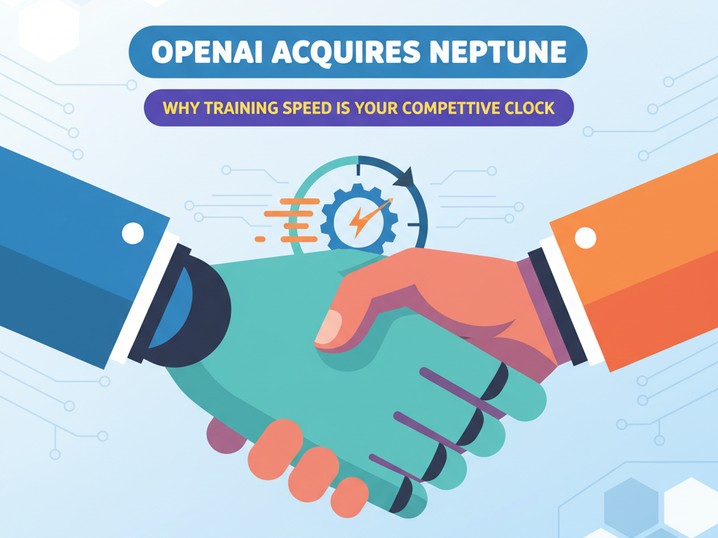

OpenAI Acquires Neptune: Why Training Speed Is Your Competitive Clock
**Executive Summary**
- OpenAI bought Neptune.ai for under $400M in stock—its fourth acquisition this year, signaling vertical integration of the training stack.
- Neptune's debugging tools compress experimental cycles by making model training "traceable, reviewable, and auditable," shrinking iteration time from weeks to days.
- The real play: faster GPT releases mean your competitive window for adopting new capabilities closes faster. Teams that don't adapt their workflows will feel the squeeze.
---
The Move: OpenAI Just Made Training a Strategic Weapon
On December 4, OpenAI acquired Neptune, a Polish startup that builds the monitoring and debugging layer for AI model training.[1] The all-stock deal—valued under $400 million—was officially announced with minimal fanfare, but the timing and structure tell you everything about where OpenAI thinks the next competitive battle lives.[2]
Here's what matters: Neptune doesn't build models or push new benchmarks. It builds *visibility into the training process itself*—the unglamorous plumbing layer that lets researchers spot when a model is diverging, overfitting, or leaking gradient anomalies before they waste weeks of compute.[1]
We've watched this pattern before. The operator who understands what a move like this signals—not what it pretends to be—wins the next round.
Why This Deal Isn't About Technology, It's About Velocity
Neptune's core offer is simple: real-time tracking of hyperparameters, loss curves, and training metrics across large distributed clusters.[1] Their "training metrics dashboard" has already been embedded into OpenAI's GPT development pipeline, so this acquisition isn't really about acquiring a new capability—it's about locking down the infrastructure that accelerates the capability cycle.
Jakub Pachocki, OpenAI's Chief Scientist, put it plainly:
"Neptune has built a fast, precise system that allows researchers to analyze complex training workflows. We plan to integrate their tools deep into our training stack to expand our visibility into how models learn."[1]
Translation for operators: OpenAI is collapsing the feedback loop between "something failed in training" and "we know exactly why and can fix it by Tuesday."
The math works like this: If your experimental cycle normally takes three weeks because debugging a 10,000-GPU cluster run takes two weeks, and Neptune cuts that debugging time to three days, you've just reclaimed two weeks per iteration. Over a year of development, that's the difference between releasing one major model generation and releasing 1.5 or 2.[2]
That velocity advantage compounds.
The Consolidation Signal: Integration, Not Acquisition
Notice what OpenAI *didn't* do: they didn't leave Neptune as a standalone product. Neptune's external services are sunsetting by March 4, 2026.[1] The entire Neptune team is joining OpenAI's training org.
This is vertical integration, not acquisition theater. It's the same playbook we saw when OpenAI restructured its relationship with Microsoft and started diversifying chip suppliers—every layer that affects speed to market is becoming in-house.
In 2025 alone, OpenAI has spent over $7.5 billion on M&A, including Statsig ($1.1 billion, September 2025) and hardware partnerships worth tens of billions more.[1][2] The pattern is unmistakable: OpenAI is building a closed-loop capability machine where nothing slows iteration.
What This Means for Your Competitive Timeline
Here's where this gets real for operators building on top of OpenAI's models: their iteration velocity just increased materially.
We typically see three to six months between major capability releases from OpenAI. That window is where most teams build their competitive advantage—the gap where new capabilities exist but adoption is still nascent, and you can differentiate on implementation.
Neptune collapses training debug cycles. That shrinks the gap.
What used to be a six-month release rhythm could compress to four months. What used to give you a two-month competitive window now gives you four weeks to integrate, test, and build differentiation before the next capability floor rises.
For solo founders and small ops teams—the kind of lean outfit that *depends* on owning a capability edge for a few months—that compression is material.
Where We've Seen This Pattern Before
The parallel that matters: Nvidia's consolidation of the AI chip stack. Over the past three years, Nvidia didn't just build better chips; they built CUDA, NCCL, cuDNN, and every layer that made their hardware sticky and fast. Competitors could build chips, but the *ecosystem* around Nvidia moved the needle faster.
OpenAI is doing the same thing with the training stack. Neptune is one layer. The Nvidia partnership ($100 billion commitment announced in September) is another.[1] The Azure relationship ($250 billion over five years) is the infrastructure layer.[1] Together, they form a moat that's not just about model quality—it's about *how fast you can iterate to quality*.
Anthropic, Google, Meta—they're all running the same playbook. The company that controls the tightest training loop wins the next generation of capability releases.
The Operator Takeaway: Expect Acceleration, Not Innovation
Here's the honest assessment: Neptune isn't going to give you access to new training tools. It's an internal efficiency play, not a customer-facing feature.
But you should treat it as a leading indicator.
When OpenAI buys internal infrastructure to shrink iteration cycles, it's typically 8–12 weeks before you see the output in the model releases. And when you do, you need to be ready to adapt.
**What you should be doing now:**
- **Audit your own iteration cycles.** If you're building on GPT-4o or o1, map out your feature release schedule. When the next capability floor rises, can your team move in 2–4 weeks, or are you locked into a quarterly planning cycle? The gap between your timeline and OpenAI's is your vulnerability window.
- **Stress-test your workflows for the faster release cadence.** If you've built a product that bakes assumptions about model behavior, you're at risk. Build evaluation harnesses now so you can validate new model versions in hours, not weeks.
- **Watch for the release cascade.** OpenAI's acquisition pattern suggests we're 2–3 months out from a capability announcement. Start prepping your team for "model X releases Monday; we pilot Tuesday; we decide by Thursday." The operators who can move that fast win the quarter.
- **Don't get caught on old versions.** The cost of staying on last-gen models—in terms of competitive disadvantage—rises when iteration cycles compress. Budget for continuous model updates, not annual ones.
The Broader Competitive Reality
Neptune's acquisition is a tell. It says OpenAI has decided that *speed of iteration, not isolated breakthrough capability, is the moat.*
That's a different competitive game than most teams are playing.
Most companies optimize for accuracy, cost, or reliability. OpenAI is optimizing for *velocity*—the ability to go from "we have an idea" to "we have a working model" to "we've shipped it to customers" in the tightest possible loop.
If you're building products or businesses on top of OpenAI's models, that matters more than you might think. Velocity is contagious. When your vendor moves faster, you have to move faster just to stay even.
What's Next: Three Months to Adaptation
We expect the operational impact of Neptune's integration to surface in Q1 2026. That's when the training infrastructure consolidation typically translates into visible capability releases or iteration improvements.
For operators: that's your timeline to prepare.
- Revisit your model-selection logic. Are you anchored to a specific version because it's "proven," or are you building in flexibility to adopt new versions when they drop?
- Tighten your evaluation loops. Can you A/B test new models in production without months of planning?
- Brief your team on the acceleration. Sales, marketing, and product teams need to understand that the window for "we're the only ones who know how to use this capability" just got smaller.
The Bottom Line
OpenAI's Neptune acquisition is not news about a training tool. It's news about competitive velocity.
The company that moves fastest—both in building models and in integrating them into products—wins the next market cycle. Neptune is one more brick in the machine that turns the dial faster.
Your job as an operator is to ask yourself a hard question: When GPT gets faster at iteration, do you get faster at iteration? Or do you stay on quarterly planning cycles while your vendor moves on weekly ones?
The answer to that question, honestly, is where your competitive advantage lives or dies.
---
**Meta Description** OpenAI's Neptune acquisition signals accelerated model iteration cycles. Here's why compressed training timelines are your competitive clock—and how to adapt.