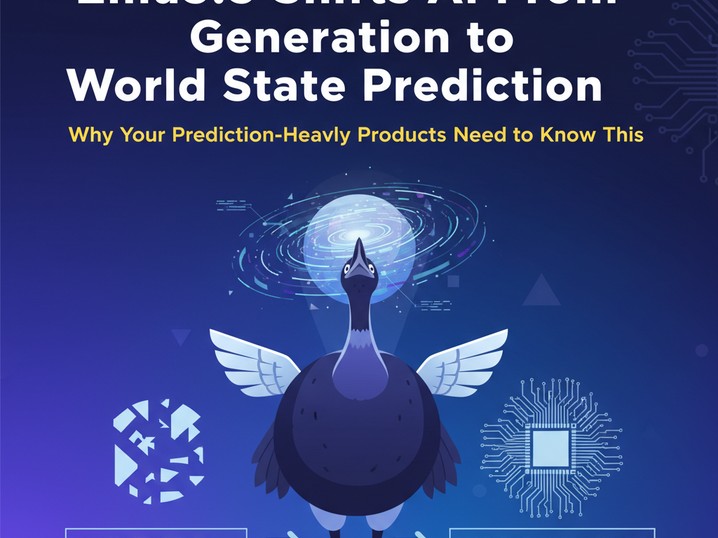

Emu3.5 Shifts AI From Generation to World State Prediction—Why Your Prediction-Heavy Products Need to Know This
**Executive Summary**
- Beijing's Zhiyuan Institute released Emu3.5, a unified multimodal world model that predicts *next states* across vision and language—not just generating isolated images or text[1]
- The architecture moves AI from passive content creation to causal reasoning about physics and outcomes, enabling robotics, autonomous systems, and embodied manipulation at scale[1]
- Operators building prediction-heavy products (supply chain forecasting, autonomous navigation, dynamic simulation) should pilot this unified tokenization approach—it represents where multimodal AI is heading[1]
---
The Paradigm Shift We've Been Waiting For
We've spent the last two years watching AI vendors pitch generation as the endgame: better images, faster text, smoother video synthesis. Incremental wins. Each announcement felt like a faster Ferrari in a parking lot.
Then Emu3.5 arrived, and the framing shifted.
The Beijing Academy of Artificial Intelligence released a model that doesn't just *generate* the next frame or the next sentence—it predicts the *next state*.[1] That's a fundamentally different ambition. It's the difference between a camera that takes better selfies and a system that understands how objects behave in the real world.
We're talking about AI that watches a video of a person stacking blocks and can predict what happens if gravity shifts. Or a robot arm that understands not just how to move, but what the physical outcome will be.[1]
For operators running lean teams, this distinction matters more than you might think. The vendors who understood generation first now have to redesign their entire stack around prediction. The teams who **studied this shift early** will have a three-to-six-month head start on competitors still chasing generation benchmarks.
---
What Is World State Prediction, and Why It's Not Just Better Generation
Let's clear the air: "next-token prediction" isn't new. It's the core mechanism behind every LLM and image generator you've used.
But Emu3.5 does something different. It trains a single 32-billion-parameter model on interleaved vision-language sequences—over 10 trillion tokens of sequential video frames and transcripts—using a unified next-token prediction objective.[1] The critical word is **unified**.
Most multimodal systems treat images and text as separate problems: a vision encoder, a language decoder, maybe an adapter layer bolting them together. Each modality has its own path through the network.
Emu3.5 doesn't. It natively ingests and generates interleaved vision-language outputs, meaning the same token prediction logic applies to both pixels and words simultaneously.[1]
Here's what that unlocks:
**Spatiotemporal coherence.** The model learns to predict not just the next image, but the next *state of a scene*, understanding momentum, physics, and causality.[1] If you show it three frames of a ball rolling down a ramp, it doesn't hallucinate a random fourth frame—it predicts where the ball will be based on the laws of motion.
**Embodied reasoning.** The system exhibits "open-world embodied manipulation," meaning it can reason about how an agent (a robot, a person, a virtual character) should interact with an environment to achieve an outcome.[1] It's not generating pretty pictures; it's simulating causality.
**Inference efficiency gains.** Emu3.5 proposes Discrete Diffusion Adaptation (DiDA), which accelerates per-image inference by approximately 20×—without sacrificing performance.[1] For operators, that translates to lower compute costs and faster time-to-prediction at scale.
---
The Architecture That Changes the Game
Here's how Emu3.5 actually works, and why it matters for your stack:
**Stage One: End-to-End Pretraining.** The model trains on a corpus of vision-language interleaved data from internet videos—sequential frames plus transcripts.[1] Instead of separate vision and language objectives, one unified next-token prediction mechanism learns to model both modalities.
**Stage Two: Supervised Fine-Tuning and Reinforcement Learning.** After pretraining, the team runs supervised fine-tuning on 150 billion samples to establish a unified multimodal generation interface, followed by large-scale reinforcement learning guided by multimodal rewards.[1] This teaches the model to reason across longer chains of reasoning and generation tasks.
**Stage Three: Inference Optimization.** DiDA converts token-by-token sequential decoding into bidirectional parallel prediction, achieving that 20× speedup we mentioned.[1] For operators, this means you can run more inference calls per GPU-hour, or downsize your infrastructure.
The payoff: A single model handles text-to-image, image-to-text, long-horizon vision-language generation, and any-to-image generation—all without task-specific heads or modality adapters.[1]
---
Where This Actually Moves the Needle for Operators
Let's talk specifics. We've guided teams through enough AI pilots to know which capabilities matter operationally and which are impressive-sounding footnotes.
Emu3.5's world modeling wins are genuinely relevant for three operator use cases:
**1. Autonomous Systems and Robotics**
If you're building or operating fleet robotics, autonomous warehouses, or embodied AI agents, Emu3.5's world-state prediction directly addresses your core problem: *How do I tell a robot what will happen if it takes action X?*
Traditional approaches bolt together a simulation engine (often slow, brittle, and expensive to maintain) with a vision system (often accurate for recognition, poor for prediction). Emu3.5 learns both simultaneously from video, so it naturally predicts the consequences of physical interactions across real and imagined environments.[1]
**Operator takeaway:** If you're shipping robots or autonomous systems, start a pilot with Emu3.5's embodied manipulation framework. The speedup in policy iteration—where you can test outcomes in simulation before hardware—could compress your development timeline by months.
**2. Supply Chain and Predictive Logistics**
We've worked with operations teams trying to forecast demand, inventory flow, or equipment failure using fragmented tools: time-series databases, separate vision systems for warehouse robotics, and text-based demand signals bolted together via API chains.
Emu3.5's unified multimodal prediction could streamline this. Imagine feeding live warehouse camera feeds, real-time order transcripts, and historical flow data into a single model that predicts the next state of your supply network—where bottlenecks will form, which SKUs will stock out, what equipment needs maintenance.
You're no longer stitching three systems together; you're running one forward pass.
**Operator takeaway:** If predictive logistics is a competitive edge in your business, this deserves a pilot on your highest-ROI use case (demand forecasting or equipment health prediction). Start with a single product line or facility to prove the model's generalization before enterprise rollout.
**3. Content Creation for Embodied Experiences**
If you're building interactive narratives, educational simulations, or dynamic AR/VR experiences, Emu3.5's long-horizon vision-language generation is relevant.
The model can generate coherent sequences of visual frames and text that maintain temporal and semantic consistency, enabling visual storytelling, step-by-step guidance for complex tasks, and dynamic scene simulation.[1] No more jarring cuts between AI-generated frames; the model understands narrative flow and physical plausibility.
**Operator takeaway:** Pilot with your highest-engagement content (training modules, interactive scenarios). Measure engagement lift and production time saved. If you're not in embodied experiences, skip this use case for now.
---
The Honest Assessment: When to Pilot, When to Wait
Let's be direct. Emu3.5 is impressive architecture, but it's early. Here's our decision framework:
**Deploy Now** if you're:
- Building embodied AI or robotics (internal R&D teams, not yet in production)
- Running high-volume prediction-heavy workflows where 20× inference speedup has direct ROI
- Willing to train or fine-tune on proprietary data (the model is open-source)
**Pilot This Quarter** if you're:
- Exploring world-state prediction for supply chain or logistics optimization
- Currently relying on multiple bolt-together systems for multimodal tasks
- Have GPU infrastructure already (Emu3.5 is a 32B model; you'll need VRAM)
**Skip for Now** if you're:
- Purely focused on content generation (existing fine-tuned diffusion models are faster for your specific use case)
- Running on CPU-constrained infrastructure
- Need production SLAs and vendor support (this is cutting-edge; production support is limited)
---
The Real Operator Questions We Haven't Answered Yet
Here's what we're watching as Emu3.5 matures:
- **Fine-tuning cost.** How much proprietary data do you need to adapt this for your specific prediction task? We don't have pricing yet.
- **Latency vs. throughput trade-offs.** DiDA is fast, but at what accuracy threshold does that speed cap out? Real-world embodied tasks often need sub-50ms prediction windows.
- **Hallucination under distribution shift.** World-state prediction models can "imagine" plausible futures that violate your domain's physics. How does Emu3.5 handle that? Early tests suggest it's better than diffusion models, but we need longer evaluation horizons.
---
Next Steps
If you're running a prediction-heavy product or considering embodied AI:
- **Study the Emu3.5 paper.** We linked it below. The architecture section is worth 20 minutes of your time if you're evaluating multimodal infrastructure.
- **Run a one-week spike.** Grab the open-source model, feed it one high-value prediction task (supply forecast, robot outcome simulation, dynamic content generation), and measure end-to-end latency and accuracy.
- **Share what you find.** We're collecting operator experiences with Emu3.5 and competitive world-state prediction models. Reply with your use case, infrastructure, and results—we'll synthesize insights and share back with the community.
This isn't hype. It's the direction multimodal AI is moving: from isolated generation to causal world modeling.
The operators who move first will own the insights.
---
**Meta Description:**
Emu3.5's unified world-state prediction moves AI from generation to causal reasoning. Here's how operators can pilot this for robotics, logistics, and embodied systems. [155 characters]