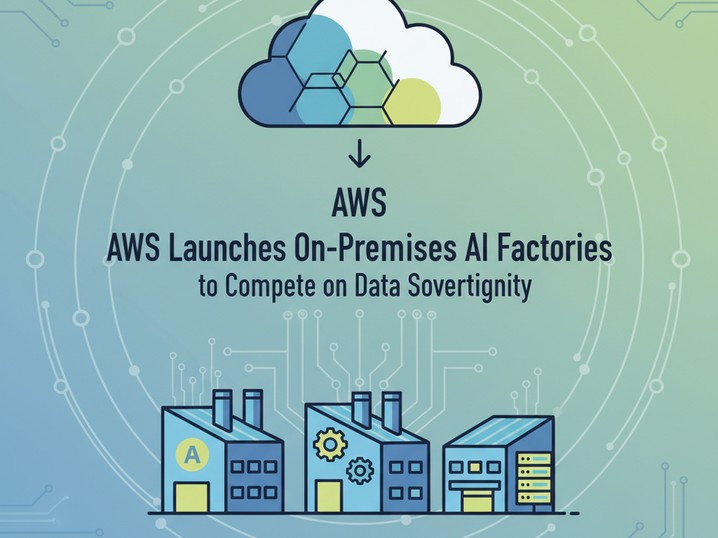

AWS Launches On-Premises AI Factories to Compete on Data Sovereignty
**Executive Summary**
- AWS is now deploying dedicated AI infrastructure inside your data center—meaning you keep data local while AWS handles hardware, software, and management
- This is a direct play to capture enterprises blocked by data residency rules or regulatory friction; if data sovereignty has killed your cloud roadmap, this removes that friction
- Trade-off reality: You avoid cloud sprawl and regulatory risk, but lock into AWS hardware refresh cycles and pay premium pricing for on-premises convenience
---
We've all felt it. You're evaluating Claude, GPT-4, or Gemini for some critical business process—and halfway through the pilot, legal or compliance pushes back: "Data can't leave the country" or "Regulators won't let us store customer information on public cloud." Suddenly your AI roadmap stalls. The models are ready. Your team is ready. The infrastructure isn't.
Last week, AWS stepped directly into that friction point. They're calling it AI Factories[1]—and it's a calculated move to recapture deals that data sovereignty concerns have been killing for years.
Here's what's actually happening, and why operators need to pay attention.
The Infrastructure Shift We Didn't See Coming
For a decade, cloud migration was the default narrative: Move everything to AWS, Azure, Google Cloud. Cheaper. Faster. Less maintenance. This still works for most workloads.
But generative AI changed the calculus. Training and deploying frontier models requires massive GPU clusters, specialized networking, and custom cooling. You can't just lift-and-shift; you're rebuilding. And if your government, your customers, or your industry says "this data stays within our borders," suddenly the entire cloud value proposition vanishes.
I've watched this play out with founders and operations leaders we work with. The conversation used to be simple: "Move to the cloud." Now it's fractured into competing pressures: speed and cost efficiency *versus* data residency and regulatory control. That tension is expensive.
AWS AI Factories are betting they can resolve it. Here's the mechanism[1]:
**AWS supplies the infrastructure**—NVIDIA GPUs, AWS Trainium accelerators, specialized low-latency networking, and high-performance storage. All pre-engineered and tested for AI workloads.
**You provide the space and power**—the data center real estate and electrical capacity you've already paid for.
**AWS manages everything remotely**—deployment, optimization, security patches, hardware lifecycle. Think of it as AWS cloud operations running inside your walls.
The upshot: Your proprietary data never leaves your facility. Your models (whether fine-tuned foundation models via Amazon Bedrock or custom SageMaker training) run on hardware you control. Yet you get AWS's operational expertise and avoid the two-year procurement and setup nightmare that typically delays AI infrastructure buildouts by years[1].
Why Now? The Data Sovereignty Moment
This isn't theoretical. It's a direct response to a structural change in enterprise AI adoption.
Over the past eighteen months, every large bank, defense contractor, healthcare system, and government agency we've worked with has hit the same wall: cloud adoption is blocked not by capability but by compliance. The EU's digital sovereignty mandates. China's data localization rules. The UK's GDPR alignment. Sector-specific regulations in finance, defense, and healthcare that make public cloud a non-starter.
AWS and NVIDIA are already proving this thesis works. Their announced customer, HUMAIN in Saudi Arabia, is building what they call an "AI Zone"—a dedicated data center housing up to 150,000 AI chips using AWS infrastructure and NVIDIA GPUs[2]. That's not a pilot. That's a nation-state-scale commitment to sovereign AI infrastructure.
The timing is sharp: As model costs collapse and everyone scrambles for deployment volume, AWS isn't competing on list price. They're competing on deployment *location*—and removing the legal and regulatory friction that's been blocking entire market segments.
What This Actually Means for Your Company
Let's be direct: If you're running a 20-person SaaS company operating in the US with cloud-friendly customers, AWS AI Factories isn't for you. The infrastructure overhead, minimum commitments, and cost structure are enterprise-scale plays.
But if you operate in any of these scenarios, it's worth a serious conversation:
**Your industry requires data residency by law.** You're in financial services, defense, critical infrastructure, or healthcare—and regulators mandate that customer or operational data stays within specific geographies. Public cloud is off the table, but you need frontier models for competitive advantage.
**Your customers have data sovereignty requirements.** You're B2B selling into enterprises where data localization is a contract dealbreaker. You've lost deals because you couldn't guarantee data residency. AI Factories let you offer that guarantee while keeping your operational stack in AWS.
**You've already built data center capacity and paid for it.** You have excess rack space, power budget, and fiber connectivity. Rather than build AI infrastructure from scratch (18–36 month lead time, procurement complexity, hiring), you can deploy managed infrastructure into underutilized capacity.
**You operate in a regulated market and need air-gapped AI.** You want foundation models and LLM deployment but can't justify the full engineering team required to manage it independently.
In these cases, AI Factories removes years from your timeline and eliminates the capex risk of building custom GPU infrastructure.
The Real Trade-offs (What AWS Won't Lead With)
Here's where we get honest. Operator expectations need to match reality.
**Lock-in and refresh cycles.** You're dependent on AWS hardware and AWS's refresh roadmap. When NVIDIA releases a new generation, you don't upgrade independently; you wait for AWS to offer the new hardware generation. Your capex is now AWS's capex timing.
**Pricing structure.** On-premises managed services always cost more than public cloud equivalents because AWS is taking on deployment, integration, and lifecycle risk inside your facility. If your math was "save 40% by moving to on-prem," that assumption is wrong. You're paying for convenience and sovereignty—not saving on unit economics.
**Minimum scale.** AI Factories are designed for enterprise commitments. If you're thinking about deploying this for a pilot or a 50-GPU cluster, AWS isn't interested. These are multi-facility, multi-year infrastructure plays.
**Operational responsibility splits.** You own the data center environment (cooling, power delivery, physical security). AWS owns the infrastructure. When something breaks, the blame game between "your facility" and "AWS systems" gets real, fast.
**Slower pace of model iteration.** With your own dedicated environment, you don't benefit from AWS's rapid model updates the same way cloud customers do. You're on a release cadence, not continuous updates.
How to Evaluate This for Your Situation
If any of the scenarios above apply, here's the operator framework for deciding:
**Step 1: Confirm the constraint.** Is data residency actually killing your AI roadmap, or is it a perceived limitation? Get explicit legal/compliance guidance. Some "data residency" requirements have more flex than companies assume.
**Step 2: Map your current infrastructure.** Do you have spare data center capacity? Existing power and cooling? If you're leasing everything, the unit economics change entirely. Calculate your actual capex baseline.
**Step 3: Talk to AWS about real commitments.** Don't evaluate AI Factories in isolation. Get deployment timelines, true all-in costs (hardware, AWS service fees, integration), and SLAs. Ask about hardware refresh cycles. Understand the contract lock-in.
**Step 4: Run a back-of-envelope ROI.** Compare the cost of on-premises AI infrastructure (build-from-scratch timeline + personnel + ongoing operations) versus AWS AI Factories (higher unit cost but 6–12 month faster deployment). For many regulated enterprises, "faster to production" is worth the premium.
**Step 5: Pilot with a single workload.** Don't commit the whole infrastructure roadmap. Pick one use case (fine-tuning a foundation model, running a custom LLM), deploy it, measure performance and cost, then decide on scale.
The Strategic Play: Why AWS Is Doing This
Let's zoom out. AWS isn't building AI Factories because on-premises is a better business model; they're building it because the alternative is losing enterprise AI deals entirely.
For five years, cloud consolidation felt inevitable. Then data sovereignty, regulatory fragmentation, and geopolitical tension made it uncertain again. Now AWS is saying: "You don't have to choose between cloud and sovereignty. Take both."
That's not a technology innovation—it's a market realization. And it matters because it signals how AI infrastructure decisions are going to be made for the next decade. Location, regulatory alignment, and operational control now matter as much as price.
For operators, the takeaway is this: If you've been sitting on AI capability because data residency is a blocker, that blocker just got removed. Your move isn't to rush into AI Factories; it's to run the evaluation framework above and see if the math works for your situation.
The enterprises that benefit most won't be the early adopters testing the latest model. They'll be the ones that were stuck—and now have a clear, managed path forward.
---
**Meta Description:** AWS AI Factories bring managed AI infrastructure inside your data center, addressing data sovereignty concerns. Explore the when, how, and real trade-offs for regulated enterprises considering on-premises deployment.