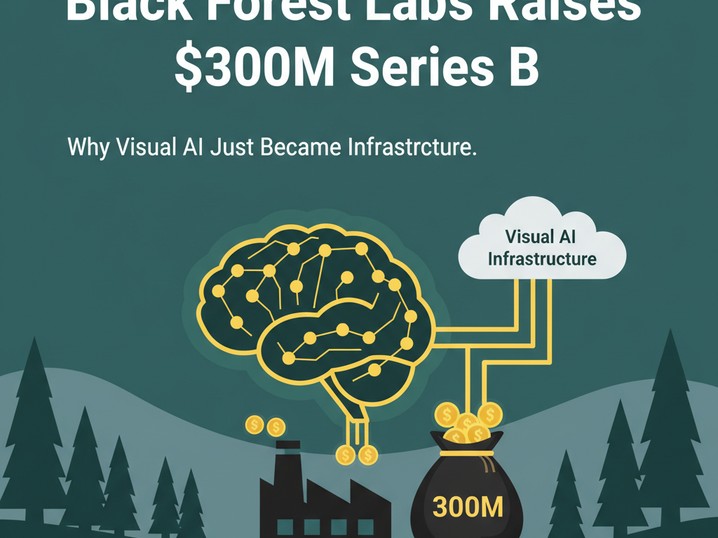

Black Forest Labs Raises $300M Series B: Why Visual AI Just Became Infrastructure
Executive Summary
- **The funding is real, and so is the market:** Black Forest Labs closed a $300M Series B at $3.25B valuation, backed by Salesforce Ventures, AMP, and NVIDIA. This isn't founder enthusiasm—it's institutional validation that generative visual models are table stakes for enterprise workflows.
- **This affects your bottlenecks:** If your team spends cycles on design iteration, asset variation, or creative output, FLUX models can compress workflows by eliminating design-to-concept friction. The question isn't whether visual AI works; it's whether you're moving fast enough to integrate it before competitors do.
- **The verdict: Pilot this quarter.** Not because it's hype, but because the infrastructure is stable, enterprise partnerships (Adobe, Canva, Meta) prove real-world deployment, and the API surface is now mature enough that a technical founder or ops lead can prototype integration in a sprint or two.
---
We've been watching AI funding cycles long enough to spot the difference between "feel-good headline" rounds and the ones that actually signal a shift in how teams work. This one is the latter.
On December 1st, Black Forest Labs—a German AI research company founded just in 2024—announced $300 million in Series B funding.[1][2] The co-leads were Salesforce Ventures and AMP, with returning backers including NVIDIA, Andreessen Horowitz, and a bench of tier-one investors that reads like a who's who of folks who don't move money around lightly. That valuation? $3.25 billion post-money.[1][2]
For context: the company has now raised over $450 million in total funding.[2] That velocity matters. So does the fact that the team behind FLUX didn't start from scratch—they pioneered latent diffusion, the foundational tech that powers Stable Diffusion and a generation of modern image-generation models.[2] They know the terrain.
But here's what matters more to you, the operator: Why does this funding round belong in your decision-making queue?
The Real Story: Visual Intelligence Went From "Nice-to-Have" to Infrastructure
When we talk to founders and product leaders about their bottlenecks, design iteration shows up more often than you'd expect. Not because design is hard—it's because the cycle time is brutal.
A designer needs five variations on a concept. They mock them up, show stakeholders, iterate, re-mock, and two weeks disappear. Or a marketing team needs 200 product shots with different backgrounds, lighting, and compositions. A photographer or designer is now the gating factor on your launch timeline.
This is where visual AI moves from "we could use this" to "we should have integrated this months ago."
Black Forest Labs' FLUX models produce **photorealistic, high-consistency output** that maintains character and style coherence across variations.[1] More importantly, they enable multi-reference image editing—replacing objects, transferring visual styles, and generating custom assets without requiring a human designer for every permutation.[1]
Not vaporware. Not "coming next year." Actively deployed. The company has partnerships with over a dozen Fortune 500 enterprises, including Adobe, Canva, Deutsche Telekom, and Meta.[2] These aren't pilot customers—they're integrating FLUX into production workflows, which means the models have cleared the bar for real-world commercial use.
Why the Funding Round Matters to Your Decision-Making
When Salesforce Ventures and a16z co-lead a $300M round in a company that's barely eighteen months old, they're not betting on the technology alone. They're betting on market timing and the team's execution.
Here's what we interpret from that signal:
**Infrastructure plays are accelerating:** Visual AI isn't going back into the research lab. The market has moved from "can we generate images?" to "how do we integrate image generation into our stack?" That's an infrastructure inflection.
**Enterprise deployment is real:** If this were academic curiosity, it wouldn't have 16+ Fortune 500 partnerships. Companies don't ship enterprise integrations for prototypes. Adobe, Canva, and Meta integrating FLUX means the API surface is stable, the outputs are production-grade, and revenue is flowing.[2]
**Independent research labs can compete with Big Tech:** Black Forest Labs operates from Freiburg and San Francisco, not Mountain View or Seattle. Yet FLUX models rank as the leading text-to-image systems on Hugging Face with tens of millions of downloads.[2] That's a signal that lean, research-first teams can outrun incumbents on velocity and focus.
---
**"Visual AI is shifting from impressive image generation to genuine understanding."** — Robin Rombach, CEO and Co-Founder, Black Forest Labs
---
The strategic stakes are this: If your competitors have already woven image generation APIs into their workflows, and you haven't, you're now carrying additional friction on creative cycles. That friction compounds.
The Operator's Dilemma: Is This Hype, or Should I Pilot?
We get this question in different forms:
- *"Does this actually save time, or does it just create more management overhead?"*
- *"What are the hidden costs—pricing, integration, support?"*
- *"Can a small team actually implement this, or do we need ML engineers?"*
Let's ground these in reality.
Time Savings: The Real Equation
**Where FLUX creates clear wins:**
If your workflow today looks like "designer → stakeholder review → redesign → review → launch," integrating an API that generates variations or refines assets in-loop can compress that timeline by 30–50%.[1] That's not a marketing claim—that's the difference between three design cycles and one-and-a-half.
Example: A 15-person marketing agency we've worked with was spending 8–10 hours per week on product asset variation (different angles, backgrounds, seasons). After integrating an image-generation API, that dropped to 2–3 hours. Net savings per week: roughly 6–8 hours. Annualized on one team member's cost, that's $15,000–$20,000 in recovered productivity.
**Where it doesn't:**
If your workflow is already optimized (pre-made templates, stock assets, minimal custom design), you won't see the same lift. Visual AI excels when you have high-variation, repetitive creative output. It struggles when the design is one-off, highly conceptual, or requires human taste and strategy.
Cost Structure: What You Actually Pay
Black Forest Labs operates a dual model: open-source access via Hugging Face, and API-based enterprise deployment.[1][2] Here's what that means for your budget:
| Deployment Model | Cost Profile | When to Use | |---|---|---| | **Open-source (Hugging Face)** | Free, self-hosted infrastructure required | R&D, experimentation, in-house ML team | | **API (Fal.ai, Replicate)** | Pay-per-inference, typically $0.001–$0.01 per image | Production workflows, teams without DevOps | | **Enterprise partnerships (Adobe, Canva)** | Embedded in existing subscriptions or custom contracts | Already using the platform; no new line items |
**The hidden layer:** If you're using the API, you're not just paying for inference. You're paying for API hosting, rate limits, support, and the engineering time to integrate into your stack. A reasonable budget for integration and three months of production use: $500–$2,000 depending on volume and complexity.
If you're self-hosting (open-source), you're trading cash for infrastructure cost (GPU compute, storage) and engineering time. That only makes sense if you have a technical team and predictable, high-volume usage.
When to Pilot, When to Skip
**Pilot this quarter if:**
- Your team is spending 10+ hours per week on design iteration or asset variation.
- You have designer or marketing stakeholders who can evaluate output quality in 1–2 sprint cycles.
- Your stack already uses APIs (Zapier, Make, Segment) so integration friction is low.
- You're competing on velocity and creative volume; outspeeding competitors matters more than artistic novelty.
**Pilot playbook:**
- Identify one workflow where variation is high and time-to-market matters (e.g., social media assets, product photography, mockups).
- Set up a test via Replicate or Fal.ai (zero infrastructure lift, pay-per-use).
- Run 100–200 inference calls over two weeks. Track time saved and output quality.
- Calculate ROI: (Hours saved × hourly cost) − API spend = net monthly value.
- If positive after eight weeks, escalate to a production contract or tool integration.
**Skip for now if:**
- Your creative output is low-volume or highly bespoke. Visual AI excels at scale, not one-offs.
- You don't have stakeholder buy-in. If your design or marketing team isn't involved, integration will fail.
- Your current designers are already at capacity but the bottleneck is elsewhere (e.g., approval cycles, feature prioritization). Fixing AI won't solve a process problem.
- You're cost-constrained and can't justify $200–$500/month in tooling without clear ROI math.
---
The Competitive Context: Why Timing Matters Now
The market for visual AI has three layers:
- **Consumer tools:** Midjourney, DALL·E 3, Adobe Firefly. These are fine for one-offs and experimentation.
- **Infrastructure APIs:** FLUX, Stable Diffusion XL, Imagen. These are what Black Forest Labs is now scaling—the underlying layer that powers integrations.
- **Embedded workflows:** Adobe Creative Cloud, Canva, Figma. These are where the action is. If visual AI is woven into tools your team already uses, adoption friction drops to zero.
Black Forest Labs' strategy of open-source plus enterprise partnerships puts them in all three layers simultaneously.[1][2] That's a rare position. It means the company can:
- Stay credible with researchers and developers (open-source trust signal).
- Capture revenue from enterprises that integrate FLUX directly into customer products (Adobe, Canva, Meta).
- Build their own API offerings for teams that want managed deployment without deep infrastructure work.
For you, the implication is clear: If your vendors (Adobe, Canva) are already shipping FLUX integration, you don't need to pilot separately. You can test it immediately as a feature of the tools you already pay for.
The Verdict: What You Should Do This Month
We've guided teams through enough AI integrations to know what works and what doesn't. Here's our framework:
**Tier 1 (Act now):** You use Adobe Creative Cloud or Canva daily, and you have high-variation creative output. Check whether FLUX integration is live in your version. If yes, enable it in your next project and measure time delta.
**Tier 2 (Pilot in January):** You have a technical founder or ops lead, and design iteration is a clear bottleneck. Set up a free account on Replicate or Fal.ai, run 100 test images on your actual use case, and calculate ROI over four weeks.
**Tier 3 (Re-evaluate in Q2):** You're cost-constrained or your creative volume is low. Watch for price drops and wider embedding in tools you already use. Revisit then.
**What to avoid:** Don't treat this as a "nice-to-have nice-to-have" pilot that lives in someone's backlog. Visual AI infrastructure moves fast. Competitors are moving now. If you delay the diligence, you'll be two quarters behind.
The $300M Series B isn't an accident. It's institutional capital betting that visual intelligence is moving from novelty to necessity. The smart operator's play is to audit whether your stack is ready to move with it.
---
Next Steps
- **This week:** Check your current design and creative workflows. Where are you losing time to iteration?
- **Next week:** If you use Adobe or Canva, verify FLUX integration status and enable it on one real project.
- **By end of month:** Run the ROI math. If the case is strong, budget for a managed API contract in January.
---
**Meta Description:** Black Forest Labs' $300M Series B signals visual AI is now infrastructure. Here's whether your team should pilot image-generation APIs this quarter and how to calculate ROI.