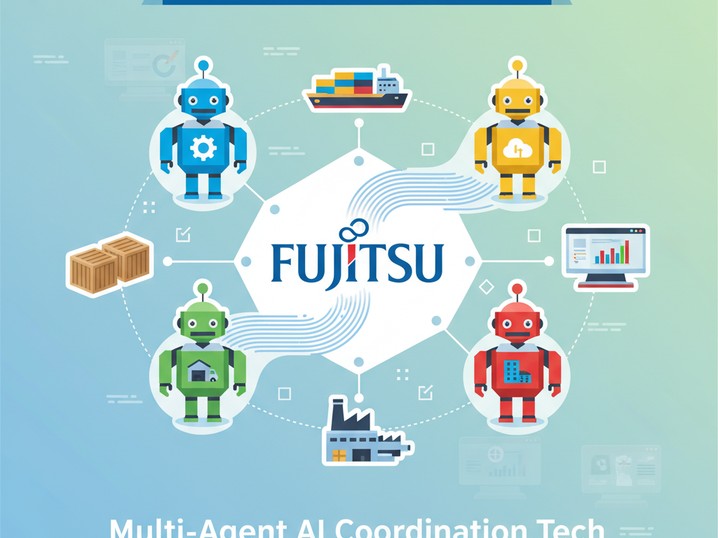

Fujitsu Launches Multi-Agent AI Coordination Tech for Enterprise Supply Chains
**What You Need to Know:**
- Fujitsu built technology enabling separate AI agents (from different vendors) to coordinate without exposing proprietary data—solving the "silos" problem that plagues lean teams running multiple AI tools
- January 2026 field trials with Rohto Pharmaceutical show 30% potential transportation cost reductions; real-world deployment follows by end of 2026
- For operators managing cross-departmental workflows or external partnerships, this addresses your current pain: manual orchestration overhead between AI systems that don't speak to each other
---
The Integration Bottleneck Nobody Wants to Admit
I've watched this unfold a dozen times with operators we've guided: You deploy an AI tool for forecasting. It works. Then you add another for inventory optimization. Then a third for procurement routing. Three months in, you're manually threading insights between systems because they weren't built to talk to each other. Your team spends Friday afternoons copy-pasting outputs instead of acting on recommendations.
That's the real tax on scaling AI inside lean organizations.[1]
Most vendors won't say this out loud—because it's bad for positioning—but multi-tool AI deployments fail not because the models are weak, but because **the coordination layer doesn't exist**. You're paying for intelligence you can't operationalize.
Fujitsu's announcement this week targets that exact gap. On December 1, 2025, they unveiled multi-AI agent collaboration technology designed to let separate AI systems coordinate securely without sharing sensitive data across organizational or vendor boundaries.[1] If you're running multiple AI systems today—or planning to—this matters more than you think.
The Problem They're Actually Solving
Let me translate the press release into operator language.
Today, when you want multiple AI agents to work together on a supply chain decision, you hit a wall: **How do you get agents from Company A to coordinate with agents from Company B (or from different internal teams) without exposing your pricing, supplier relationships, or demand forecasts?**
The old workaround was clunky. You'd either:
- Share your sensitive data (security nightmare, compliance violation waiting to happen)
- Build custom integration pipelines (engineering effort you don't have)
- Run everything through a single vendor (vendor lock-in)
- Keep humans in the loop for every decision (defeats the purpose)
None of these scale for a 20-person or 50-person operation running lean.
Fujitsu's approach solves this through two core mechanisms:[1]
**Global Optimal Control for AI Agents Under Incomplete Information**
Each AI agent proposes a solution to its local problem—procurement finds the cheapest supplier, inventory optimizes stock levels, production schedules manufacturing. Instead of sharing raw data, the agents communicate through "negotiation": One agent suggests a direction, others respond with whether that works for them, and the proposing agent calibrates without ever seeing their confidential constraints. Think of it as AI agents playing poker with incomplete hand information but still landing on a table consensus.
**Fujitsu Secure Inter-Agent Gateway**
This is the plumbing: A communication layer built on distributed AI learning that lets agents exchange ideas without exposing proprietary details. When agents first connect, they learn supply-chain characteristics through knowledge distillation—a deep-learning technique where insights from multiple "teacher models" get transferred to a shared "student model," but only the insights travel, not the raw data.[1]
In practice, your agent talks to theirs. Information flows. No spreadsheets. No manual handoffs.
Real Numbers: What the Trials Actually Show
Fujitsu started field trials in virtual environments with Rohto Pharmaceutical (a major Japanese pharma company) and the Institute of Science Tokyo. Early results:[1]
**Up to 30% reduction in transportation costs** when logistics routes and schedules were optimized across agents that previously operated in silos.
Let that sit for a moment. For a mid-sized supply chain, transportation cost reduction of that magnitude is the difference between a quarterly miss and a beat. For a lean operator managing cost per unit, that's survival margin.
The trials are scaling now. From January 2026 through March 2027, Fujitsu will run large-scale tests using Rohto's actual supply chain data, simulating real-world conditions. This isn't theoretical anymore—it's field validation with a live customer.[1]
For context, Fujitsu also runs AI supply-chain solutions for other manufacturing customers. A separate simulation using data from a hypothetical $10 billion company showed their broader AI approach reducing annual inventory costs by approximately $15 million and cutting unnecessary inventory stock by $20 million, plus reducing work hours by more than 50%.[3] Not all of that comes from multi-agent coordination, but it signals the scale of optimization possible when you stop operating in silos.
When This Actually Matters for Your Team
Here's the brutal honesty: **If you're a 10-person bootstrapped company using ChatGPT and Zapier, you can skip the rest of this article.** Fujitsu's tech will come to market through enterprise channels and SaaS partnerships before it reaches solo founders.
But if you fall into any of these buckets, pay attention:
**You're managing multiple AI systems across departments.** You've got demand forecasting in one tool, inventory management in another, and someone's building a custom chatbot for customer queries. Coordinating these manually is eating your operations team's week. When Fujitsu launches their Dynamic Supply Chain services (targeted for end of fiscal 2026), the inter-agent orchestration becomes a feature you buy instead of a problem you build.[1]
**You're integrating AI with external partners.** You work with suppliers, fulfillment networks, or co-packers who also run AI systems. Right now, the best you can do is weekly syncs and email updates. A coordination layer that lets agents negotiate in real-time without exposing your data changes the conversation from "let me know your forecast" to "here's what we can optimize together."
**You're feeling the integration tax.** You deployed three AI tools last year. You're paying for three subscriptions, maintaining three logins, and your team is drowning in switching context between platforms. If Fujitsu's approach becomes available through your existing vendor stack (which the NVIDIA partnership suggests is coming), you'll be able to unify that coordination without ripping and replacing.
**You're in supply-chain-sensitive verticals.** Pharma, food, manufacturing, or logistics where a 30% cost reduction compounds fast. The early field trials are targeting these industries because the ROI math is clearest.
---
The Verdict: Watch or Act?
**If timeline is January 2026 and beyond:** This is a **watch-and-pilot** play.
Fujitsu is running live trials with Rohto Pharmaceutical starting next month. By Q2 2026, there will be real-world data on whether the 30% transportation gains hold in messy, real supply chains. That's when you have a reason to kick tires with your vendor partners or Fujitsu directly.
What you should do now:
- **Audit your current AI stack.** How many tools are you running? Where are you spending engineering time on integration? That's your coordination tax baseline.
- **Map your data-sharing constraints.** Where would you benefit from agent coordination but can't share raw data today? That's your Fujitsu use case.
- **Flag this for your Q1 roadmap.** Not as an immediate implementation, but as a conversation starter with your ops team: "If we could orchestrate our AI tools without manual handoffs, what changes?"
**Skips:**
- You're pure SaaS with a single operational workflow. Orchestration only matters if you have multiple agents competing or collaborating.
- Your vendor stack is locked into a single player (e.g., everything is Salesforce, everything is SAP). You'll wait for those vendors to integrate Fujitsu's tech rather than adopting it independently.
- You don't have supply-chain complexity. If you're not coordinating procurement, inventory, production, and sales decisions simultaneously, the ROI isn't there yet.
---
What Comes Next
Fujitsu's strategy is clear: Build the trials with Rohto through March 2027, prove the model works, then commercialize through their Uvance business platform and partner channels (NVIDIA is a big one).[1][5] By late 2026, we'll see whether this becomes the industry standard for multi-vendor AI coordination or remains a niche play for large manufacturers.
For operators watching this space, the real opportunity isn't Fujitsu's tech itself—it's the **shift in thinking**. Right now, when we deploy AI tools, we assume they're independent. Each gets bolted on, each solves one problem. That model is reaching its ceiling. The teams that figure out how to make their AI agents collaborate securely—without organizational friction—will outpace everyone else on both cost and speed.
Fujitsu didn't invent that truth. They just built a proof that it's operationally possible. That's worth tracking for 2026.
---
**Meta Description:** Fujitsu's multi-agent AI coordination tech lets separate AI systems collaborate securely without exposing data. Field trials with Rohto show 30% cost cuts. What it means for your stack.