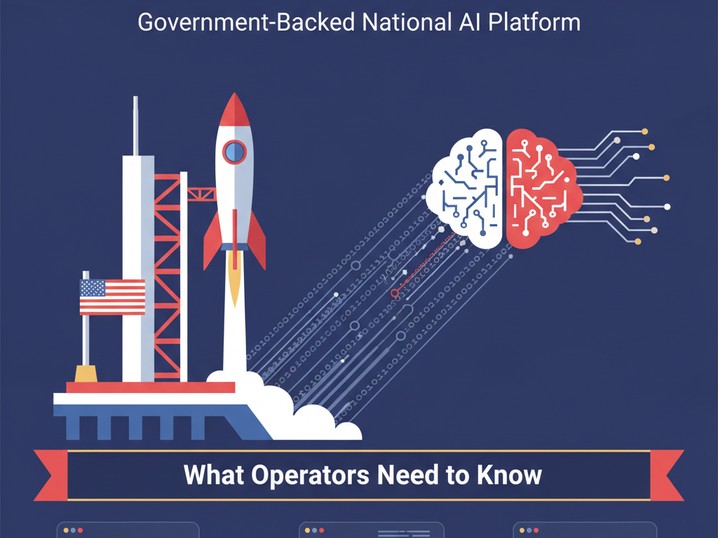

U.S. Launches Genesis Mission: Government-Backed National AI Platform—What Operators Need to Know
**Executive Summary**
The Genesis Mission, signed by executive order on November 24, is reshaping how federal AI compute, data, and funding flow through the U.S. research ecosystem.[2] This isn't a science grant program; it's national infrastructure consolidation—comparable to the Interstate Highway System or the Space Race. For operators in biotech, energy, materials, semiconductors, and quantum domains, it signals one critical shift: federal lab partnerships and data access will become a legitimate source of competitive advantage. Your move is to map which national labs align with your business, begin positioning early, and understand the new pathways to federal compute resources before your competitors do.
---
What Actually Happened on November 24
On the surface, President Trump signed an executive order launching an ambitious initiative. The headlines called it a "science and innovation" program. We read the briefings and saw the usual government language about "accelerating breakthroughs" and "American competitiveness."
But let's cut past the announcement speak.
What the Genesis Mission actually does is **concentrate federal computing power, scientific datasets, and research infrastructure into a single coordinated platform**, then open deliberate pathways for private companies—especially startups and lean teams—to tap into it.[2] That's structural. That's different. And if your business touches biotech, semiconductors, quantum, nuclear energy, or advanced materials, it's worth understanding exactly how.
The order establishes three critical pieces:[1][2]
**A unified AI platform** linking federal datasets, DOE supercomputing resources, and national lab infrastructure. Within approximately nine months of the executive order, this platform is expected to demonstrate capability for at least one national research challenge.[4]
**The American Science and Security Platform**, operated by the Department of Energy, as the backbone.[2] The Secretary of Energy is tasked with turning the National Labs into a cooperative research system—not siloed, but connected. DOE must identify available computing assets within 90 days, assemble initial datasets within 120 days, integrate robotic laboratory capabilities within 240 days, and achieve initial operating capability within 270 days.[2]
**A coordination structure** with Michael Kratsios, the Assistant to the President for Science and Technology, leading national coordination efforts, working alongside NSF, NIST, NIH and other federal agencies.[1][2]
The goal? Double American research productivity and impact within a decade.[4] Not incrementally. Double.
---
Why This Matters More Than You Think
We've been around enough government initiatives to know when something stays government-only and when it actually reshapes the operating landscape. This one reshapes it.
Here's why: **Federal compute has always been fragmented and hard to access.** A startup in biotech or quantum might need to go through a dozen grant cycles, wait 18 months for a decision, and still not get meaningful compute access. A small materials science team might have brilliant ideas but no way to run the simulations that prove them out—because supercomputing time was rationed and buried in bureaucracy.
Genesis is centralizing that. The point of a "unified platform" is that you don't need to navigate 10 different agencies anymore. You apply once. You get access to curated datasets, cutting-edge compute, and infrastructure that previously would have cost millions to build yourself.
**For lean operators, this is a genuine unlocking.** If you're running a 20-person biotech firm and suddenly have access to federal supercomputers and linked federal datasets without years of grant red tape, your R&D cycle changes. Your time-to-hypothesis changes. Your competitive position relative to incumbents who own their own data and compute changes.
---
The Operator's Question: Which Domains Actually Matter?
Not every business is affected equally. If you're in SaaS or consulting, this probably doesn't move the needle for you. But if you operate in one of the **priority research areas**, it absolutely does.[4] The Department of Energy is expected to identify 20 potential science and technology challenges within 60 days, with focus on areas including:
- **Biotechnology** (drug discovery, vaccine development, protein folding)
- **Critical materials** (rare earths, advanced semiconductors, battery materials)
- **Nuclear energy** (fission and fusion reactor design and safety)
- **Quantum information science** (quantum computing and sensing)
- **Medicine and advanced health research**
We're talking about capital-intensive, data-hungry, compute-heavy domains where access to simulation and modeling infrastructure is a genuine barrier to competition.
Let me ground this with an example: **A materials science startup trying to develop next-generation battery materials.** Historically, your playbook is: model compounds in-house, run limited simulations on cloud compute (expensive), run expensive physical experiments, fail 90% of the time, go back to the drawing board. Timeline: 3–5 years. Cost: millions.
With Genesis-granted access to federal supercomputing and linked materials datasets, you could run vastly more simulation cycles, fail cheaper and faster, and use federal data to prime your models. Timeline: 18 months. Cost: fraction of what it was. The operator who figures out this pathway before competitors do wins.
---
The Real Constraint: Federal Bureaucracy Still Exists
Here's where we need to be honest. Genesis is a structural improvement, but it's not a shortcut.
The pathway to access will still involve paperwork, procurement, security clearances, data governance agreements, and compliance reviews. The government is building infrastructure—not eliminating the need for operators to speak the government language and navigate the rules.
Some risks to anticipate:
**Timeline execution is ambitious.** The order targets aggressive milestones: 60 days for challenge identification, 270 days for initial operating capability.[2] Federal IT projects frequently encounter delays. Expect revised timelines as implementation proceeds.
**Data access will have strings attached.** Federal data governance, secure computing environments, and export controls will apply.[2] Your models may train on federal data but operate within federal infrastructure. Your IP governance may be subject to review. You need to understand these constraints before betting on this pathway.
**Competition for early access will be intense.** Once this platform is live, national labs and federal agencies will prioritize access for projects with the clearest connection to national priorities. Lean startups need to move early and make a compelling case for why your work supports those priorities.
---
Your Positioning Move (The Checklist)
If you're in one of the priority domains, here's how we'd approach this:
**Month 1: Map your alignment**
- Which national labs or federal agencies have expertise adjacent to your domain?
- What federal datasets could legitimately accelerate your R&D?
- Is your work defensible as supporting "American research productivity" or "national competitiveness"? (The clearer this connection, the stronger your case.)
**Month 2–3: Build relationships**
- Contact DOE business development or laboratory partnership offices.
- Attend Genesis-related workshops or technical listening sessions (DOE will run them as the platform develops).
- Talk to academic labs that already have federal relationships—they know the operating model and compliance requirements.
**Month 4 onward: Prepare your case**
- Document exactly what compute, data, or infrastructure would accelerate your current roadmap.
- Model the ROI: What does access to this resource save us in time, cost, or speed to product?
- Understand compliance requirements (IP ownership, export controls, reporting) and budget for them accordingly.
- If timing allows, position for early-adopter partnerships before the platform reaches full operating capability.
---
The Bottom Line: Infrastructure Becomes Competitive Advantage
We're living through a moment where national infrastructure is being rebuilt with AI at the center. The Interstate Highway System transformed logistics. The space program catalyzed entire industries. Genesis is that kind of structural shift.
For operators in the right domains, the question isn't whether this matters—it does. The question is whether you'll be ready to use it when it opens.
"The mission aims to double the productivity and impact of American research and innovation within a decade."[4] That's not a policy goal. That's a market reset. The operators who position for federal partnership pathways early will have access to resources their competitors are still waiting for.
Early movers in biotech, quantum, materials science, and semiconductors should start mapping their federal alignment now. The platform won't reach initial operating capability until late 2026, but procurement and partnership conversations move slowly. If you wait until that launch, you'll be last in a long line.
This isn't hype. It's infrastructure. And infrastructure access has always been a source of quiet, durable competitive advantage.
---
**Meta Description**
Genesis Mission opens federal compute and data to private operators in biotech, quantum, and energy. Here's how to position for early access and competitive advantage.