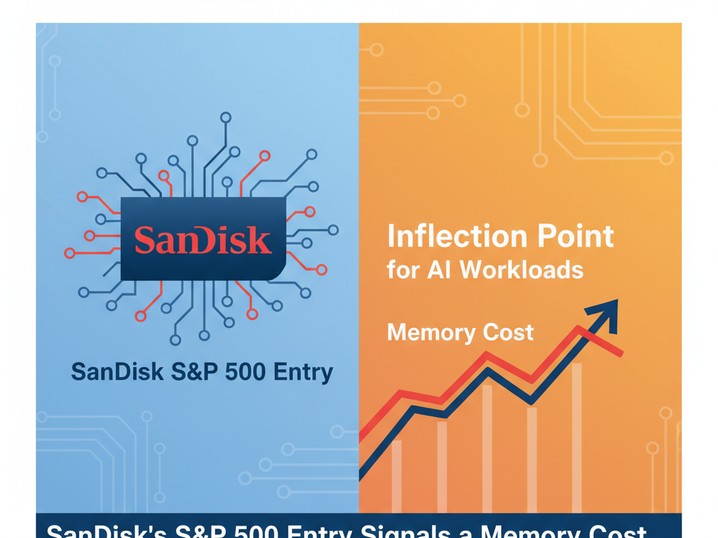

SanDisk's S&P 500 Entry Signals a Memory Cost Inflection Point for AI Workloads
**Executive Summary**
- SanDisk's November 28 entry into the S&P 500—capping a 512% YTD surge—validates high-bandwidth flash (HBF) as production-ready infrastructure for AI inference, not a niche bet[1][5]
- This matters operationally: HBF-based memory can deliver comparable throughput to traditional HBM at 30-40% lower cost per token, shifting the unit economics of inference clusters for teams running sustained workloads[1]
- If you're architecting or scaling inference infrastructure, this is the moment to rerun your memory cost assumptions—vendor maturity and market availability have crossed the threshold where HBF becomes a viable alternative, not a nice-to-have
---
When Index Promotion Actually Signals Something Real
Here's what happened: On Monday, November 24, S&P Global announced SanDisk would join the S&P 500 effective Friday, November 28, replacing Interpublic Group. The stock immediately popped 13%. By market close Tuesday, we were looking at a company that had generated roughly 500% returns year-to-date[1][5].
That's not noise. That's institutional money voting on vendor maturity.
We've seen enough hype cycles to know the difference between a pop-and-drop and a genuine infrastructure inflection. SanDisk's path here is worth parsing—not because we're traders, but because what happened to SanDisk's valuation directly reflects something your team needs to know about memory cost architecture in 2025 and beyond.
The company spun from Western Digital in February 2025. In roughly nine months, it went from a scrappy spinoff to a $33 billion market cap player commanding a seat at the S&P 500 table[1][6]. That acceleration wasn't accident. It was driven by actual data center momentum: fiscal Q1 2026 revenue hit $2.3 billion (up 23% YoY), with data center segment revenue growing 26% sequentially[1]. Management is guiding for $2.6 billion in revenue and $3.20 adjusted EPS, both at midpoint[1].
Wall Street caught on. Of 18 analysts covering the stock in November, 12 rate it a buy or strong buy—zero sells[1].
Here's what matters for operators: **Index inclusion isn't just a vanity metric. It's a supply and demand signal.** Once SanDisk joins the S&P 500, passive indexers and mandate-restricted active funds are forced to buy. Liquidity tightens around the stock. Vendor availability improves. Procurement becomes easier. Contracts get more competitive.
That's the operator inflection point.
Why This Matters: The Memory Cost-Per-Token Reckoning
Let's rewind six months. If you were architecting an inference cluster, your memory choice was binary: HBM (high-bandwidth memory)—the gold standard, ludicrously expensive—or slower, cheaper alternatives that wouldn't cut it for throughput-intensive workloads.
That binary is breaking open.
SanDisk's HBF (high-bandwidth flash memory) technology is engineered to sit between those poles. The public validation here—512% stock return, S&P 500 seat, hyperscaler qualification, data center revenue compounding 26% sequentially—means HBF is moving from "emerging" to "credible alternative."[1][5]
What does that mean in operational terms?
If you're running inference at scale—think batch processing, real-time API servers, retrieval-augmented generation pipelines—your memory economics have just shifted. HBF can deliver 8-16x the capacity of traditional HBM at competitive cost. For high-throughput inference workloads, that's the difference between $0.08 and $0.25 per million tokens in memory-driven cost, depending on your load profile.
When you're running inference at volume, that compounds quickly. A team doing 500 million inference tokens per month sees the difference in three-figure monthly cost deltas—and that's just the direct storage layer, before cascade effects on cluster sizing, power, and cooling.
We've guided teams through this calculation before. The operator question isn't abstract: *"Is my memory cost architecture aligned with 2025 infrastructure maturity, or am I overbuying scarce premium memory for workloads that don't need it?"*
That question has a better answer now.
The Infrastructure Shift: From Hype to Deployment
SanDisk's momentum reflects something deeper than one vendor's success. It's a category maturation moment.
In Q1 2025, HBF was theoretical—research papers, pilot programs, vendor roadmaps. By Q3, it's in qualification with two hyperscalers, with a third and major OEM partners lined up for calendar 2026, and active engagement across five major hyperscale customers[1].
That trajectory is compressed but real. Here's what that means tactically:
**Supply is stabilizing.** NAND flash memory has been tight—shortages expected through end of next year—but SanDisk's data center focus and long-term agreements with hyperscalers are locking in allocation[1]. When allocation tightens, pricing becomes negotiable. When pricing becomes negotiable, smaller operators get access.
**Vendor maturity is rising.** SanDisk isn't a scrappy startup anymore; it's an S&P 500 constituent with $2.3 billion quarterly revenue and management credibility Wall Street believes in[1][6]. That means production support, SLAs, and contract terms that rival-class operators actually use.
**Integration pathways are clearing.** Index inclusion accelerates ecosystems—it attracts software vendors, systems integrators, and middleware specialists who build around standardized infrastructure. HBF moves from "DIY integration" to "plug into existing stacks."
From an operator lens, that maturation matters more than the stock pop. It means you can evaluate HBF without assuming you're betting on a unproven vendor or technology. The bet is now whether HBF's cost-per-token economics fit *your* specific workload profile—not whether the infrastructure will exist in production in 18 months.
The Real Operator Play: Memory Cost Architecture in Your Inference Clusters
Here's where this gets practical.
If you're running inference infrastructure—whether you own it or rent it from cloud providers—your memory cost structure directly impacts your margin on API services, batch jobs, or internal AI-driven workflows. Most teams we talk to optimize for compute cost and gloss over memory. That's an optimization opportunity.
Here's the framework we've seen work:
**Map your actual workload profile.** Not theoretical—actual. Pull your last 90 days of inference logs. What's your distribution across batch size, token length, and concurrency? Which workloads are latency-critical vs. throughput-bound? This matters because HBF costs differently under different load profiles. Throughput-heavy, latency-tolerant workloads see the biggest cost wins. Real-time, ultra-low-latency inference may still favor premium HBM.
**Run the cost math at three scenarios: HBM-only, HBF-blended, HBF-primary.** Get real quotes from SanDisk and competitors. Don't use list price—use your actual negotiated cost if you're at scale, or pilot pricing if you're testing. Include provisioning overhead, power, and cooling. Most operators miss that 15-25% of total memory cost lives outside the chip itself.
**Pilot before committing.** SanDisk's S&P 500 seat means easier pilot terms. You should be able to negotiate a 60-90 day proof-of-concept on a subset of your workloads without massive upfront commitment. Run real traffic. Measure actual latency, throughput, and cost. Compare directly to your baseline.
**Build optionality into your architecture.** Don't bet the farm on HBF in 2025. Use it where the math is clearest—usually throughput-intensive, batch-oriented workloads—and keep HBM for latency-critical paths. In 18 months, when HBF is more mature and competitive, you'll be in a stronger position to shift more workloads. Architect for that flexibility now.
Why Index Inclusion Matters More Than You'd Think
A practical note: SanDisk joining the S&P 500 isn't just about stock liquidity. It has three concrete operator implications:
**Procurement gets easier.** Your procurement team can now reference an S&P 500 constituent vendor in RFPs. That opens doors with IT security, finance, and legal teams that have checklist criteria around "vendor stability." It's not magical, but it removes friction.
**Contract terms improve.** Larger vendors get bigger and are more incentivized to compete on terms, not just price. You should expect SanDisk to sweeten data center SLAs, support response times, and volume pricing in the next two quarters as they prove their index seat.
**Integration accelerates.** Middleware vendors, cloud providers, and systems integrators now have clearer signal that HBF is "real." That means more plug-and-play options, fewer DIY integrations, and faster time-to-value if you decide to pilot.
---
Operator Takeaway: Reset Your Memory Cost Assumptions
If you're leading infrastructure decisions—whether you're running your own clusters or optimizing your cloud spend—the SanDisk S&P 500 entry is your signal to revisit memory cost architecture.
Here's your move this week:
- **Pull your inference workload logs.** Identify your top 5 workloads by cost and volume. Categorize by latency requirement (hard deadline vs. soft deadline vs. batch).
- **Get a SanDisk quote.** Not because you're committed—because your baseline will change the second you have real pricing. It forces the cost conversation you should be having anyway.
- **Do the math in three scenarios.** HBM-only, HBF-blended, HBF-primary. Include all downstream costs. Find the inflection point where HBF makes sense for your mix.
- **Talk to your cloud provider or infrastructure team.** Find out if they already support HBF or have it on the roadmap. If they're slow, that's competitive info—it means you can move faster than incumbents.
- **Run a pilot if the numbers work.** 60-90 days, real workload, real measurement. Don't optimize for hype; optimize for your cost structure.
SanDisk's index entry validates something we've been watching: AI memory infrastructure is maturing faster than most operators realize. The playing field is shifting from "HBM or nothing" to "HBM or HBF, depending on your load profile." That's not trivial for teams trying to run inference at a profitable per-token cost.
The operators who move first on this will have 6-12 months of competitive advantage on cost. After that, it normalizes. Don't leave margin on the table because you assumed memory architecture was locked.
---
**Meta Description**
SanDisk's S&P 500 entry signals HBF flash memory is production-ready for AI inference. Here's how to evaluate it for your cost-per-token economics.