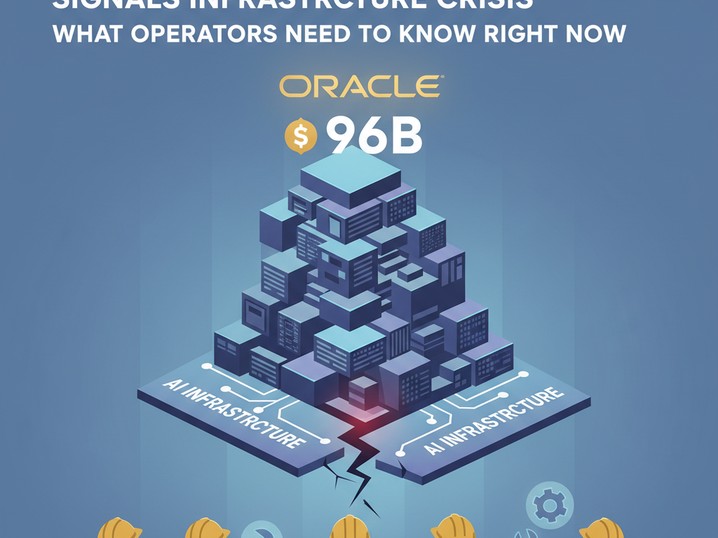

Oracle's $96B AI Debt Load Signals Infrastructure Crisis: What Operators Need to Know Right Now
**Executive Summary**
- Oracle and peers have amassed $96 billion in debt to build AI infrastructure on speculative demand, with OpenAI accounting for nearly all of Oracle's contracted revenue growth—yet OpenAI has diverted commitments elsewhere.[1]
- DA Davidson downgraded Oracle's stock from $300 to $200, warning the cloud giant has become "a pawn in the grand game of fake it 'till you make it" as infrastructure providers face margin collapse and rising debt service obligations.[1]
- Operators must lock in multi-year compute pricing commitments now and develop fallback infrastructure plans, as providers face growing pressure to cut capacity or raise prices to service unsustainable debt loads.[1]
---
The Debt Reckoning Nobody Wants to Talk About
We're living through one of the strangest moments in technology infrastructure. The promise of AI has triggered a lending spree so aggressive it echoes the boom-bust cycles we thought we'd learned from. But this time, the debt isn't abstract—it's sitting on Oracle's and other providers' balance sheets, and it's already reshaping the economics of cloud compute.[1]
Here's what happened: Tech companies desperate to build AI capacity rushed to borrow. Nearly **$96 billion in new debt** entered the system as OpenAI, CoreWeave, xAI, and Oracle all secured massive loans to expand data centers and cloud infrastructure.[1] That number alone signals something unusual. But the real crisis isn't the total borrowed—it's who borrowed it, what they borrowed it *for*, and whether any of it makes financial sense.
The infrastructure party looked sustainable—until it didn't. And now, operators like you are caught between watching vendors collapse under debt loads or face price increases designed to keep them solvent.
---
The Oracle Problem: When Your Biggest Customer Stops Paying
Oracle is where this story gets concrete. The cloud computing giant isn't just *using* AI infrastructure—it's *betting the farm* on it. How badly? OpenAI accounted for **nearly all of Oracle's reported increase in remaining performance obligations (RPO)**, the metric investors watch to gauge future revenue.[1]
Let that sink in. Not most of Oracle's growth. Nearly *all* of it.
An investment firm, DA Davidson, did the math and didn't like what it found. They cut Oracle's price target from $300 to $200—a 33% reduction—with a grimly candid rationale: OpenAI's **"trillion-dollar commitments to other providers"** have turned Oracle into "a pawn in the grand game of fake it 'till you make it."[1]
Translation: Oracle is sitting on massive debt service obligations backed by a customer who's hedging bets elsewhere. That's not a sustainable foundation. That's a time bomb with a quarterly earnings call on top.
---
The Supply Chain Crack-Up: Borrowed Money, Questionable Returns
We need to be direct about what's actually happening in the infrastructure layer. The debt surge isn't funding profitable capacity. It's funding *speculative* capacity—infrastructure bet on demand that may never materialize at the assumed scale.
Consider the numbers. **AI-related corporate credit issuance hit $141 billion year-to-date in 2025, already exceeding 2024's full-year total of $127 billion.**[3] That's debt being issued at accelerating pace. The issuance curve is steep. And it's funding providers betting that tomorrow's AI revenue will cover today's debt service and capital costs.
But here's the operator reality: the customers buying this capacity are, themselves, unprofitable. Symbotic, a robotics company with a $22.5 billion backlog tied to Walmart and SoftBank, grew revenue 30% year-over-year—yet **still operates at a loss.**[1] It's one example of a broader pattern: capacity utilization is climbing, but unit economics are collapsing.
When infrastructure providers can't charge customers enough to break even *and* service debt, three outcomes emerge:
**Outcome 1: Price Increases** — Providers raise rates to improve margins and cover debt obligations.
**Outcome 2: Capacity Cuts** — Providers reduce data center expansion or halt new builds, creating regional bottlenecks.
**Outcome 3: Provider Failure** — Overleveraged vendors default or seek emergency capital, disrupting service agreements.
We're watching the early signals of all three. And they matter directly to operators because compute is no longer a commodity—it's a chokepoint.
---
Why This Matters to Your Operations
You're running a lean team. You can't absorb a 20% compute price increase in Q2. You can't lose AWS availability in your primary region. You can't manage a surprise migration because your secondary provider hit financial trouble.
The Oracle situation is a **visible symptom of invisible systemic stress.** The infrastructure layer—the pipes carrying all AI inference and fine-tuning—is carrying debt loads that were rational in 2023, when everyone assumed AI adoption curves would be vertical. But adoption has plateaued. Usage is consolidating. And debt service obligations haven't moved.
This creates asymmetric pressure. Providers must either:
- Raise prices (which you'll absorb as an operator cost squeeze)
- Cut capacity (which means longer wait times, worse availability SLAs)
- Seek new capital (which dilutes existing investors but doesn't fix the unit economics problem)
None of these outcomes are neutral. All of them affect your infrastructure roadmap.
---
The Hidden Time Bomb: Debt Service vs. Actual Revenue
Let's talk about the math nobody's highlighting. When a provider carries $96 billion in debt, the annual interest and principal payments are staggering. Even at favorable rates, we're talking billions in annual debt service that *must* come from operations.
That obligation is locked in. It doesn't care if OpenAI decides to diversify vendors. It doesn't care if AI adoption slows. The debt service happens or the provider enters restructuring.
For operators, this means one thing: **Infrastructure pricing power is about to shift.** Providers facing margin compression and rising debt obligations will move from "discount to acquire volume" mode into "optimize margin to survive" mode. The era of multi-year price locks is ending. The era of annual repricing and "market rate adjustments" is beginning.
We've guided teams through this cycle before. The operators who win are the ones who:
- Lock in pricing commitments *before* providers get desperate (desperation makes them aggressive on terms)
- Build fallback infrastructure plans so they're not hostage to one provider's financial health
- Understand that "cheap capacity now" often becomes "unavailable or expensive capacity later"
---
What Operators Need to Do Now: A Framework
**Lock in multi-year commitments immediately.**
If you're planning to renew compute contracts in 2026, start negotiating now. Providers still have capacity they need to fill. Debt service obligations aren't front-of-mind yet. In six months, when Q1 2026 forecasts force internal conversations about debt coverage ratios, the negotiating posture shifts. Move first.
**Demand pricing certainty beyond year one.**
Annual repricing clauses sound reasonable until your provider faces debt pressure and decides $0.15 per compute unit needs to become $0.25. Build contracts with clear escalation caps (e.g., "no more than 5% annual increase"). Make it mutual pain if margins get squeezed—don't let providers pass 100% of that pain to you.
**Build a secondary infrastructure layer.**
Fallback capacity doesn't mean redundancy across identical providers. It means contractual access to a second vendor you can activate if your primary provider hits trouble. This is uncomfortable to budget for. It's also what separates operators who sleep at night from operators who don't.
**Ask your provider direct questions about debt.**
If you're a meaningful customer ($1M+ annual compute spend), you deserve answers about your provider's balance sheet health. Ask: "What's your debt-to-revenue ratio? How much of your revenue goes to debt service? What happens if AI adoption slows 20%?" The answers often reveal more about financial stability than earnings calls do.
**Stop assuming "market rates" are real.**
Vendors quote "market rates" as though capacity pricing is efficient and transparent. It isn't. It's opaque. It's driven by debt obligations and survival pressures vendors won't disclose. When you hear "market rate," translate it as "the rate we need to charge to keep the lights on." Push back hard.
---
The Uncomfortable Truth: This Might Get Messier
We're not saying a provider will fail tomorrow. We're saying the current debt-to-revenue ratio is unsustainable if AI adoption stays flat or dips. Providers have built capacity betting on vertical growth curves. Growth has normalized. And debt obligations haven't adjusted.
This creates what economists call a "solvency trap"—the provider is mathematically sound today but structurally unsound if operations don't grow fast enough to outrun debt service.
The operators who navigate this best are the ones who accept that infrastructure is no longer a stable utility. It's a volatile asset class with real default risk. Acting on that assumption—now—is what separates competent operators from those who get blindsided.
We're collecting case studies from teams who've already gone through vendor crises: sudden price increases, capacity withdrawals, contract disputes. If you've experienced this, hit reply. The real operator edge is learning from peers who've been in this position before.
---
**Meta Description:** Oracle's $96B debt load on speculative OpenAI contracts signals infrastructure crisis. Operators must lock in compute pricing now and build fallback plans before providers raise rates or fail. Here's how.